

A quarter of all working Americans have no savings, and half die with less than $10,000 in financial assets. Nevertheless, some of us will have a small nest egg, and where to put that bit of money can be a challenge. Even for many socially minded people what we know we’ve learned from “talking to Chuck.” But there are alternatives and they matter.
I first became aware of other ways to think about investments when I realized my denomination’s retirement fund screens its portfolio for tobacco, alcohol, gambling and guns. Many other faith communities with substantial funds do also. There are also a number of public mutual funds that have significant track records in screening for social responsibility issues. Some invest in alternative energy. Some avoid military contractors. Some look for environmentally enhancing product lines. Others invest in locally owned small businesses or in organic food sources. And some do a combination of all those.
» Read more about: Finance the Future By Investing in Change »


Nina Revoyr is the author of four acclaimed novels, including Southland, The Age of Dreaming and Wingshooters. She is also executive vice president of Children’s Institute in Los Angeles and has taught at Pitzer and Occidental colleges, and at Antioch and Cornell universities. Revoyr will be this year’s keynote speaker at the Los Angeles Alliance for a New Economy’s Women for a New Los Angeles Luncheon on May 9. We recently spoke to her about her work and Los Angeles’ place in it.
Your first novel, A Necessary Hunger, dealt with two young girls on the cusp of adulthood. What are the particular challenges young people of color face growing up in Los Angeles today?
» Read more about: Trauma and Vision: An Interview With Novelist Nina Revoyr »



Vocation of the Chair
It longs to be the one
who holds you, keeps you
from falling, its curved legs
shapely as a bride.
The chair that would be saint.
martyr, acolyte. Your little
sins of omission and false pride
cannot sway it — the chair believes
in you. It grows taller in the dark.
Soon it will fill the room,
its cushion of praise all you need
in the crude and faithless light.
Laurel Ann Bogen is the author of 10 books of poetry and short fiction. In 2016, Red Hen Press will publish All of the Above: New and Selected Poems 1975-2015. From 1996 until 2002 she was literary curator at the Los Angeles County Museum of Art.
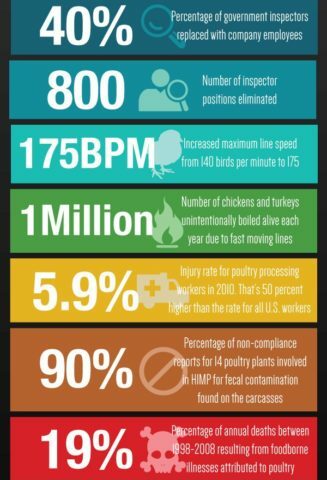
In most of the country the weather is finally getting warmer and the imagery of baby chickens and pastel eggs surround us – but yellow fuzzy chicks aren’t just a symbol for spring and Easter. They’re also part of the $38 billion poultry industry and a controversial proposal by the USDA to privatize poultry inspection.
In 2012, the USDA announced a proposal to expand a pilot program known as “HACCP-based Inspection Models Project” (or HIMP for short) that allows the poultry industry to reject government inspectors and allow company employees to police themselves. That’s right: The fox is literally guarding the hen house.
Obviously this is a big deal, so we created an infographic you can share about the 7 things you should know about the USDA’s plan to privatize poultry inspection. When you click on the image you will learn more about what you can do to speak out about this urgent issue.


When Californians elected Democratic supermajorities in the state Assembly and Senate in 2012, many expected to see a new era marked by progressive policies on everything from the economy to the environment to education. While some change has come, it’s not the kind most voters envisioned when they left the polling booth two years ago.
A central reason, as Pulitzer Prize-winning investigative reporter Gary Cohn reveals in this first article of a new series, is the emergence of the Corporate Democrat, who is not a traditional moderate but an enabler of big developers, gambling concerns, insurance companies and other interests. With the continuing decline of the Republican Party in the nation’s largest state, the Corporate Democrat promises to shape California politics and policies for years to come.
Marin County is one of California’s most liberal regions and, with its iconic redwoods and stunning coastline, it is also a power center for environmental activism.
» Read more about: In Plain Sight: The Rise of Corporate Democrats in California »


A recent report from the Los Angeles Black Worker Center addresses challenges facing African American workers, while offering strategies for combating unemployment and low wages. Black Worker Congress Blueprint for Addressing the Jobs Crisis focuses on information gathered from the Black Workers Rising for Justice, Jobs and Dignity congress, a gathering of workers and leaders of community and labor groups, held last September. The event, which occurred alongside the AFL-CIO national convention, gave African Americans a platform to voice concerns about labor and economic issues. Some of the report’s key findings:
The report cites some alarming statistics about the unemployment rates among blacks and whites from Steven Pitts, an economist from the University of California Berkeley Labor Center. Pitts claims that the unemployment rate for whites during the height of the recession remained below the nine percent jobless rate that African Americans faced before the recession even began.


 You’d think that that public television would support public education, but you’d be wrong. The Public Broadcasting System (PBS) has gotten in bed with the billionaires and conservatives who want to privatize our public schools. PBS has nary a word to say about the big money — from folks like the Walton family (Walmart), Microsoft founder Bill Gates, Eli Broad, business titan and former New York mayor Michael Bloomberg, media mogul Rupert Murdoch, Joel Klein (former NYC schools chancellor and now a Murdoch employee), and their ilk — that has been funding the attack on public schools and teachers unions. They’ve donated big bucks to advocacy groups, think tanks, and candidates for school boards who echo their party line.
PBS and its local stations have fallen all over themselves to promote Waiting for Superman, a documentary film that could easily been mistaken for a commercial on behalf of charter schools.

In 1895, Eugene V. Debs — the patriotic labor leader, socialist, and five-time presidential candidate — observed: “There is something wrong in this country; the judicial nets are so adjusted as to catch the minnows and let the whales slip through.”
In that regard, our justice system hasn’t changed that much in the 119 years since Debs uttered those words. We spend many more resources policing and prosecuting crime in the streets than crime in the suites, even though corporate crime is much more costly in terms of death, injury and disease.
If you need evidence of this double standard, look no farther than how the federal government has “punished” General Motors for failure to provide timely information about mishandling its recall of about 2.5 million cars with a defective ignition switches that the company has linked to 13 deaths.
On March 4, the National Highway Traffic Safety Administration insisted that GM answers 107 questions about why the company waited until this February to begin its recall when it knew about the problem as early as 2001.

You know the old joke. It gets tailored for whatever the despised group of the moment is:
Q: What do you call 10,000 [lawyers/politicians/whatever] at the bottom of the ocean?
A: A good start.
I was thinking about that recently with regard to Wall Street and bankers. The popular (and populist) rage that has been rising against Wall Street seems to be reaching new levels. According to Gallup, Americans rank the “honesty and ethical standards” of bankers as “low” or “very low” at a rate about three times higher than we did in the mid-1980s. (The vast majority of that increase came after the most recent financial meltdown.) And politicians – even Republicans – now regularly use Wall Street as an easy punching bag for cheap political points.
It’s hard to argue with the sentiment. Those people did ruin a minimally well-functioning economy.
» Read more about: Study: Wall Street Banks Overcharge L.A. »


Skopje, Macedonia might seem a long way from Los Angeles, but for the 2,000 professional musicians who earn their living recording the film scores for Hollywood’s big movie studios, the Balkan capital — and the bleak future for L.A. movie musicians that it might represent — seems to be getting closer every day.
In at least one way, that future has already arrived in the form of Lionsgate’s Draft Day and the Ivan Reitman film’s nonunion score. Starring Kevin Costner, the movie tells an all-American story of a fictionalized general manager of the lowly Cleveland Browns and his efforts to save Cleveland football on NFL draft day by trading for the number one player pick.
Less all-American is the story behind the recording of Draft Day’s music, which was reportedly piped via the Internet to a Hollywood studio and the film’s composer, John Debney,
» Read more about: ‘Draft Day’ in Macedonia: Hollywood Musicians Under Siege »