



As the summer winds down, family barbeques are in full swing and supermarkets are filled with shoppers searching for the right foods to grill up with friends and neighbors.
But do they really know what they’re buying? What they may not know is that Walmart has admitted it will soon start selling agrichemical giant Monsanto’s sweet corn, which has been genetically engineered with an insecticide inside it — not on the corn, but IN it.
Bt toxin works as an insecticide by disintegrating the lining of insects’ stomachs when they chomp on the corn. So what is this doing to the bodies of adults or children who eat the corn? We don’t know.
The genetically engineered sweet corn, which has also been manipulated at the DNA level to withstand pesticides that are sprayed on it, has never been proven safe. The US Food and Drug Administration require no safety testing of genetically engineered foods.
» Read more about: Walmart to Sell Genetically Altered Corn »


A question that is being asked by talking heads on the right-wing yak shows lately is, “Where are all the green jobs?” Well, there is a simple answer: Those jobs are here in the Southwest, my little conservative Debbie Downers. All over Southern California, Nevada, New Mexico and Arizona you will find massive solar projects with thousands of construction workers getting their first paychecks in months or, in some cases, years. There are so many solar-energy jobs helping us climb out of the absolute depression in the electrical industry that you can’t swing a Birkenstock and not hit one.
That’s right, despite their efforts to kill every single meaningful jobs bill in the House and Senate for the last four years, conservatives have failed to stop the sprouts and shoots of the new green economy.
Why is it happening now? There is a requirement for all of California’s electric utilities to buy 33 percent of our power from renewable energy sources by 2020.
» Read more about: Earth to Right-Wing Pundits: The Green Jobs Are Here »
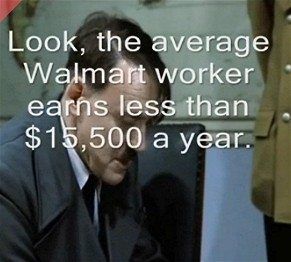
 Last week we posted a video here on Frying Pan News, and apparently there’s some outrage. It seems some of our friends at Walmart felt we were comparing them to Hitler, and saw that as horribly unfair.
We got comments from Nikki Ung (ED of the Chinese Chamber of Commerce, which supports Walmart), Bill Imada (lobbyist for Walmart), Dennis Huang (ED of the Asian Business Association, which also supports Walmart) and Greg Jenkins (who may or may not be a Walmart store manager).
We can understand why they are a bit behind the times on this one. After all, the Hitler parody meme has only been around for five or six years, and written about in The New York Times as far back as 2008.
For their reference, however, we suggest they check out a few other videos.
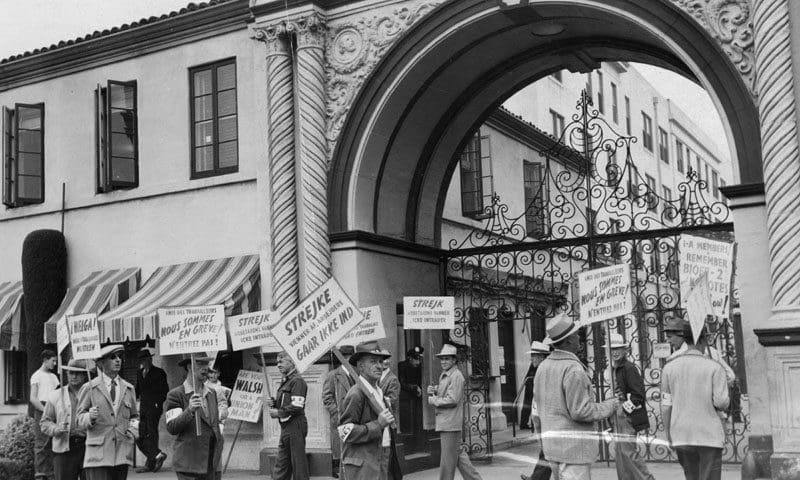
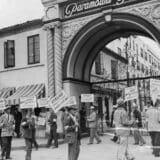
With large-scale domestic manufacturing off-shored and de-unionized, Hollywood film and television production may now be the most heavily unionized private-sector industry in the American economy. I had no idea when I started in the labor movement in the 1980s that I would get my foot in the (back) door of “the business” by working with some of the entertainment industry unions and guilds. Today’s “above the line” unions include the Directors Guild, the Writers Guild and the newly-merged SAG-AFTRA (Screen Actors Guild and American Federation of Television and Radio Artists); “below the line” unions encompass the IATSE (International Alliance of Theatrical Stage Employees – also called the “IA”), the Teamsters and others.
Though I barely knew which end of the camera to look through, I was first hired-on for some interesting projects by IA Local 600 – the Cinematographers Guild. When three regional camera locals were consolidated in the mid-1990s, I wrote and edited mail-outs to members about the merger and,
» Read more about: The Big Picture: Hollywood Unions Fight On »


We just returned from a week of glorious — and nearly free – recreation in three of California’s state parks and want to reflect for a moment on the amazing resource that our state government manages for everyone.
Despite the recent controversy about the “extra” $54 million that was discovered by the state Department of Recreation, we were reminded about the incredible natural resource that we all have in our state parks. We should also be celebrating the extra money found to keep the parks open. It’s important to remind ourselves periodically that the only thing protecting the redwood forests and gorgeous coastlines from being 100 percent privately owned recreation centers for the rich, or a special resource for the lumber industry, is our government.
We spent a week vacationing in Mendocino County, the home of redwood groves that spill down to the gorgeous rocky Northern California coastline. We were surrounded by exquisite beauty.


Watch the latest video at video.foxnews.comLast week, much to my surprise, Bill O’Reilly invited me on his Fox News show, The O’Reilly Factor.
He was upset that I called him a “right wing buffoon” in my Huffington Post article, “Pete Seeger – In His Own Words – Graces the Colbert Report.” The article was actually about Pete Seeger’s appearance on Stephen Colbert’s show on Monday night.
In truth, the reference to O’Reilly in my Huffington Post piece was an after-thought. I was praising Stephen Colbert for inviting Seeger on his show and I suggested that Colbert lead a campaign to get Pete nominated for the Nobel Peace Prize. I wrote that: “Colbert’s show — including his faux campaign for president, his Super PAC, and his nightly send-up of Bill O’Reilly’s right-wing buffoonery — brilliantly satirizes the absurdities of America’s corporate-dominated political culture.
» Read more about: Peter Dreier's Five-Minute Debate With Bill O'Reilly »



On May 12, 1998, Danny Keysar, a 16-and-one-half-months-old toddler, was strangled at his licensed childcare facility in a Chicago neighborhood. Danny was killed by a defective children’s product where he napped in the afternoons at the childcare home. The product was a mesh portable crib, or play yard — the Playskool Travel-Lite.
On August 14, 2008, Congress passed the Consumer Product Safety Improvement Act that – for the first time – directed the Consumer Product Safety Commission to set safety standards for children’s products and required they be tested to ensure compliance. Infants and toddlers are safer as the commission sets standards for cribs, bath seats, portable bed rails, infant walkers and toddler beds, high chairs, booster chairs, hook-on chairs; gates and other enclosures; stationary activity centers; infant carriers; strollers; walkers; swings; bassinets and cradles, changing tables, infant bath tubs and infant slings.


I have been wading through the three volumes of Taylor Branch’s history, America in the King Years, and reliving the dozen years between Montgomery and Memphis. The Montgomery bus boycott catapulted Martin Luther King, Jr., into the national headlines; Memphis was where he was assassinated. Throughout that tumultuous time, the Reverend James Lawson stood just offstage, a key partner in the nonviolent campaign for full citizenship for African Americans.
While King spearheaded the campaign to desegregate the buses in Montgomery, Lawson trained students in Nashville in the ways of nonviolence. He led small workshops tucked away in church basements. He taught his students not to react to taunts and threats. He gave them tools to remain calm and centered while undergoing arrest or physical attacks. Lawson believed that only by enduring the blows of hatred could haters see their own humanity. He brought Gandhi’s understanding of nonviolence to this country and he trained thousands of civil rights workers during those years.


Jose Tejeda, a member of Warehouse Workers United, talks about the “dark side of Walmart” — working 16-hour days without breaks, and at a fast pace lifting hundreds of heavy boxes every hour. When employees started to unite to improve conditions, they suddenly faced retaliation, shortened work days and less pay.
» Read more about: Walmart to Warehouse Workers: "Your Health Is Not a Concern." »
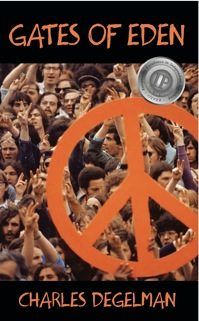

 There are epic chapters in American history that inspire a seemingly endless flow of fiction, historical analysis and first-person reflection. Not least among these chapters is the 1960s, and the dramatic social movements that helped define that decade.
One of the newest entrees in the ’60s canon is Gates of Eden, a novel by longtime theater artist and political activist Charles Degelman. The anti-war movement is the canvas against which Degelman sets his story, and while the book is not autobiographical, the author knows his subject well. After graduating from Harvard in 1967, Degelman left Cambridge for San Francisco and joined the San Francisco Mime Troupe, the radical theater company grounded in the work of Bertolt Brecht. The troupe performed its anti-war repertoire across the country, partnering with Students for a Democratic Society (SDS), one of the leading activist groups of the era.
Degelman,
» Read more about: Author Charles Degelman on the Legacy of the 1960s »