
On a side street that runs alongside the World Trade Center, two bronze bas-relief murals depicting rescue scenes from 9/11 are affixed to a wall facing the construction site. One reads, “Dedicated to Those Who Fell and Those Who Carry On.” The other admonishes us to “Never Forget.”
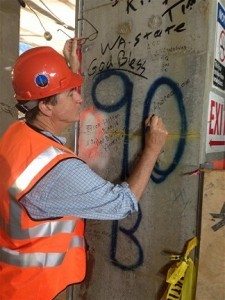
When I had a chance to write my own name of the 90th floor of the new tower going up on the site of the two that were destroyed, I wrote “Remember,” underneath my name. But aside from keeping the sacrifice and bravery of those who died on 9/11 in our thoughts, what was the content of the memory that I was supposed to protect? What are those memories supposed to tell me about how to live now, how to act personally and politically in this world?
To some extent, the struggle over what would replace Ground Zero has been an argument about memory and its uses.


What happens when you grow up with a father who lost everything in the Great Depression? For Howard Sherman, you spend the rest of your life studying the causes of devastating financial collapses and how nations can avoid them.
With 22 books and more than a hundred articles, Sherman — a Visiting Scholar at UCLA and former chair of the U.C. Riverside Economics Department — is still fighting the good fight. His latest volume is Principles of Macroeconomics: Activist vs. Austerity Policies, co-written with Michael Meeropol. While the title may be dry, Sherman is anything but. In a recent interview, he offered blunt assessments of President Obama’s economic policies and why the U.S. labor movement should make full employment its highest priority.
Frying Pan News: Why did you write this book?
Howard Sherman: The main issue in economics is the distribution of income between workers and owners.
» Read more about: Economist Howard Sherman: Why Labor Should Fight for Full Employment »
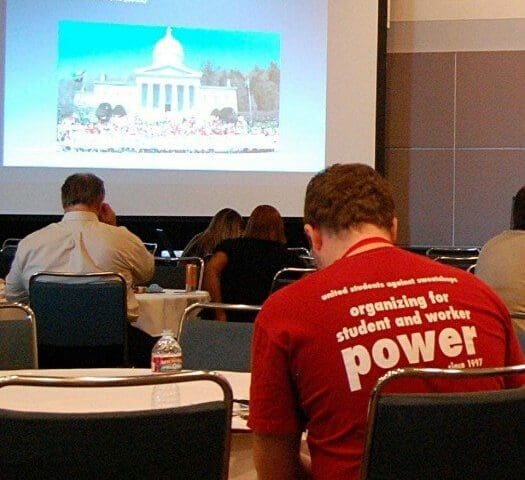
Day Three of the AFL-CIO’s quadrennial convention in Los Angeles kicked off yesterday with an address by newly minted U.S. Secretary of Labor Thomas Perez.
The Labor Secretary energized delegates by affirming the Obama administration’s support for a strong labor movement, praising the AFL-CIO’s efforts on comprehensive immigration reform and by pledging his department’s commitment to aggressively enforcing existing workplace laws.
Perez singled out the administration’s recently proposed rule to limit exposure to deadly silica dust in the workplace, saying that “it is a false choice to suggest that we can have job creation or job safety, but not both.”
He called raising the minimum wage “a moral imperative,” but admitted that despite 42 straight months of private sector job growth, job recovery overall remained disappointing, particularly for public-sector workers. “This is the first economic recovery in American history,” Perez noted, “in which government jobs haven’t come back.”
Perez’s presence marked the highest-level appearance at this convention by the Obama administration after the President last week canceled his own plans to attend the gathering,
» Read more about: AFL-CIO Day Three: Labor Sec’y Perez, Action Sessions »
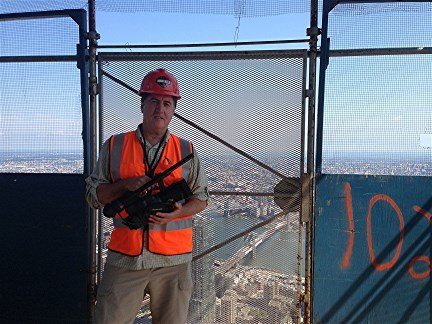

The construction elevator of One World Trade Center in Lower Manhattan is attached to the outside of the 104-story tower. From the ground it looks like a giant zipper, moving slowly up and down as the car, filled with workers and their tools, makes the six-minute, 1,776-foot journey from ground level to the top. (The building’s height was purposefully designed to match our year of independence.)
Riding up in that elevator to the 103rd floor recently, I kept myself a safe distance from the steel gates that protect you but also, unfortunately, allow you to see how high up you are hanging in space. I had to “man up” just to step into the metal box.
Phil English, a shop steward at the tower for LIUNA (Laborers’ International Union of North America), one of several unions that have members working to complete the tower, rode up with me. (See LIUNA World Trade Center videos here.) He laughed when he said he wanted to ride on the window-washing contraption attached to the outside of the top floor.
» Read more about: One World Trade Center: More Than Ground Zero »

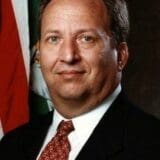
In the fall of 2011, millions of Americans were drawn to a movement directly challenging dramatically rising income inequality. The Occupy Movement dominated public discourse and put economic unfairness at the center of policy debates. Yet only two years after Occupy began on Wall Street, efforts to redress still worsening income inequality have stalled. The national grassroots campaign to get House Republicans to enact immigration reform has not been matched by similar efforts to raise the minimum wage or end corporate tax loopholes, with advocacy for such policies no stronger today than before Occupy’s emergence. We even face the prospect of President Obama selecting Lawrence Summers, a longtime backer of the One Percent, as the new head of the Federal Reserve. Are activists preoccupied with other issues, or have people decided that challenging the power of the One Percent is not a winnable political fight?
This past weekend I came across two documentaries about dramatic wealth inequality in the United States: Alex Gibney’s November 2012,
President Barack Obama was scheduled to speak this week at the AFL-CIO Convention in Los Angeles. As a delegate, I was very excited and looked forward to seeing him again. I had heard him here last summer during the 2012 presidential campaign. It was truly an unforgettable experience: He spoke to us like an organizer, sharing personal stories and pushing his base to get up and lead the next generation of progressive activism. Everyone knows he’s an incredible speaker, but to witness his strength and oratory skills in person is something immensely moving and inspiring.
Beyond that, however, our country is at a critical moment with the economy and the attempts to rebuild the middle class, and he was going to join the one and only Senator Elizabeth Warren in addressing the issues that working people struggle with every day.
(Above: President Barack Obama addresses AFL-CIO delegates via video.)
But something happened on the way to the convention.
» Read more about: AFL-CIO Convention: There’s Still Time, Mr. President »
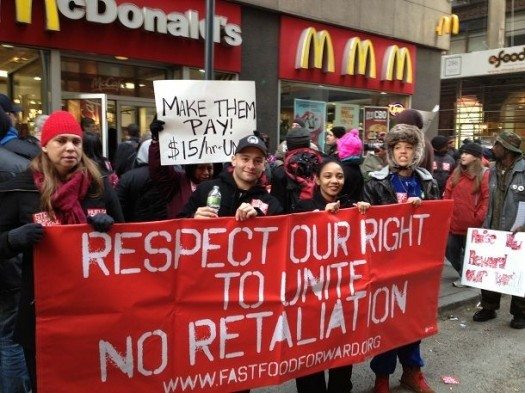
Labor Day may be over, but if the recent strikes in 60 cities are any indication, fast food workers intend to keep turning up the heat on a vast American industry built around poverty wages. For the first time, this mega-sector that grosses $200 billion a year is under serious scrutiny, as increasingly emboldened employees across the country demand a living wage from immensely profitable corporations sensitive to their public image.
While the focus on fast food workers’ paltry wages is well deserved, there’s another issue that demands attention: the rampant violation of labor laws by fast food giants.
It’s bad enough that 83 percent of workers in this industry earn less than $10.10 an hour — the average fast food cook, for example, makes $9.02 an hour or $18,760 a year — while typically being denied health insurance and other benefits.
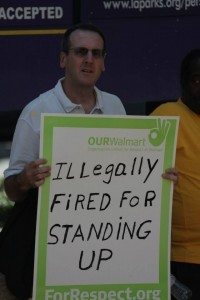
September’s shaping up to be another tough month for Martha Sellers. The Walmart cashier cleared $732 on her last twice-monthly paycheck but hasn’t paid this month’s $700 rent on her place in Bellflower. When she does, she’ll have to decide how much of the remaining $32 will be divided between food and gas to get her to the job she’s held for the past 10 years.
“I am just always broke, always late on things,” Sellers says. “Thank goodness I have a nice landlord who understands.”
Sellers’ employer, however, is not so understanding. Sellers makes $13 an hour, which on paper doesn’t look too bad when compared to many other Walmart workers’ salaries, which tend to run less than $9 an hour. The problem is that the retail giant is continually cutting her hours, so that the $13 doesn’t tell the whole story.
“When I first started I worked 35,
» Read more about: Walmart Workers Fight Poverty: A Cashier’s Story »
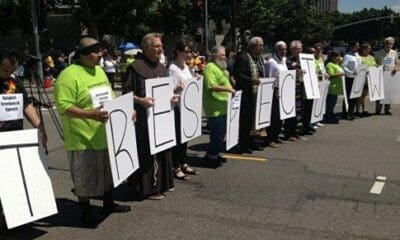
My friend Allison is a United Methodist minister. Her husband, Andy, pastors a United Church of Christ congregation. Both serve churches in Pasadena. Both of them have been involved in advocacy for the workers at Walmart.
Allison’s father, Alan, is also a United Methodist minister and an old friend of mine who lives in Honolulu, where he took the lead to start a faith-based advocacy organization that has made a strong impact on the city. So Alan has earned some progressive credibility. Andy told me that the last time he visited his in-laws in Honolulu, Alan and he were on their way back home from a golfing excursion, when Alan announced he was going “to pick up a few things at Walmart.”
Andy was aghast and said, “You shop at Walmart?”
“Well, of course I do,” said Alan, “And don’t tell me that Allison doesn’t!”
“No, she never shops there!”
“Really?” said Alan.
» Read more about: Saying ‘No’ to Walmart’s Inhuman Resources »
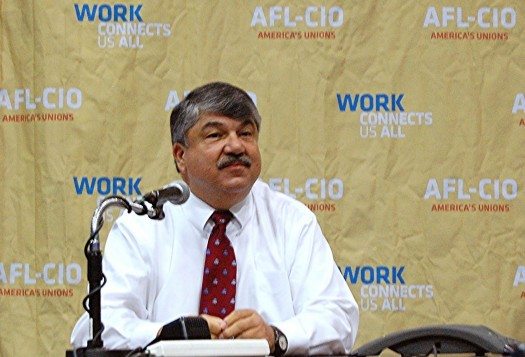
Massachusetts Senator Elizabeth Warren opened the AFL-CIO’s quadrennial convention in Los Angeles yesterday with a stirring tribute to the legacy of organized labor and a call to arms for the country’s progressive cause.
Speaking before about 5,000 cheering delegates at the L.A. Convention Center, Warren rolled out a list of issues near to labor’s heart. These included a raise in the minimum wage, tougher policing of Wall Street and government investment in infrastructure, jobs and education. She also called for transparency in the Obama administration’s ongoing secret negotiations of the Trans-Pacific Partnership (TPP) trade agreement.
She reserved some of her harshest words for what she called “the increasing corporate capture of the federal courts” and charged that Supreme Court Justices Alito and Roberts topped the list of the most pro-corporate and anti-consumer justices of the past 50 years.
The remarks were in sync with those of AFL-CIO President Richard Trumka,
» Read more about: AFL-CIO Convention: Inclusiveness and Bridge-Building »