
Mother Jones has unearthed another video in what might be called the One Percent Behaving Badly genre. While not as awesome as the magazine’s previous discovery of footage of Mitt Romney bad-mouthing the half of America who are shiftless parasites, this one will nevertheless fill you with holiday cheer. It shows AIG honcho and white rapper Robert Gifford at a company party in New York, flowing freestyle about his street cred — Wall Street cred, that is. AIG, of course, was the recipient of more than $182 billion of government bailout money in 2008.
Sample lyric, sung to Jay-Z’s “Empire State of Mind:”
Concrete jungle where attitude reigns supreme
There’s nothin’ you can’t do
Now you’re in GRE (GRE!)
Big write offs will inspire you
Preparing business cases will make you feel brand new
» Read more about: Yo Yo Yo! AIG's Definitely in the House! »


 A former colleague and friend once described a job interview he had with a well-known political figure. My friend, who got the job, said that during his interview he was asked, “What do you like to do outside of work?” There was just one acceptable answer in that instance: “Nothing.”
An abandonment of any non-professional interests is also a requirement for an unpaid internship listing in London’s Dalkey Archive Press.
The listing discourages free thinking applicants and those who have ever made a mistake:
Any of the following will be grounds for immediate dismissal during the probationary period: coming in late or leaving early without prior permission; being unavailable at night or on the weekends; failing to meet any goals; giving unsolicited advice about how to run things; taking personal phone calls during work hours; gossiping; misusing company property, including surfing the internet while at work;

It seems appropriate that after Michigan Governor Rick Snyder (R) shepherded through the state House and Senate the right-wing extremist and corporate CEO backed “right to work” for less legislation—that he had long-called “too divisive to pursue”—without any public input, that he would sign the measure in secret Tuesday.
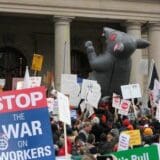
With as many as 15,000 people swarming the state Capitol in Lansing denouncing Snyder and the legislature for bowing to the likes of the Koch brothers, Grover Norquist, the American Legislative Exchange Council (ALEC) and the extremes of the Republican Party, Snyder retreated behind closed doors to sign the legislation and, only after the fact, announced his signature. Here are some details of the legislation that, if it follows the pattern of “right to work” laws in other states, will lower the standard of living for Michigan workers.
» Read more about: Facts About Michigan's New Anti-Union Law »


 On the day North Korea launched a missile this week, the virulently anti-labor website Union Facts splashed a banner on its home page that likened union membership to living in North Korea. This was December 11, when a lame-duck legislature turned Michigan into a right-to-work state — banning unions from collecting fees or dues from workers as a prerequisite for working in unionized shops. (In a shrewdly divisive ploy, Republican bill-sponsors exempted police and firefighter unions from the law.)
In this week’s tightly scripted political theater, Lansing’s two legislative houses raced through their synchronized movements as though the capitol were afire. Later, hitting his marks on cue, Governor Rick Snyder emerged from the wings to sign this coup d’etat into law. (To think, only a few months ago the New York Times was giving Snyder the Profiles in Courage treatment, portraying him as that mythical unicorn of a politician,
» Read more about: Puppet Government: What the Michigan Vote Means »

A record number of billionaires are dodging potential tax increases by taking taxpayer-subsidized Christmas bonuses from companies they control. Their windfall stems from a Bush administration tax loophole known as “qualified dividends.” This scheme, completely legal thanks to Bush-era tax cuts, will expire December 31. It lets some wealthy heirs and other stockholders pay taxes on at less than half the rate you and I pay on wages or interest income.
At least 150 corporations are helping rich shareholders shelter $20 billion in corporate earnings by issuing “special dividends” before year’s end. Additional last minute tax avoidance schemes will cut taxes for other One Percenters, including corporate lawyers and private equity investors.
Edwin Durgy, who monitors “America’s billionaires and how they got that way” for Forbes, identified 10 top tax avoiders who together stand to gain more than $500 million.
» Read more about: The Rich Played Santa to Themselves — On Taxpayers' Dime »

The California Federation of Teachers, AFT, AFL-CIO, officially released an animated cartoon video on Tuesday, December 4, narrated by Ed Asner, that lays out the case for fair taxation. The union video urges Congress to repeal Bush-era tax cuts for the wealthiest Americans.
CFT President Joshua Pechthalt:
Following the decisive victory of Prop 30 in California, this video promotes a fair tax system to fund America’s priorities. The best way to build a better American education system and protect the social safety net is by asking those who can most afford it to pay their fair share in taxes, so that educators will be better positioned to help our students achieve their dreams.
Tax the rich: An animated fairy tale, with animation by award-winning artist Mike Konopacki, was written and directed by yours truly. The eight-minute cartoon shows how we arrived at this moment of poorly funded public services and widening economic inequality.
» Read more about: "Tax the Rich" Video and Why Fox News Hates It »
It’s hard to define good leadership, but we all know it when we see it in action. Leaders we truly respect inspire us with their vision and feel trustworthy in both their personal and professional lives. They are smart strategists but also have a balanced sense of themselves – brilliant but not arrogant. And most important, they are able to genuinely connect with, and respect the people they aspire to lead.
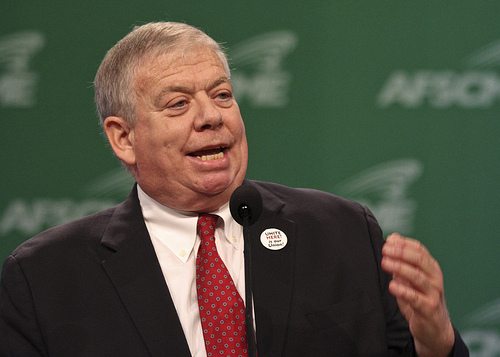
In late November John Wilhelm, the highly regarded president of the national hotel workers’ union (UNITE-HERE), stepped down from his position at the age of 67 to make way for a new generation of leaders in his organization. During John’s tenure the union developed a deep bench of committed worker-leaders, organizers and strategists who he helped recruit and nurture over his 43 years with the organization. John populated this bench by sharing information, skills and decision-making with those he developed while expecting the highest standards of effectiveness and hard work.


After spending more than $1.6 billion, Tesco, the world’s third- largest food retailer, has finally thrown in the towel and announced the closure of its Fresh & Easy stores. This move brings closure to the British company’s effort to establish a foothold in California’s highly competitive grocery industry. Many analysts believe this decision has been a long time coming, with Fresh & Easy stores never seeing the kind of market penetration that the U.K.-based giant expected from the chain. Investors cheered the December 5 announcement, but U.S. workers have reason to celebrate too — this marks the end of a five-year struggle with Tesco.
Like most new entrants into the grocery market field, Tesco planned to operate non-union. Indeed, a Tesco employee-relations director described the primary responsibilities of that job in an advertisement as “maintaining non-union status” and “union avoidance activities.” The United Food and Commercial Workers union (UFCW) sought to organize the company,


 ’Tis the season of miracles. There’s only enough oil to light the lamp for a couple of days, but it stays lit for eight. A peasant’s vision upsets a bishop, especially when the peasant returns with roses. Darkness grows until the earth shifts and the light returns. A child born in a stable turns out to be a presence of God. A festival celebrates the principles that make the miracle of human community. A star moves across the sky guiding astrologers on a quest.
These ancient tales and festivals, developed around the miracles of light and life, create the season’s themes of hope and love and peace. There are unsung miracles as well — happening in our own time that you will never read about in the papers or see on the nightly news. These stories tell about people without power claiming their strength and about the lowest-wage workers achieving victories.
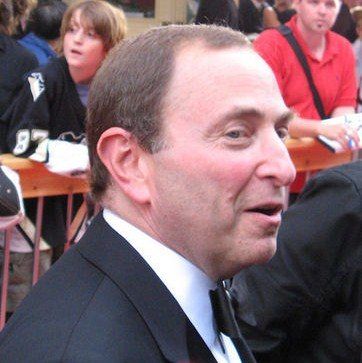
Over the past year we’ve written quite a bit about the business of sports, and unfortunately, lockouts in the National Football League (NFL) and National Basketball Association (NBA) have given us quite a bit to discuss. We haven’t said much about things going on in the National Hockey League (NHL), perhaps because the script has come to seem so familiar, and there seemed little doubt that after some fireworks, things would finally result in a an unsatisfying deal that got everyone back on the ice a bit late, but in time for a meaningful season. Now it’s December, and they still ain’t playing.
Hockey’s labor history is a sorry one, as the league’s union was run for decades by a shill for the owners who stole money and helped the bosses keep the players in poverty well past the point you’d think that’d be true. In the ’90s, however, players started to make real money,
» Read more about: Hockey League Turmoil: Gary Bettman’s Ruler »