


While the 2013 BART [Bay Area Rapid Transit] strike involves current disputes over wages, pensions and worker safety, its roots go back decades. BART management and its workforce have long had a poisonous relationship. The 90-day 1979 strike/lockout is the most obvious example, and despite the last strike occurring back in 1997, bargaining always goes down to the wire with a work stoppage imminent. Why is this relationship so stormy? The chief reason is BART management’s historic insensitivity to its workers.
For over thirty years, BART’s primarily white management has disrespected its heavily minority workforce. And while compensation levels could reduce tensions over this lack of respect in good times, in the recent down years BART workers have gone backward. These workers (along with riders) have paid the price when the BART Board’s suburban majority long refused to raise revenue by charging for parking at its stations, and when BART squandered money on costly expansions rather than improving safety and service in existing areas.
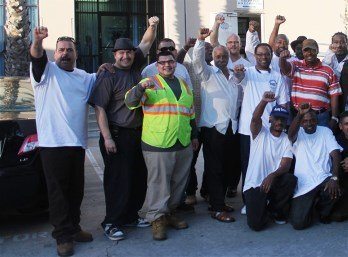

The trucking industry likes to say, “If you have it, a truck brought it.” The industry’s point is that trucking is an essential and ubiquitous part of our economy.
This is true, so far as it goes. But trucks don’t drive themselves. And so at a recent meeting of the Carson City Council, a slightly different message was on display: If you want a good job, you’re no longer likely to find it in port trucking – at least not without a fight.
Carson, located 10 minutes north of Los Angeles’ harbor, is a major hub of port trucking: Fifty-two port trucking companies operate there — more than in any other Southern California city except L.A. and Long Beach; hundreds of truck drivers call Carson home and more than 1,000 port trucks are parked in town. The conditions of the industry impact the city profoundly — from road safety to environmental quality to jobs to tax revenue.
» Read more about: Carson Pledges Support for “Modern-Day Sharecroppers” »


As the number of American public- and private-sector workers belonging to a labor union reached an all-time low this past year, many of us sat on the sidelines scratching our collective heads, wondering why. Academics and economists will say it’s because the type of work Americans do is changing and, as we shift from a manufacturing to a service economy, union jobs in factories (those that haven’t already been offshored) are being replaced by nonunion desk jobs. However, ask an average employee or person on the street why fewer workers belong to a union than a generation ago. They will most likely say it’s because unions have lost their relevance, are outdated concepts or that they aren’t needed.
But how can the latter be true when the mean real wages of American workers are lower than they were in the 1970s, around the time that union manufacturing jobs began globally migrating south and to Asia?
» Read more about: Why Aren’t Unions More Appealing to the Public? »


The surprise announcement from the Obama administration that it will delay for one year penalizing employers that do not offer health coverage to their workers is the latest capitulation by the White House to big businesses that want to shirk their responsibility to help pay for health insurance. But the decision leaves huge unanswered questions about whether health coverage for uninsured workers will also be denied.
Yesterday, the Treasury issued a notice delaying for one year, until 2015, the requirement that employers of more than 50 full-time employees (three percent of all employers) report on whether they offer health coverage to their employees. The Affordable Care Act requires that these employers pay penalties when they do not offer qualified coverage or when their workers access coverage through the new health care exchanges. The Treasury’s notice does not change the legal requirement that employers provide coverage,
» Read more about: Christmas in July: Big Companies Get Obamacare Reprieve »


The New York Times recently characterized the economic recovery that officially began in 2009 as a “golden era for corporate profits.” Indeed, corporate profits doubled between 2008 and 2011 and reached a record high.
However, these increased profits have fueled inequality and come at the expense of worker compensation. Profits are now a larger share of total national income, and wages and benefits are a smaller share than at any time since the 1960s. Over the last four decades productivity gains have overwhelmingly accrued to business and not labor. The Economic Policy Institute calculates that between 1973-2011 productivity increased by 80 percent, but median hourly compensation by only 11 percent.
The recovery has not lifted up those at the bottom of the income distribution, nor has it increased opportunity for the middle. According to the Women’s Foundation of California, one in three families in the state (with family members reporting a combined work effort of 39 or more weeks annually) are the working poor who earn less than $45,397 a year.
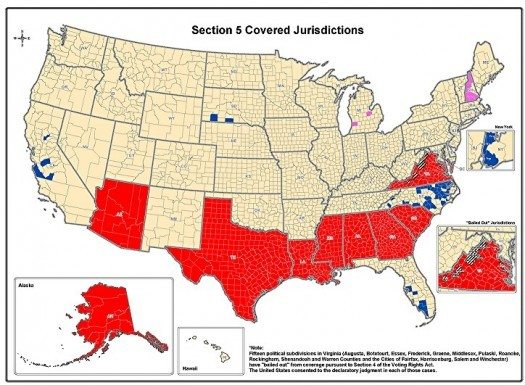
The Supreme Court’s activist conservative majority, in a 5-4 vote on June 25, threw out the provision of the 1965 Voting Rights Act which required states and localities (mostly in the Old Confederacy) to clear any changes in electoral law with the federal Department of Justice. The argument was that the criteria and standards used by Congress were obsolete. Congress is invited to revise them, but of course everyone (including the justices) knows that this Congress is too gridlocked to agree on anything of the sort.
But, to paraphrase the old saying, when the Court gives you lemons, make lemonade. As the Court’s opinion affirms, conditions surrounding voting in this country are now radically different than they were in 1965. The old Democratic Solid South with legal discrimination against African American voters has been replaced by a Republican hegemony that is adapted to black voting. At the same time,



Twice in the last five days, President Barack Obama referred to divestment — the controversial strategy to bring about social change by pressuring corporations to behave more responsibly.
On Tuesday, Obama mentioned divestment during a major speech at Georgetown University outlining his plan to address climate change. And on Thursday, at a press conference in Senegal, Obama recalled his involvement during college in the anti-apartheid movement, which relied heavily on divestment to push companies to boycott South Africa until it dismantled its racist system.
Was the one-time student activist signaling his support to the current generation of campus radicals who are calling on universities to divest from energy companies that promote fossil fuels? Was the former community organizer embracing the movement to dump stock holdings in order to compel corporations to be more socially responsible?
“I’m here to enlist your generation’s help in keeping the United States of America a global leader in the fight against climate change,”


The battle over immigration reform is often about economic fear — fear that immigrants are hurting the economy for native born Americans. But that fear is based on several economic myths:
Myth One: Immigration reform will strain already overburdened government safety net programs like Social Security and Medicare.
Wrong.
The nonpartisan Congressional Budget Office finds that immigration reform will actually reduce the budget deficit by hundreds of billions of dollars.
Why is that? Because while they seek citizenship, undocumented workers will be required to pay into Social Security and Medicare even though they won’t be eligible for them.
They’re also younger on average than the typical worker, so even when they’re citizens they’ll be paying into Social Security and Medicare far longer.
Myth Two: New immigrants take away jobs from native-born Americans.
Wrong again.
» Read more about: Immigration Myths: Three Wrongs Don’t Make a Right »


The victory in the state Assembly was a narrow one, but a victory nonetheless for Governor Jerry Brown and opponents of California’s troubled enterprise zone program. The zones reward companies with $750 million in annual tax breaks for relocating their businesses to depressed parts of the state – and for replacing their workforces with newer, usually lower paid ones. Thursday, the Assembly approved a bill already passed by the state Senate that would radically overhaul the program.
Although the vote was 54-16, passage required a two-thirds vote, since it amended a tax law; four Republican Assemblymembers joined 50 Democrats in voting for AB 93. The legislation now goes to the governor for his signature.
According to the Los Angeles Times’ Marc Lifsher, “Brown’s proposal, the centerpiece of his economic development strategy, all but eliminates the power of the state’s 40 locally controlled enterprise zones and replaces the program with a broader,
» Read more about: Enterprise Zone Bill Goes to Governor’s Desk »


Wednesday’s Supreme Court rulings on same-sex marriage represented a major victory in the battle for social justice. But the Court stopped short of proclaiming same-sex marriage a basic right. It left it to the states to determine whether gay Americans have the same right to marry as their straight counterparts.
This is the same logic — states’ rights — that allowed the Court this week to weaken the Voting Rights Act of 1965, essentially giving states permission to discriminate against Blacks and Latinos in gerrymandering electoral districts and erecting obstacles to voting. Soon, we’re likely to see a number of Republican-controlled states, including Texas, redraw legislative boundaries to make it harder for minority candidates and white liberal candidates backed by minority voters (such as Texas State Sen. Wendy Davis, who courageously waged a filibuster this week to protect women’s reproductive rights) to win public office and to change state laws to make it harder for people to vote.
» Read more about: What the Supreme Court Didn’t Do for Marriage Equality »