
Labor & Economy
What Does It Take to Employ L.A.’s Poorest & Most Disadvantaged?

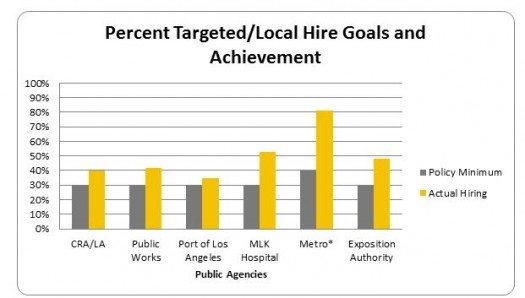
Since 2011, the Construction Careers Coalition has secured agreements with public agencies to bring good jobs and benefits to local community members through public construction projects. These agreements are bearing fruit: At each of the six public agencies, we have exceeded our hiring goals for local residents, which means that more families can support themselves and more money flows back into our local economy.
The coalition has used a key tool, the Project Labor Agreement (PLA), to create public accountability and good middle-class jobs for local residents. A PLA is an agreement between a government agency and construction unions in which both sides offer concessions to ensure that construction work is completed on time and on budget. The Construction Careers Coalition has focused on adding a Construction Careers policy to PLAs here in L.A. as a way to create green infrastructure that employs local people. At each agency, the policy has set goals to hire local construction workers, local construction apprentices and disadvantaged workers who have experienced barriers to employment. The idea behind these policies is that public infrastructure should be built with local dollars and local hands.
So how has it played out? Let’s take the example of our first policy, won at the former Community Redevelopment Agency (CRA/LA). That policy set hiring standards to ensure that 30 percent of construction jobs would go to local residents and 10 percent to workers with barriers to employment, while 50 percent of apprenticeship hours would be completed by local residents.
Even with the 2012 dissolution of redevelopment agencies across the state, the projects approved by the CRA/LA exceeded the goals, reaching 40 percent local hire, 17 percent disadvantaged workers and 51 percent local apprenticeship hours. This means that 1,365 workers in Los Angeles had solid employment in a time of economic turmoil, allowing them to support their families and invest in their local communities. Research shows that for low-income families, as income increases and families are able to meet their basic needs, they invest directly back into the local economy. For example, sheet metal workers spend an additional $11,000 each on goods and services as soon as they begin their apprenticeship and more than $34,000 when they complete their training, according to a UCLA Labor Center study.
Today the coalition has a twofold strategy to ensure accountability and success: the “Pipeline” and the Construction Careers tracking project. The Pipeline is the coalition’s outreach and referral strategy to ensure that people all over Los Angeles who are interested in the construction industry know about the opportunities and requirements to enter a career in construction. The Construction Careers tracking project is a tool that tracks all hiring at each agency where a PLA and Construction Careers policy were passed. The Construction Careers Coalition is continually working to ensure that public agencies across the city and county link public construction to public benefits. That’s how we will continue to make the promise of Construction Careers a reality.
(Ashley K. Thomas is a research/policy analyst with LAANE’s Construction Careers Project.)



-

 Latest NewsJune 9, 2026
Ousted by the Trump Administration, U.S. Immigrants Remain Locked up in African Kingdom
-

 The SlickJune 10, 2026
Data Centers Are on the Ballot — This Pennsylvania Candidate Won Her Primary Keeping Them Top of Mind
-

 Latest NewsJune 8, 2026
The Glacier May Be Gone, but the Love Isn’t
-

 Latest NewsJune 12, 2026
California Town Lets Private ICE Detention Centers Police Themselves
-

 Column - State of InequalityJune 11, 2026
County Tax Measures Show Limits of Local Responses to Medicaid Cuts
-

 The SlickJune 16, 2026
Why Coal Will Lead to More Deaths in Colorado
-

 Latest NewsJune 17, 2026
California Rideshare Drivers Move Toward Unionizing, Following Massachusetts
-

 Latest NewsJune 19, 2026
Sheriff’s, Probation Litigation Cost L.A. County Taxpayers $1 Billion, Study Finds