
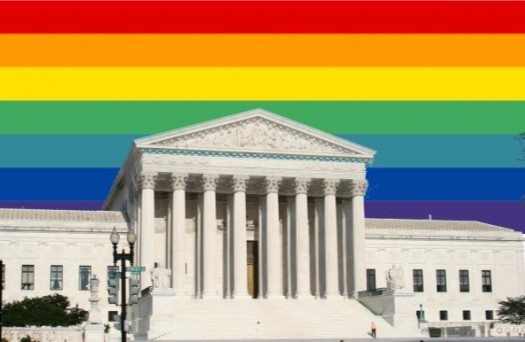
Wednesday’s Supreme Court rulings on same-sex marriage represented a major victory in the battle for social justice. But the Court stopped short of proclaiming same-sex marriage a basic right. It left it to the states to determine whether gay Americans have the same right to marry as their straight counterparts.
This is the same logic — states’ rights — that allowed the Court this week to weaken the Voting Rights Act of 1965, essentially giving states permission to discriminate against Blacks and Latinos in gerrymandering electoral districts and erecting obstacles to voting. Soon, we’re likely to see a number of Republican-controlled states, including Texas, redraw legislative boundaries to make it harder for minority candidates and white liberal candidates backed by minority voters (such as Texas State Sen. Wendy Davis, who courageously waged a filibuster this week to protect women’s reproductive rights) to win public office and to change state laws to make it harder for people to vote.
» Read more about: What the Supreme Court Didn’t Do for Marriage Equality »


 David Acosta, a leader in the fight to improve warehouse working conditions, is back to work today. David was fired from his job as a forklift driver at a critical Walmart-controlled warehouse in Mira Loma, California at the end of May for allegedly violating a safety policy. David and his coworkers fought back against his unfair dismissal and retaliation by the warehouse operator, Schneider Logistics, for helping expose wrongdoing at the warehouse.
David is a lead plaintiff in a massive federal lawsuit that exposed millions of dollars in stolen wages. The lawsuit, of which Walmart, Schneider and the temporary staffing agencies that employed warehouse workers are defendants, helped end decades-long scheme to defraud workers.
“We know that Walmart is in control and now we will know the extent of their involvement to defraud workers,” Acosta said of the lawsuit.
In October 2011, workers who were jointly employed at the Walmart warehouses by Schneider Logistics,



For days before Thanksgiving, 2009, Santa Ana winds had been blowing up ash and dust from the massive Station Fire that recently burned north of Los Angeles. The scorching, high-pressure weather system seemed a suitable climate for L.A.’s financial meltdown as the city entered the third year of America’s recessionary slump. Inside City Hall on that Wednesday before the holiday, government representatives and members of the news media listened to the testimony of a man who was on his way to becoming one of Los Angeles’ most powerful figures. He was only 40, held no elective office and had started his job as the City Administrative Officer just three months before.
Yet on this Thanksgiving eve Miguel Santana held the rapt attention of the City Council and journalists as he delivered shocking news: Los Angeles faced an imminent shortfall of $98 million and, based on his projections, the city could be burdened by a $1 billion debt by 2013.
» Read more about: L.A. Budget Czar Miguel Santana’s Shaky Math and Polarizing Ideology »
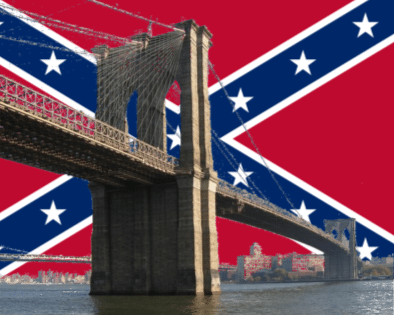

The immigration reform bill likely to pass the Senate this week will pick up a few more votes because it commits the government to building a longer fence. Thanks to a Republican amendment, workers will erect an additional 700 miles of fencing along the U.S.-Mexico border.
But if we’re going to build a fence, is that really where it should go? If we have apprehensions about our neighbors to the south, are those the neighbors — and is that the south — that really present the United States with its most difficult problems?
By now, even the economics profession concedes that our openness to the developing world — call it the Global South — has played a role in depressing the incomes of U.S. workers. And depressed they are: Hourly wages fell 3.8 percent in the first quarter of 2013, the biggest drop since the government began measuring in 1947.


Yesterday’s historic Supreme Court rulings supporting marriage equality marked an important step forward for justice for all workers. Labor unions in California and across the nation have been strongly united for marriage equality for years. In fact, the California Labor Federation and 50 other labor organizations signed on to an amicus brief in support of marriage equality back when the challenges to Prop 8 first began nearly five years go.
Tim Paulson of the San Francisco Labor Council, which was one of the most vocal parties to the amicus brief, celebrated the announcement, which happens to coincide with the 43rd annual San Francisco Pride celebration that kicks off this weekend.
Here in San Francisco, where it all started, workers are celebrating this great civil rights victory. As we say, “an injury to one is an injury to all.” Now all of our LBGT members and their partners can be treated with equal respect.
» Read more about: Labor Pride: Unions Celebrate Marriage Equality Ruling »
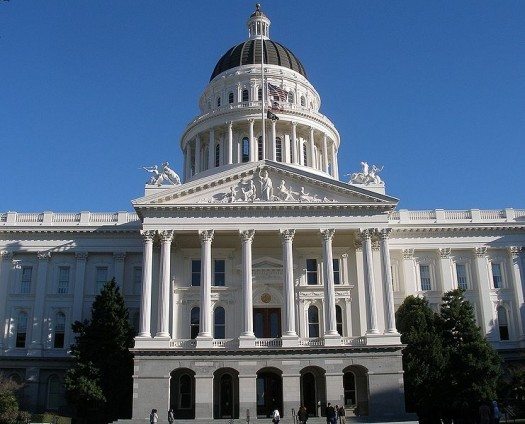

(Editor’s Update: Luke Dowling’s June 25 piece below references Governor Jerry Brown’s proposal to restructure California’s controversial enterprise zone program. Last night the state Senate approved Brown’s initiative to transform the program. The next move rests with the Assembly, which is considering a Brown-backed measure that would create an alternative to the program.)
The fight over California’s enterprise zone program continued last Friday when John Burton, chairman of the California Democratic Party, proposed a measure for the November 2014 ballot which would give voters the power to eliminate the zones.
This proposal echoes concerns contained in Frying Pan News reporter Gary Cohn’s exposé of the rampant exploitation of the enterprise zone program. These zones are intended to foster the creation of jobs in economically distressed areas of the state by providing financial incentives to companies to move to those areas.
» Read more about: State Senate Approves Enterprise Zone Overhaul »
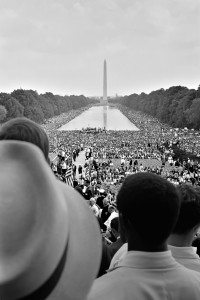

Reactions to the Supreme Court’s ruling Tuesday that halts the use of a key provision in the landmark Voting Rights Act (VRA) included disappointment, motivation to continue community organizing and a sense that it was fair.
The Associated Press and Equal Voice News collected comments from elected officials and community leaders, who work directly on voter engagement issues and in key states affected by the Supreme Court’s decision.
President Barack Obama:
“I am deeply disappointed with the Supreme Court’s decision today… Today’s decision invalidating one of its core provisions upsets decades of well-established practices that help make sure voting is fair, especially in places where discrimination has been historically prevalent.”
Scott Douglas, executive director of Greater Birmingham Ministries in Alabama:
“Our deepest concern is that if a state like ours had the gall to pass voter suppression and racially-discriminatory laws under the scrutiny of Section 5 of the VRA,
» Read more about: Reactions to High Court’s Voting Rights Act Ruling »
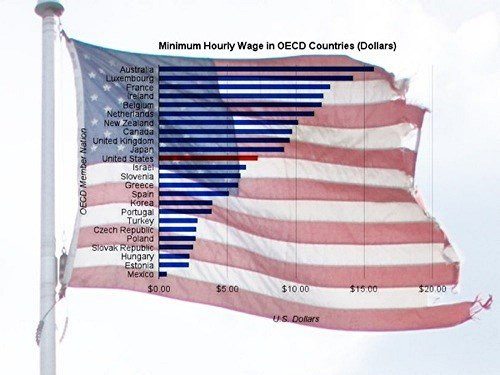
Business groups and their political allies have consistently attacked the idea of a minimum wage ever since President Franklin D. Roosevelt proposed it during the Depression to help stimulate the economy. And yesterday — the 75th anniversary of the Fair Labor Standards Act (FLSA), which FDR signed on June 25, 1938 to establish the minimum wage as well as the eight-hour day, paid overtime and child labor protections — their contemporary counterparts are still at it.
A recent report by the National Employment Law Project and the Cry Wolf Project, Consider the Source: 100 years of Broken Record Opposition to the Minimum Wage, chronicles the history of unchanging sky-is-falling rhetoric by business interests opposed to minimum wage laws.
Even today, business groups and their political allies still complain that the minimum wage violates employers’ freedom to set pay levels, forces business firms to cut jobs or even file for bankruptcy,
» Read more about: Raising the Minimum Wage for the Most Good »


The fight over California’s enterprise zone program continued last Friday when John Burton, chairman of the California Democratic Party, proposed a measure for the November 2014 ballot which would give voters the power to eliminate the zones.
This proposal echoes concerns contained in Frying Pan News reporter Gary Cohn’s exposé of the rampant exploitation of the enterprise zone program. These zones are intended to foster the creation of jobs in economically distressed areas of the state by providing financial incentives to companies to move to those areas. However, a study by the non-partisan Public Policy Institute of California found that “enterprise zones have no statistically significant effect on either business creation or employment growth rates.”
Moreover, Senator Jerry Hill (D-San Mateo) called the enterprise zones “the most abused program I’ve seen,” adding that they amounted to little more than “a big-industry, big-business tax grab.”
Burton is not the only high-profile California Democrat to come out against the zones —
» Read more about: John Burton Measure Would Eliminate Enterprise Zones »
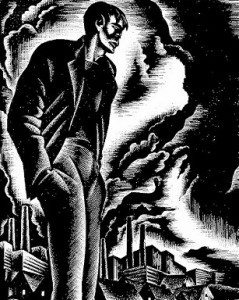

My friend, mentor and colleague, Rev. James Lawson, calls our economic system “plantation capitalism.” Lawson was the nonviolent strategist for Martin Luther King Jr. during the civil rights movement and the key figure in the desegregation of Nashville. His reference, of course, pulls forward the image of enslaved field workers in the Old South.
The image chafes in my mind. Yes, slavery, but today’s workers are not slaves. They are not the landless peasants or sharecroppers that emancipated slaves were forced to be. They are not the low-level, below-the-standard-wage employees that Southern blacks became when they migrated to the steel cities of the North. They are not second-class citizens isolated into segregated neighborhoods and limited to menial jobs.
Except, there is a growing body of evidence showing that this is exactly what a majority of workers of all colors is becoming. Between 1965 and 2011, while the top 10 percent gained an inflation-adjusted annual income increase of $116,000,