
Latest News
It’s Getting Tougher to Teach LGBTQ History, Even Where It’s Required by Law
California law requires public schools to teach about the contributions of LGBTQ people. Teachers say that’s only getting harder under Trump.
Olive Garrison has been teaching high school history in Bakersfield for the past eight years. Born and raised in the Central Valley city, Garrison has incorporated LGBTQ history into lessons, from the Lavender Scare, a moral panic in which thousands of gay workers in the 1940s and ’50s were driven out of government service jobs, to the struggles of queer Americans during the Great Depression.
“For many of my students, there’s no other place that they’ll be able to learn about this,” Garrison said. “They don’t learn about it at home.”
Over the years, Garrison has sometimes gotten pushback about those lessons from students and parents, many of them upset not because of what they were teaching or how they were teaching it, but by the fact that they were talking about LGBTQ people at all.
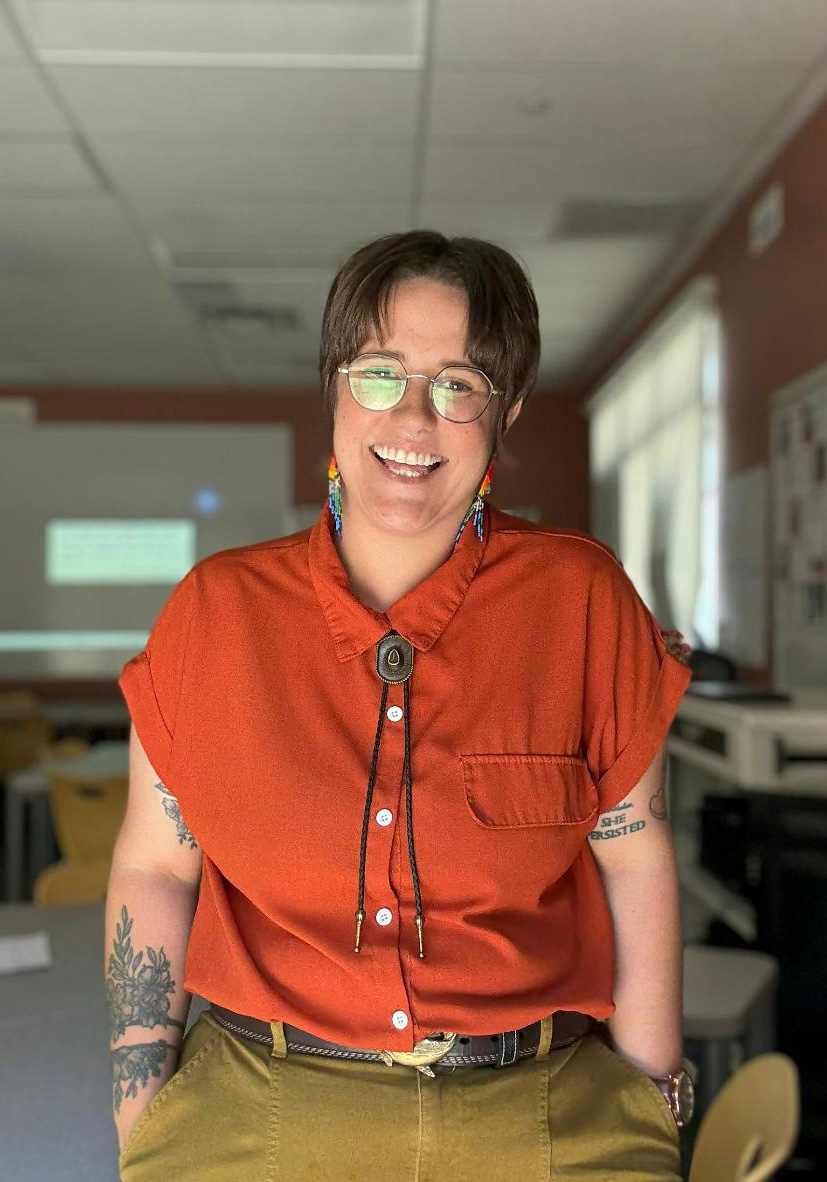
Olive Garrison.“I got parent phone calls to my administrator when I was teaching about HIV and AIDS,” they recalled. “More people died of HIV/AIDS complications in this country than died in Vietnam. I don’t know how you skip that.”
Garrison teaches the material because they find the history important and relevant. But Garrison also teaches it because they’re legally required to do so. When Gov. Jerry Brown signed the Fair, Accurate, Inclusive and Respectful Education Act (FAIR) into law in 2011, the landmark bill, the first of its kind in the country, mandated that the state’s history and social science educators teach about the role and contributions of LGBTQ people in the development of California and the country.
In some ways it’s never been easier for educators to do so, with 15 years’ worth of curricula created to help them comply with the law. But in many other ways their jobs have become much harder since last year’s election to a second term of President Donald Trump and his and his supporters’ forceful attacks on diversity, equity and inclusion and LBGTQ-themed materials in schools, libraries and other public spaces. That reality has had a chilling effect, making many teachers question how to include LGBTQ history in the classroom — and the pushback they might open themselves up to if they do.
Even 15 years after the passage of the FAIR Education Act, relatively few school districts have put its requirements into practice. According to Equality California’s most recent Safe and Supportive Schools Report Card, released in 2024, only about a third (37%) of self-reporting districts had adopted FAIR-compliant materials across all grade levels.
“Enforcement has been uneven throughout the state,” said Tony Hoang, executive director of Equality California, a nonprofit that advocates for LGBTQ rights. “Some districts have made meaningful investments in inclusive curriculum, but others have done very little beyond technical compliance.”
“When the FAIR Education Act was passed, there was neither a carrot, meaning funding to train educators on how to do this work, nor a stick,” said Don Romesburg, a leading scholar on the implementation of the law who wrote the book Contested Curriculum: LGBTQ History Goes to School. “There’s no consequence to educators or schools or districts if they simply choose not to follow the law.”
Last year, Assemblymember José Luis Solache (D-Lynwood) introduced a bill that would require the California Department of Education to monitor school district compliance with the FAIR Act. But it failed to advance in the Legislature.
The state Department of Education, which oversees the adoption of instructional materials, did not respond to requests for an interview.
Teaching LGBTQ history has only gotten tougher over the past year, both in California and across the country. Last year, the ACLU tracked 616 anti-LGBTQ bills in the U.S., including several so-called “Don’t Say Gay” laws that prohibit classroom instruction on sexual orientation and gender identity. Last June, in Mahmoud v. Taylor, the U.S. Supreme Court ruled that parents could opt out of instruction that might “substantially interfere with the religious development of their children,” siding with parents in Maryland who didn’t want their grade school children exposed to LGBTQ-inclusive picture books like “Uncle Bobby’s Wedding” and “Pride Puppy.”
“The Mahmoud decision is technically only about specific parents opting their children out of specific lessons, but the effect of these kinds of rulings is far broader than that,” Romesburg said. “And certainly the Supreme Court justices knew full well what they were doing in making that decision.”
The ruling is having a chilling effect, Romesburg said. “Teachers who would not be inclined to do this work anyway are certainly not going to do it now,” he said.
In this climate, California educators face a difficult choice: Do they teach the state-mandated curriculum and deal with the possible consequences, or quietly succumb to the political headwinds coming out of Washington and keep LGBTQ history out of their classrooms?
* * *
The first time Elizabeth Bergman taught LGBTQ history was nearly a decade ago at an all-girls Catholic school in Princeton, New Jersey.
“I had lots of girls and gender queer, nonbinary students who really appreciated those lessons,” said Bergman, an East Coast native who received her PhD in musicology at Yale in 2000. The school was relatively tolerant, she recalled, but even so, she made a point of not making a “big production” about what she was teaching, like the first time she covered the seminal Stonewall Uprising. “All of that was very much on the down low,” she said.
Bergman moved to Southern California in 2019 and began teaching at elite private schools, including the Harvard-Westlake School and the Geffen Academy at UCLA. At those institutions, situated in deep blue areas of Los Angeles, topics like Stonewall barely raised an eyebrow.
Three years ago, Bergman led a lesson at the Geffen about the Newport Sex Scandal, which involved an infamous 1919 sting operation in Rhode Island in which more than a dozen young sailors, under the aegis of Franklin D. Roosevelt, then Assistant Secretary of the Navy, were used to entrap gay Navy men by engaging them in sexual acts. At a school with a “huge” LGBTQ affinity group, she said, many students found the whole story puzzling.
Some students were surprised that people would go to all this trouble. Others, however, felt excluded by the lesson. In one instance, parents of “cis het boys” complained that their kids needed to see themselves in the curriculum. “And I’m like, really? Really?,” Bergman said. “They have all of U.S. history for that.”

Elizabeth Bergman teaches at Wildwood School, a private k-12 school in Los Angeles. Photo: Barbara Davidson.
As a private school teacher, Bergman isn’t bound by the FAIR Education Act, which applies only to the state’s public school system and instructors.
“Private schools have pretty much ignored it, in my experience,” Bergman said. “Independent school curriculums aren’t beholden to state standards, so it’s not something they discuss.”
All of which makes it easier for instructors at private schools to avoid teaching LGBTQ material altogether, despite clear evidence that covering such material reduces bullying and improves student mental health. Bergman has met and worked with several colleagues who refuse to teach it.
“I had a colleague at Geffen who was very resistant,” she said. Bergman reminded her that LGBTQ history was relevant to their student population, and that the material was an important part of the history that they were supposed to be teaching. “And she just refused,” she said.
Bergman doesn’t attribute her colleague’s resistance to homophobia, however. “There’s that kind of prudish response, or a reductive sense that LGBTQ history is just teaching sex and sexuality,” she said.
In 2022, Bergman participated in a two-week summer program sponsored by the National Endowment for the Humanities that focused on teaching LGBTQ history. It drew middle and high school teachers from across the country. “We had such a wonderful group,” Bergman recalled. But when the teachers, including ones from Kentucky and Florida, met again in the ensuing years, “My heart just broke,” she said. “The kinds of pressures they were facing were just horrifying.”
Indeed, in 2023, Kentucky passed a sweeping law limiting a broad range of rights for queer and transgender students that was roundly condemned by civil rights groups like the ACLU of Kentucky and the Human Rights Campaign, and vetoed by the state’s Democratic governor (the veto was later overridden by the Legislature). In Florida, under Gov. Ron DeSantis, the state’s notorious “Don’t Say Gay” law continues to be one of the country’s strictest.
Two years ago, Bergman began teaching at Wildwood School, a progressive, private K-12 on Los Angeles’ Westside. “I have at least a couple of trans students every year,” she said. “We have out teachers.” But even at Wildwood, she’s felt a mood shift over the past year, including among her students, who are aware of the manosphere, the assortment of online communities promoting misogyny and toxic masculinity, and know all about the attacks on diversity, equity, inclusion and belonging. “I feel like in this moment, there’s a demonization of teachers generally,” she said. “I see it myself with our young boys.”
“As soon as Trump came back into office, our head of school sent out a note to parents saying we are absolutely tripling down on our commitment to DEIB work,” she continued. “So I’ve seen a lot of leadership in California and the L.A. private schools really affirming that we are going to protect and support and uplift communities of color, the undocumented, and LGBTQ students and communities.”
* * *
When Garrison was in their second year as a public high school teacher in 2016, they joined a team of 10 educators tasked with creating the curriculum for the state’s newly adopted History-Social Science Framework, which mandated, among other things, the teaching of LGBTQ history. While there, Garrison first learned about the FAIR Act. “A lot of us got together and we were like, why aren’t people doing this? Why aren’t they teaching the FAIR Act? It’s so old! And then we realized, well, it’s because they don’t know how.”
Garrison and the others began looking at important historical periods teachers were already expected to cover and worked to find creative ways to include the stories of LGBTQ people and movements within them. A section on the Harlem Renaissance, for instance, could focus on LGBTQ icons like Ma Rainey and Langston Hughes; a section on World War II might include letters between gay soldiers. Kids would sometimes ask to drop Garrison’s class. On one occasion, parents complained when the class was shown a photo of two men kissing, used to illustrate a lesson on LGBTQ protest in the 1970s.
But Garrison’s worst pushback as a teacher of LGBTQ history hasn’t come from students or parents or even from the citizens of their home town of Bakersfield. In 2022, Garrison recalled, a transgender student wanted to learn how to change their name at school, and Garrison showed them the paperwork they needed to do it. A year later, Garrison was quoted in a New York Times article about gender transitioning students in which they discussed helping students socially transition at school without their parents’ knowledge. “Sometimes, they need protection from their own parents,” they told the Times.
Garrison was hit by a deluge of hate mail and death threats through email, phone and social media. “My school got hundreds of calls,” they said. “I was getting death threats to my house, to my school, to my school district, everywhere.”
“None of them were from my community,” Garrison noted. “The worst death threats I was getting were actually from people from other states.”
The threatening messages went on for over two years, they said, some of them coming from people apparently inspired by a campaign by Moms for Liberty, a far-right parental rights organization that opposes LGBTQ inclusion in schools.
“They really focus on California, because California is where people have protections like the FAIR Act, which means they’re more likely to speak out publicly about their lives,” Garrison said.
Indeed, when Stacie Brensilver Berman first began working on her 2021 book LGBTQ+ History in High School Classes Since 1990, nearly half of the 13 teachers who were willing to speak with her were from California, with the rest hailing from blue areas of the country like New York, Chicago and the D.C. area. “Nobody talked to me from a red state,” she recalled.
Since its passage in 2011, the FAIR Act has been an imperfect shield. In 2022, Tammy Tiber, a third grade educator in Glendale, was removed from her teaching position after receiving death threats for showing a gay pride video in her class. The following year, Gov. Gavin Newsom signed Assembly Bill 1078, after the Temecula Valley school board voted to ban the state’s new social studies book because it included references to Harvey Milk, the pioneering gay rights activist and politician (at the meeting, Joseph Komrosky, the school board’s president, referred to Milk as a “pedophile,” a baseless claim that was roundly criticized by state leaders, including Newsom).
Under AB 1078, if a school district refuses to provide state-approved textbooks to students — after, say, dumping them in the trash — the state will ship them new books and instruct the state controller to bill the district for them. “I thought it was a really creative way to say that, while local control is important,” said Romesburg, the LGBTQ history scholar, “it’s also important for all school districts to follow state education law.”
* * *
For teachers of LGBTQ history, the past year has been a confusing and difficult one. Between the anti-trans rhetoric coming from the White House and increased polarization between states that support LGBTQ education in the schools and those that emphatically don’t, educators and their students find themselves caught in the middle. “For students, their sense of safety has really gone down,” Garrison said.
“It’s really frightening, and I think it’s only going to get more frightening,” Berman said. “When you look at where there are state laws censoring what teachers teach, either about LGBTQ history or other topics, it looks like a map of the United States pre-Civil War, where a very significant part of this country feels one way, a very significant part feels another way, and there’s not a lot of middle ground.”
But in California, school districts have been scrambling over how to respond to the Supreme Court’s Mahmoud decision, driving superintendents to craft opt-out forms and procedures for parents, and prompting the California Department of Education to issue a statewide guidance notice for administrators, which described the need for schools to “consult legal counsel” when dealing with possible opt-out situations.
“This is FAIR’s 14th year of existence,” said Hoang with Equality California. “It’s critical that school districts across the state incorporate this curriculum, especially as the federal administration continues to roll back protections for vulnerable young people.”
Bergman points to a host of reasons why LGBTQ education is so important, both in rural areas and more urban areas like her own. “You’ve probably seen the stories where, even in these very privileged environments, the R word has returned as a slur among kids,” Bergman said. “And we have the F word that’s returned as a slur, too. A lot of kids genuinely don’t know the history of these terms, and don’t know how they’ve been used against people in ways that are profoundly oppressive. So it’s not like I can just tell them, don’t say it. You have to teach them the history.”
Copyright 2026 Capital & Main


-
 Column - State of InequalityMay 21, 2026
In California Governor’s Race, Xavier Becerra Walks Away From Single-Payer
-

 Latest NewsMay 22, 2026
Where California’s Gubernatorial Candidates Stand on Climate and Taking Big Oil Money
-

 Latest NewsMay 15, 2026
California Hazardous Waste Rules Criticized as Years Late and ‘Polluter-Friendly’
-

 The SlickMay 20, 2026
70-Foot Wastewater Geyser Reflects New Mexico’s Latest Oilfield Challenge
-
 The SlickMay 29, 2026
Feds to Open Tens of Thousands of Acres of Colorado Wilderness to Oil Drilling
-

 Latest NewsMay 18, 2026
Budget Cuts Threaten Program That Doubles Food Dollars for Californians in Need
-
 Deadly Dust: The Silicosis EpidemicMay 27, 2026
California Moves to Ban Quartz Countertop Fabrication to Combat Silicosis Epidemic
-
 Latest NewsMay 26, 2026
Conditions at California ICE Detention Centers Are Getting Worse, Inspections Find