
The Slick
70-Foot Wastewater Geyser Reflects New Mexico’s Latest Oilfield Challenge
It’s a towering example of the contentious debate over what to do with the state’s ever-growing supply of oilfield waste.
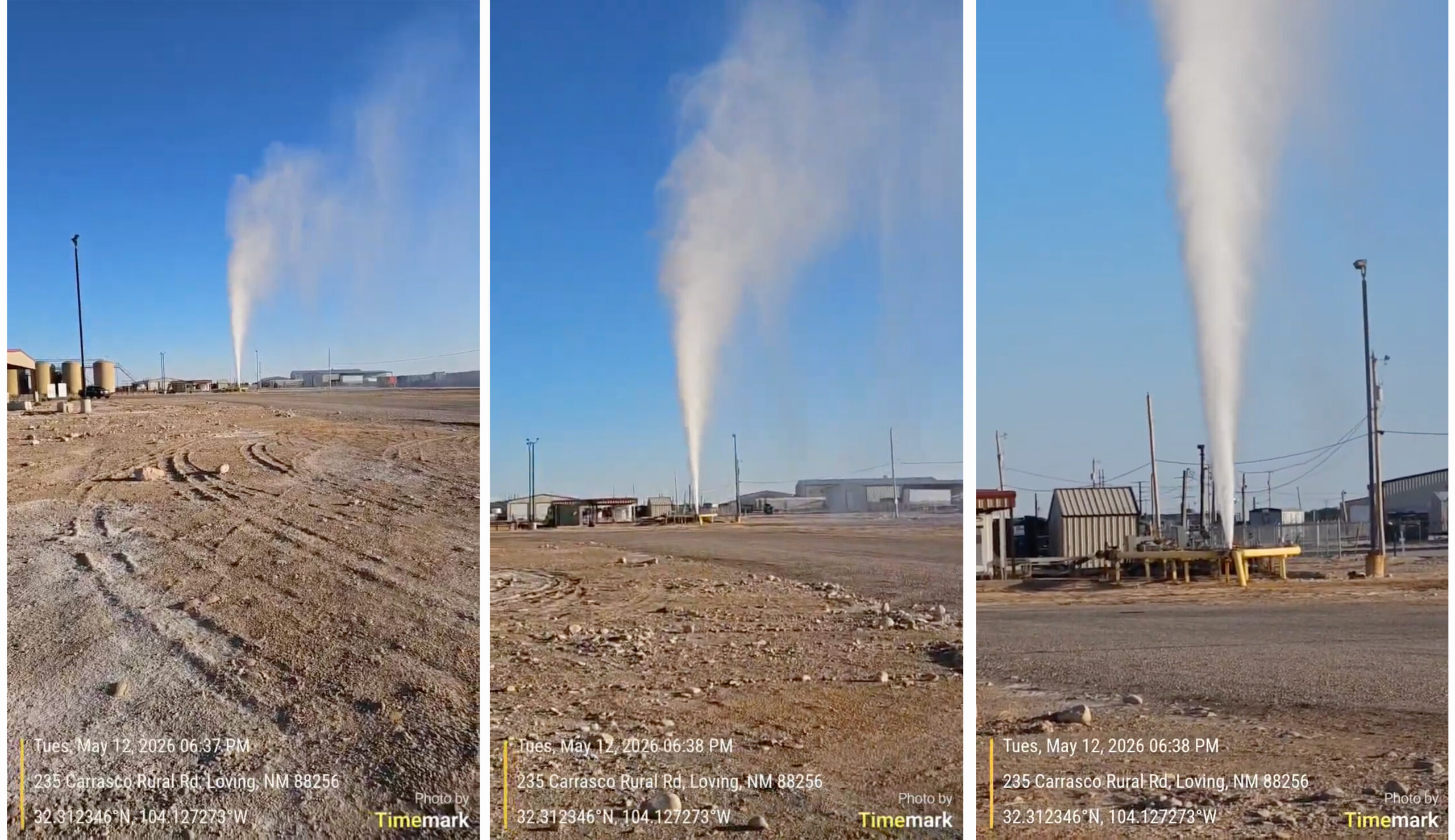

At first, he thought it was smoke.
Jackie Onsurez was driving the bustling New Mexico highway between his home in Loving and nearby Carlsbad last Tuesday evening when he thought the smoke didn’t look right. As he pulled closer, he saw that the 70-foot plume was actually a roaring geyser of toxic oilfield wastewater, commonly called produced water, spewing from a pipe at a site operated by NGL Energy Partners.
Onsurez, who until recently was running for the state’s lieutenant governor position, said he called NGL, 911, the New Mexico Environment Department and others. He was at the site for a few minutes when an oilfield roughneck arrived in a pickup truck and tried to stop the spraying water but couldn’t.
He said the man then “started to haul ass out of there. He said, ‘Get out of here. There’s gas coming out. I don’t know what’s there. Get out, get out!’”
Footage courtesy of Jackie Onsurez.
Onsurez didn’t leave, though. He is an engineer and serves on the New Mexico State Emergency Response Commission — the day before, he had attended a commission meeting on hazardous materials spills. The serendipity wasn’t lost on him.
“I was able to observe firsthand the equipment and the training and everything else that’s needed for here [in the oilfield],” he said. “The only people that had protective gear was the fire department when they arrived.”
The fire department cordoned off the area a few minutes after the roughneck fled. NGL representatives arrived soon after and shut off the shooting water. By that point, Onsurez had been at the site for about a half hour. He didn’t know how long it had been spewing before he arrived.
The contaminated water flowed across the road and ran into a nearby drainage ditch. Onsurez had also called Alisa Ogden, a farmer and rancher and member of the Carlsbad Soil and Water Conservation District, to let the group know of the spill.
“I said, ‘Ms. Ogden, I hate to bother you, but it looks like this might be getting into your acequias,’” Onsurez said, using the common Spanish term for the traditional Southwest water system.
“If you don’t know what happens, you can’t do anything about it,” Ogden said later. “Gratefully, Jackie let us know immediately when he saw it and we got right on it and were able to keep the produced water … from flowing down towards the Pecos River,” she said.
“It doesn’t keep us up at night, but with the oilfields out here, it’s always a hazard that it could happen,” Ogden said.
According to a report filed by NGL with the New Mexico Oil Conservation Division, a one-inch nipple broke on a high-pressure water injection line, leading to the blowout. The report said 40 barrels of produced water escaped, 10 of which were recovered. The remaining 30 flowed into the nearby ditch.
Sidney Hill, the public information officer at the New Mexico Energy, Minerals and Natural Resources Department, which oversees the Oil Conservation Division, said that NGL collected samples from the ditch and “We expect to receive them sometime this week.”
“Accidents do happen,” Ogden said. “We’ve all had accidents occur. It’s how you react to ’em.”
She said NGL is responsible and has agreed to do the cleanup. “They did everything they could at the time,” she said. “Once we get all the samples back and everything, then we’ll come up with a plan on what they need to do.”
NGL did not respond to phone and email requests for comment.
Footage courtesy of Jackie Onsurez.
In December 2024, an inspector from the state’s Oil Conservation Division found a pump leaking wastewater on the wellsite’s cement slab. Asked by Capital & Main about a scheduled three-month follow-up visit that didn’t appear in the well files, Hill said, “Thank you for pointing out the past due compliance. We will investigate why it isn’t closed out but it does not seem associated with the current release.”
NGL transports oil, gas and wastewater around oil basins from the Gulf Coast, Oklahoma, Colorado, Kansas and New Mexico. It also has a growing business disposing of produced water in deep injection wells like the one just north of Loving. In its annual report, the company claimed to be the largest independent wastewater transporter and disposal company in the U.S., handling nearly a billion barrels of the toxic water across its operations last year.
In the greater scheme of wastewater spills in New Mexico, NGL’s accident was notable for being visible, not for being big. Between Jan. 1 and May 19, 48 companies reported 356 spills, losing 15,335 barrels of wastewater across the state. The biggest was a 2,000 barrel spill in January by Hilcorp Energy Company, just 1,300 feet from a neighborhood in north Farmington. Devon Energy Corporation reported the most wastewater spills so far with 93, compared to three for NGL.
But last week’s briny geyser highlights one of the fastest-growing controversies in New Mexico’s oil and gas industry: what to do with produced water. In 2025, oil producers brought up more than 800 million barrels of oil and 2.7 billion barrels of wastewater in the state. Those barrels of wastewater increase as oil and gas production grows and the total has doubled since 2020. There is little agreement on what to do with all of it.
The water occurs naturally in oil and gas formations and is highly saline, laced with petroleum-based chemicals. It is often radioactive and can include the chemical cocktails that companies inject into wells during the fracking and production processes. The recipes for those cocktails are often protected trade secrets and can differ radically from well to well. Basically: The water is toxic, and its use outside the oilfield for anything but testing is forbidden in New Mexico.
Wastewater can be used to drill new wells, but the most common disposal method is underground disposal wells — like the one near Loving — where the water is reinjected into rock formations under extreme pressure.
The report filed by NGL with the Oil Conservation Division said the broken nipple was on a pipeline charged to 2,600 pounds per square inch. But the state is running out of injection locations as the rock formations fill and shift under the intense pressure of the injections, resulting in swarms of earthquakes across the Permian Basin in both Texas and New Mexico. In addition, high-pressure wastewater deposits have breached old oil and gas wells, leading to brine leaks and geysers.
A proposal put forward by the industry group Water, Access, Treatment and Reuse Alliance to allow wastewater to be treated and used outside the petroleum industry is once again before the state’s Water Quality Control Commission. It was knocked down last year following a fracas where Gov. Michelle Lujan Grisham appeared to pressure the commission to overturn a recently instituted ban on using the wastewater outside the oilfield. Earlier proposals argued that treated water could be used by other industries or possibly discharged into lakes and streams, a highly controversial use in a state that continues to suffer from a decades-long drought.
In separate interviews, lead lawyers from each side of the debate tackled each other’s arguments.
Matthias Sayer, co-founder of the alliance, said he views treated water as “a new source of water supply and as a reduced burden on the current management system.”
Sayer said, “Spills happen because oilfield [waste]water management is massive, constant, and operationally complex … That does not excuse spills, but it explains why a system built around moving very large volumes of high-salinity water will continue to experience [spills] unless the state improves infrastructure and creates better incentives for treatment, recycling, and beneficial reuse.”
Tannis Fox, senior attorney at the Western Environmental Law Center and a lead attorney against the reanimated wastewater proposal said, “The main argument that industry is making is that reuse of produced water is one solution to the water scarcity problem. And with that, we disagree. It’s not a silver bullet.”
Sayer said a “robust body of science” shows that oilfield wastewater can be treated and safely reused. “The question is not whether it can be done, but how to craft a rule that appropriately manages the risk,” he said. “That question is answered by engaging the science and the experts behind it.”
Fox said, “There is, of course, a significant debate about what the science is telling us.” She and others are skeptical that new water treatment processes can reliably clean what’s coming out of the ground. Water testing generally starts with looking for known, likely contaminants in the water.
But, she said, “We don’t know all the constituents in produced water because the hydraulic fracturing fluids that industry uses are protected by trade secret rules.” In addition, basic water chemistry and salinity varies widely across the state. The lack of clarity about what’s in the water “is a problem for emergency response workers if you don’t know what’s in those fluids,” she added, with a nod toward the Loving spill.
In addition, Fox said there hasn’t been large-scale testing. “There have not been studies at scale. There has not been discharge at scale. There has not been treatment at scale. Reuse of produce water at an industrial scale is not there yet. So it is not a solution to water scarcity tomorrow,” she said.
“If the [Water Quality Control Commission] approves a rule, the system will necessarily ramp up organically,” Sayer said. “This is a runway, not a light switch.”
Fox said, “It is by its nature a dirty industry, and obviously the world needs energy, and the sooner we get to clean energy the better.”
Copyright 2026 Capital & Main



-

 Column - State of InequalityJune 4, 2026
California’s Economy Runs on Labor Trump Wants to Deport
-
 Featured VideoJune 5, 2026
At This New Mexico Park, Mountain Bikers Pedal Amid Hundreds of Oil Wells
-

 Latest NewsJune 9, 2026
Ousted by the Trump Administration, U.S. Immigrants Remain Locked up in African Kingdom
-
 The SlickJune 10, 2026
Data Centers Are on the Ballot — This Pennsylvania Candidate Won Her Primary Keeping Them Top of Mind
-
 Latest NewsJune 12, 2026
California Town Lets Private ICE Detention Centers Police Themselves
-

 Latest NewsJune 8, 2026
The Glacier May Be Gone, but the Love Isn’t
-

 Column - State of InequalityJune 11, 2026
County Tax Measures Show Limits of Local Responses to Medicaid Cuts
-
 The SlickJune 16, 2026
Why Coal Will Lead to More Deaths in Colorado