
Column - California Uncovered
Black Angelenos Care for Alzheimer’s Patients — and Each Other
Support groups help manage the strain on caregivers in the epicenter of Alzheimer’s cases.


Peggy Melancon, known as Mother Peggy, got on the wrong bus in South L.A. She didn’t recognize her hairdresser. She kept losing her keys. These were the signs of her illness that daughters Jeanie Harris and Sharon Melancon recognized only after Mother Peggy was diagnosed with Alzheimer’s, a degenerative brain disease. Mother Peggy would need someone with her all the time, and Harris, Melancon and other family members would alternate being that someone. This wasn’t the first time for Harris and Melancon: Their cousin, Lorraine M. Jackson, whom they called Aunt Lorraine, had already been diagnosed with Alzheimer’s disease.
Harris, Melancon, Mother Peggy and Aunt Lorraine are emblematic of the impact of Alzheimer’s in America. Los Angeles County, with more residents diagnosed with Alzheimer’s disease than any other county in the nation — is the U.S. epicenter of a malady that is harming Black Americans at higher rates than any other group. As more black women and men are diagnosed with Alzheimer’s, more family members, like Harris and Melancon, are becoming caregivers, straining their own health and finances.
Though able and willing to change their lives to support Aunt Lorraine and Mother Peggy, the sisters knew they and others could use a network for both practical and emotional support. So they created Actively Caring Through Sharing (ACTS), a nonprofit group to assist other caregivers. The group meets monthly to share advice on often confusing matters such as how to best apply for aid from government agencies, or sharing things like adult diapers or even meals.
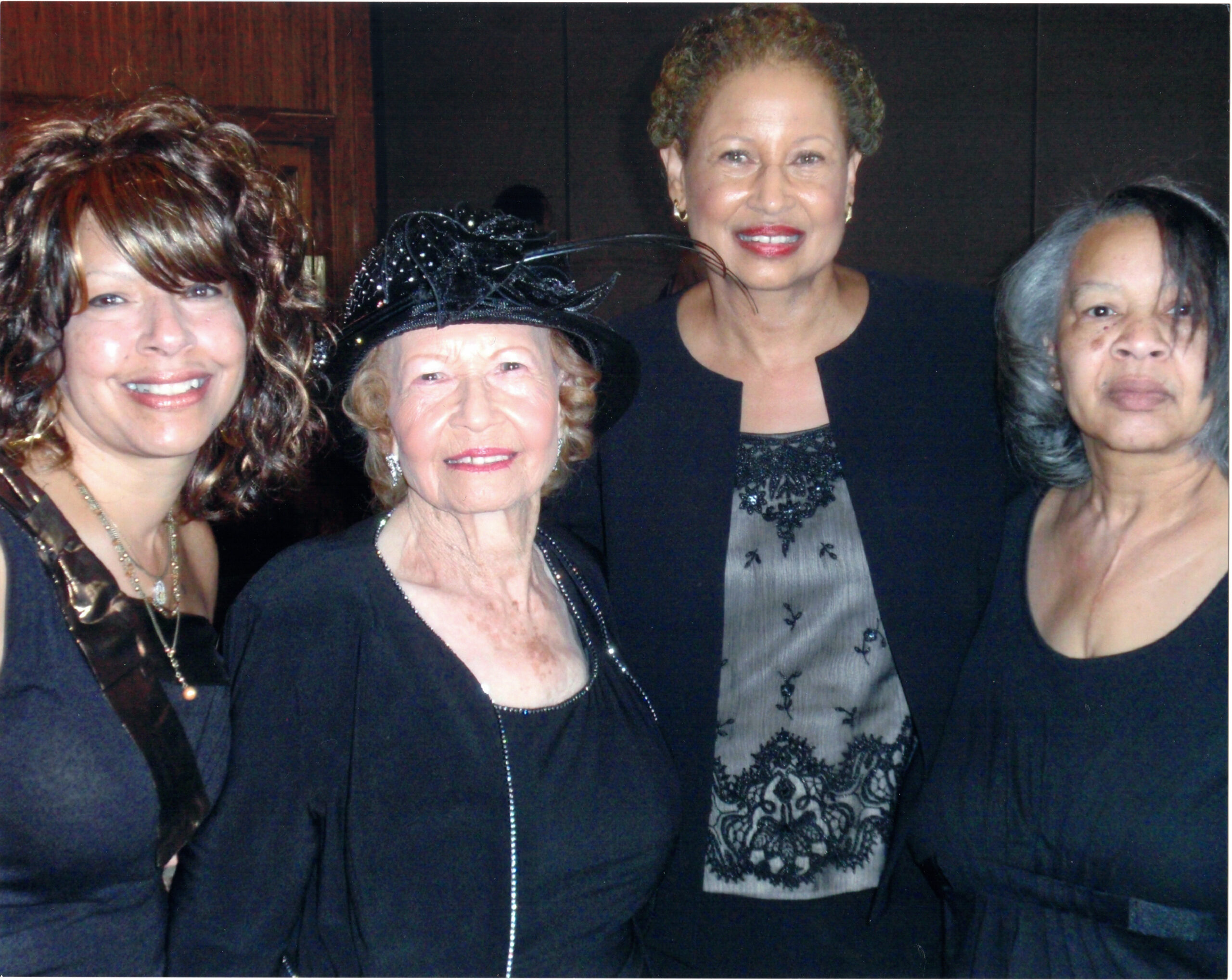
Peggy Melancon, second from left, with her daughters Vivian, Sharon and Jeanie.
Outside of those meetings, the sisters take phone calls at any hour to help a caregiver. Harris and Melancon stress the group is for anyone caring for a loved one debilitated by Alzheimer’s who could benefit from what they have learned through their experience. “Somebody called to ask us about the ACTS model. We didn’t know we had a model,” laughed Jeanie Harris. “We just want to see more caregivers supported.”
Nationwide, Black Americans are 2.5 times more likely, and Hispanics 1.7 times more likely, to be diagnosed with Alzheimer’s disease than their white peers, according to a report released last month by Alzheimer’s & Dementia: The Journal of the Alzheimer’s Association.
Alzheimer’s is a brain disease that impacts cognitive ability — speech, memory and thought. As the disease progresses, it can impact basic bodily functions, like walking and swallowing. The ill person increasingly relies on others.
A 2023 report from the Alzheimer’s Association cites historic and continued marginalization, or structural racism, as the likely cause for the higher rates of the disease among Blacks and Latinos. Increasing research highlights the physical toll of racism on the body, prompting stress and high blood pressure, among other effects.
An estimated 6.7 million Americans suffer Alzheimer’s disease dementia, including almost 720,000 people in California. In Los Angeles County, Alzheimer’s deaths have been steadily increasing among Blacks, Latinos and Asians since 2000. Blacks are dying from Alzheimer’s disease and other dementias at a rate of 68.6 per 100,000 — a rate that has tripled since 2000.
Though Blacks suffer the highest rate of Alzheimer’s death in the county, they represent only 8% of the population, or 823,000 in a county of 10.2 million people. By 2040, Alzheimer’s diagnoses in L.A. County are projected to increase for residents aged 65 and older. Whites will experience a 98% increase from 72,000 to 142,000. Blacks will be hit harder, with Alzheimer’s diagnoses growing 153%. Latinos will see an increase of 223% as the Latino population of the county grows overall and ages.
There are approximately 323,000 caregivers in Los Angeles County taking care of someone with some form of dementia and cognitive impairment. Caregiving impacts the caregiver’s physical and psychological well being. Los Angeles County public health officials estimate approximately 76% of caregivers are tending to a parent or grandparent.
When Aunt Lorraine was diagnosed with Alzheimer’s, Jeanie Harris moved to San Pedro to be near her. Then she had to move again to South L.A. once her mother became sick. In addition, Harris was considering how to adjust her work schedule to care for her mother. She worked four days a week, taking a 20% pay cut, but had additional time to care for her mother before she died in 2016.
Round-the-clock caregiving impacted every aspect of their lives, the sisters said — professional, personal and social. It took years to find a life-caregiving balance that was less strenuous, the sisters explained, noting how caregiving kept the pair from regularly attending church.
Jim Kelly met Melancon and Harris after he approached Alzheimer’s Los Angeles to volunteer. With the help of the sisters and ACTS, he began co-facilitating a monthly caregiver support group for black men, Brother to Brother.
Kelly, who helped care for his mother-in-law before his involvement with Brother to Brother, said many of the caregivers in his support group are 65 years old or older; longtime married men caring for a spouse or relative; retired professionals; and people with large, extended families. Most people join because they don’t know what to do.
“Caregivers need to have a community” to get that guidance, said Kelly.
Copyright 2023 Capital & Main


-

 The SlickJune 10, 2026
Data Centers Are on the Ballot — This Pennsylvania Candidate Won Her Primary Keeping Them Top of Mind
-

 Latest NewsJune 9, 2026
Ousted by the Trump Administration, U.S. Immigrants Remain Locked up in African Kingdom
-

 Latest NewsJune 8, 2026
The Glacier May Be Gone, but the Love Isn’t
-

 Latest NewsJune 12, 2026
California Town Lets Private ICE Detention Centers Police Themselves
-
 Column - State of InequalityJune 11, 2026
County Tax Measures Show Limits of Local Responses to Medicaid Cuts
-

 The SlickJune 16, 2026
Why Coal Will Lead to More Deaths in Colorado
-

 Latest NewsJune 17, 2026
California Rideshare Drivers Move Toward Unionizing, Following Massachusetts
-

 Latest NewsJune 19, 2026
Sheriff’s, Probation Litigation Cost L.A. County Taxpayers $1 Billion, Study Finds