
Imperial Divide
A Drying Colorado River Threatens Imperial Valley’s Future
Declining flows and the warming climate imperil farms, green energy projects and the economy of one of California’s poorest counties.
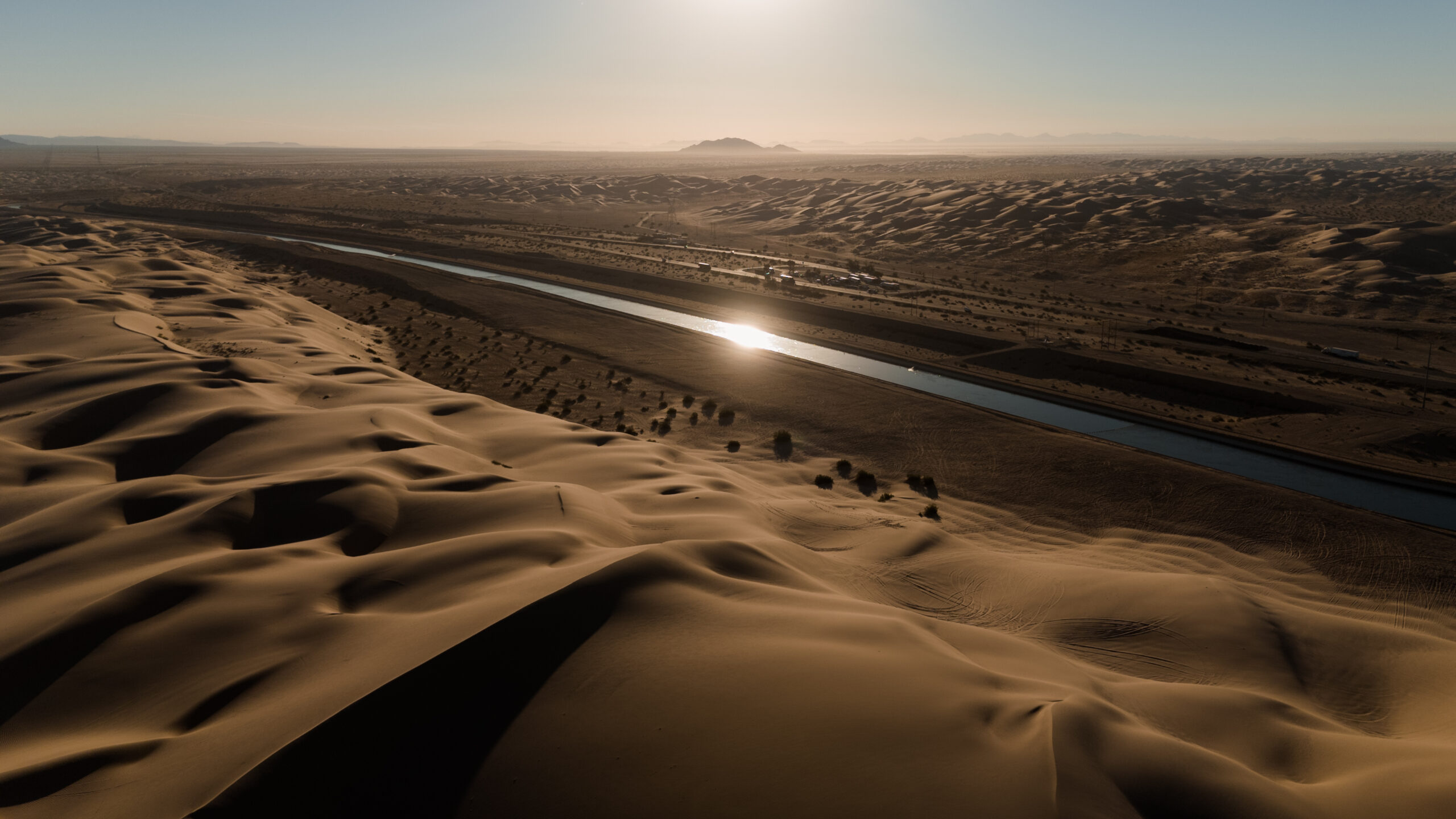

In the southeast corner of California, 300-foot-tall sand dunes rise from a sunbaked landscape dotted with ocotillo and creosote bushes. Summer temperatures here regularly exceed 110 degrees, and annual rainfall is comparable to that of the Sahara Desert.
Despite its unforgiving terrain, more than 180,000 residents live in Imperial County, one of the country’s most productive agricultural regions and more recently a magnet for data center development and lithium extraction proposals. This has all been made possible by turn-of-the-20th century canals that carve up the region, supplying it with more than a million gallons of Colorado River water every minute.
“We’ve often called it the lifeblood of Imperial Valley,” said Robert Schettler, a spokesperson for Imperial Irrigation District, the area’s public utility, which manages the region’s over 3,000 miles of drains and canals. “If something were to happen to that river, we would all have to pack up and leave.”
Something is happening to the Colorado River. Over the past century, its average water supply has fallen by nearly a third due to prolonged drought and climate change. Experts predict that decline will continue, threatening cities, tribes and farms that depend on the river’s flow, from Wyoming, Utah, Colorado and New Mexico to Arizona, Nevada and Northern Mexico.
Most of the Colorado River’s water starts as snowpack in the Rocky Mountains, but after much of the American West experienced the warmest winter ever recorded, snow levels are now at historic lows, prompting experts to warn that 2026 may be one of the river’s driest years yet.
That could spell disaster for Imperial County, whose harsh desert landscape of windblown sand and rugged burnt-orange mountains was transformed more than a century ago into productive, gridded farmland dotted with small cities such as Brawley, El Centro and Calexico.
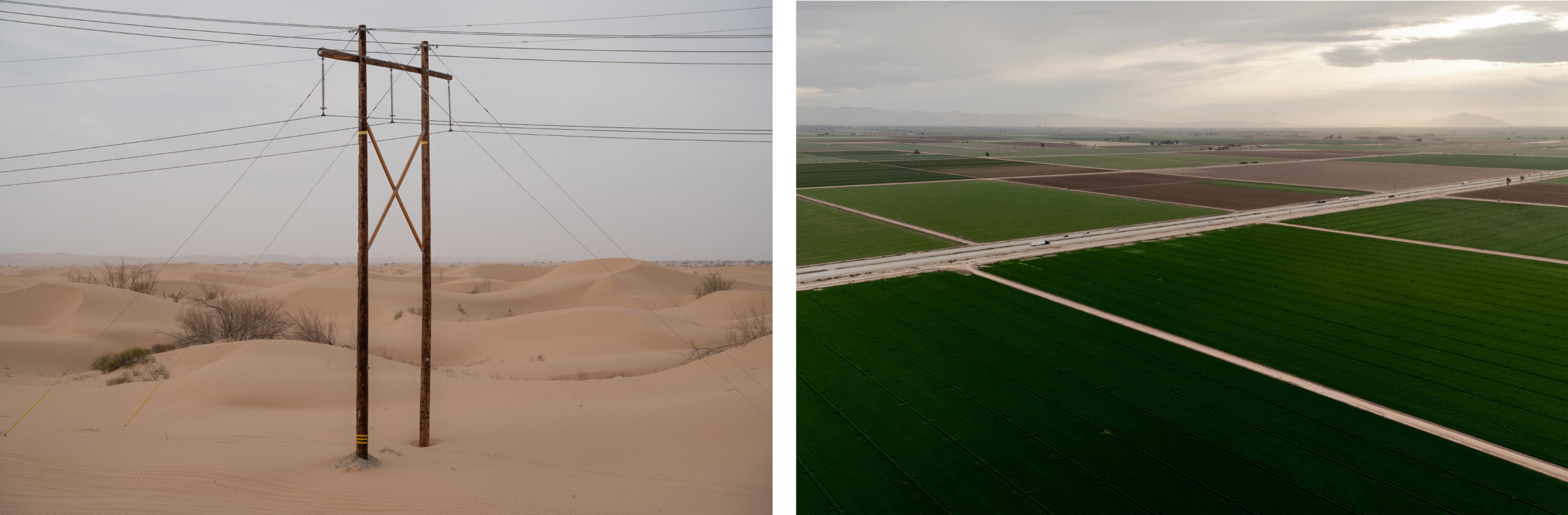
Left: Powerlines cross over sand dunes. Right: Farmland extends across Imperial Valley.
Communities across Imperial Valley are now contemplating what dwindling water resources might mean for their region, which is already struggling economically, and for the rest of the country, which relies heavily on the region’s water-intensive farms for winter vegetables. Any hit to its agricultural industry will reverberate through its majority-Latino population, which includes thousands who rely on farm jobs for their livelihood.
The success of emerging industries — including lithium extraction projects that promise to unearth minerals that are critical for renewable energy and data centers to satisfy the growing demand for artificial intelligence — also depends on their ability to tap water, Earth’s most precious resource. At the same time, residents fear what cuts could mean for daily tasks such as showering and watering their gardens. Farther to the east, members of an Indigenous tribe on the border with Arizona grow increasingly concerned about what a dying river means for their own farm-based economy and the fate of riverside plant life used in centuries-old cultural traditions.
The dilemma came into sharp focus after California and other Western states reliant on Colorado River water failed to meet a Feb. 14 deadline set by the federal government to agree on how to divide the river’s dwindling water supply. With the rules that govern the allocation of the river’s water expiring this year, JB Hamby, vice chairman of the Imperial Irrigation District board of directors and California’s Colorado River negotiator, said the region’s water future is “totally unclear.” Any sustainable path will require states to “[leave] water in the river that they otherwise would like to use,” he added.
Sowing and Reaping
Imperial Valley’s agricultural industry consumes by far the largest share of water in the region, about 97% of the roughly 2.5 million acre-feet delivered to the region by the Imperial Irrigation District every year. That’s more than five times the water used by Los Angeles, a city with more than 20 times the population of Imperial County. That water supply has allowed the county to become an agricultural powerhouse, producing two-thirds of the vegetables Americans eat in the winter.

Brian Strahm picks carrots out of his field south of Holtville.
As the Colorado River’s annual flow has declined by millions of acre-feet over recent decades, the Imperial Irrigation District has showered incentives on Imperial County farmers, encouraging them to limit their water use. Many have adopted efficiency measures such as drip irrigation and systems that capture and reuse runoff.
Those ambitious and largely successful conservation efforts have come at a cost. Much of the water used by farmers historically flowed into the nearby Salton Sea, but as farmers have reduced their water use, less runoff has reached the man-made lake, accelerating an existing environmental crisis.
Over the last three decades, the Salton Sea has shrunk by more than 60 square miles, exposing a dry lakebed laden with pesticides, particulate matter and heavy metals. Those contaminants are carried as dust through the air into nearby communities, contributing to a childhood asthma rate triple that of the national average.
Now, farmers such as Brian Strahm, whose family has been growing crops in the area for four generations, are concerned they may have to decrease their water use further. That may prove difficult since farmers have already put in place many efficiency measures, Strahm said.
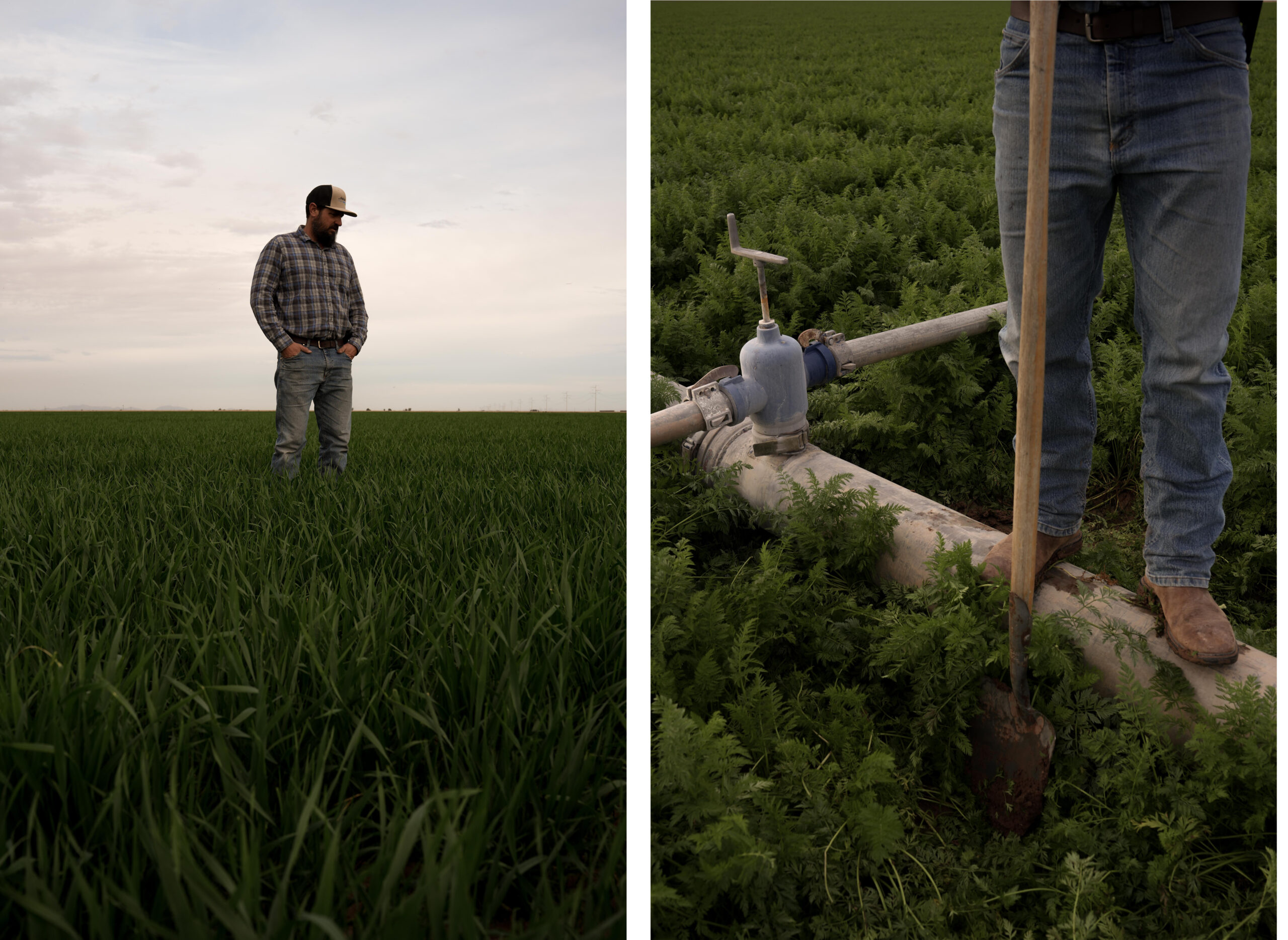
Left: Strahm in a wheat field. Right: Strahm stands on an irrigation pipe.
“Our irrigation system is almost a wonder of the world,” Strahm said. “We’ve done a good job, but we’ve pretty much exhausted anything that was cost effective or easier to do. As we go forward, conservation gets more difficult.”
Strahm said farmers can cut water use only so much before crop production in Imperial County begins to suffer. He fears farmers will be asked to leave some of their fields completely unproductive — much as they did during Imperial Irrigation District’s fallowing program, which ended a decade ago.
Imperial Irrigation District’s Schettler voiced similar concerns about further reducing farmers’ water use.
“If we have a crisis on the river, we have to ask ourselves, do we also want a food crisis?” Schettler said.
Farmers say cuts could seriously harm the area’s already struggling economy. In addition to being the county with the highest percentage of Latinos in California, Imperial has among the highest unemployment rates of any county in the country, at nearly 19%. For those who do find work, the agricultural industry offers a lifeline, accounting for one out of every six jobs in the region.
Despite the potential economic effects, water-use experts say that in the long term, cutting farmers’ supply of water may be necessary to keep the Colorado River system from collapsing. Because municipal, industrial and commercial users account for just 3% of Imperial County’s use of Colorado River water, “the bulk of the reduction will have to come out of agriculture,” said Kurt A. Schwabe, professor of environmental economics and policy at the University of California, Riverside.
But water scarcity isn’t the only threat to the region’s farmland. A new kind of gold rush is drawing industrial prospectors to Imperial Valley in search of a mineral that promises to usher in the technology of the future but that also sits beneath thousands of acres of crops.
An Underground Reservoir
More than a mile below the valley floor lies an enormous natural reservoir of geothermal brine — a scalding-hot saline fluid — long touted for its potential as a sustainable energy source. That soup is also rich with valuable minerals, chief among them lithium, a substance critical to the manufacture of rechargeable batteries used in electric vehicles and renewable energy projects.
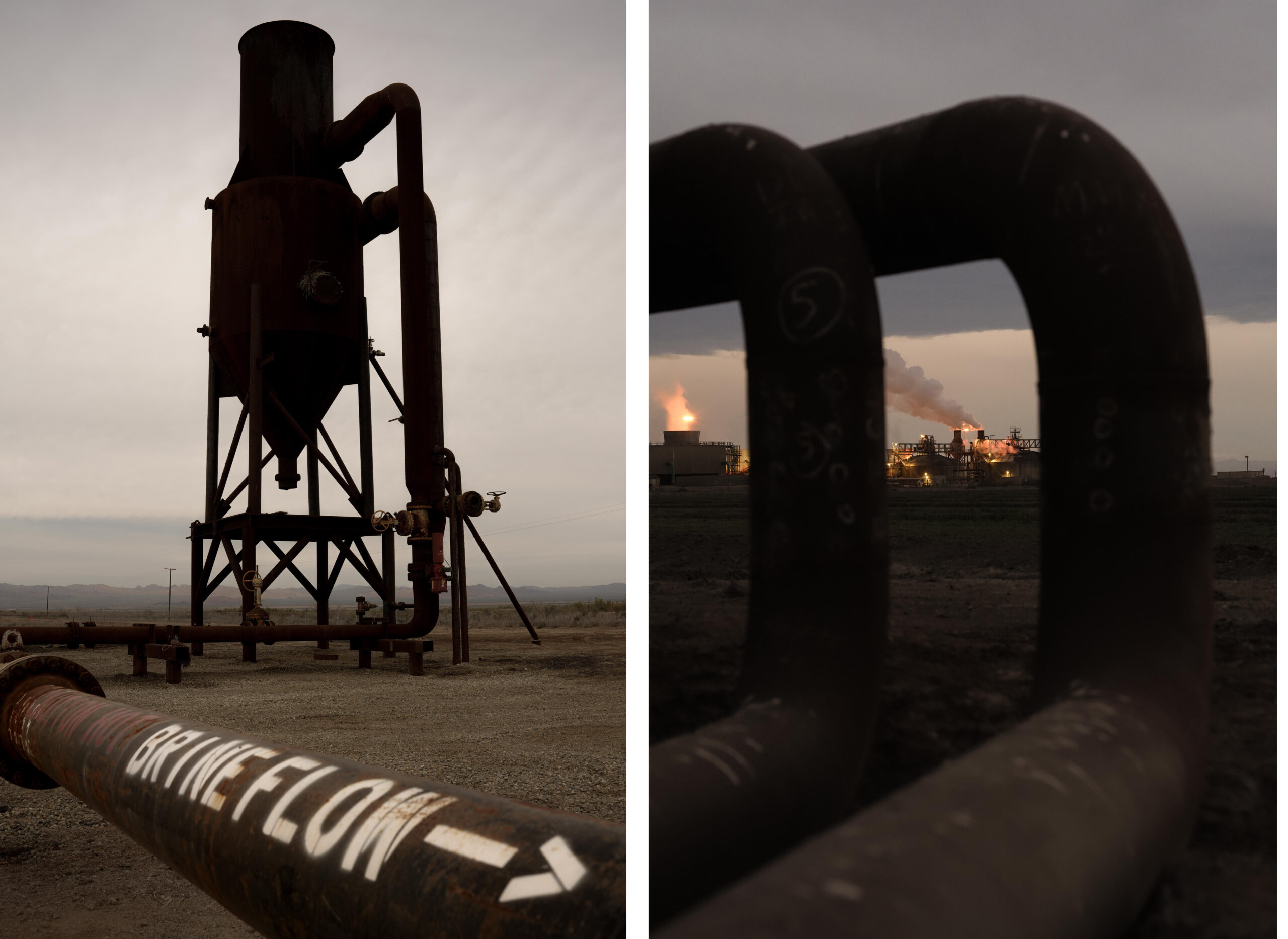
Left: A Hell’s Kitchen geothermal well near the Salton Sea. Right: Pipes lead to a geothermal facility.
After years of research and development — and defending against an ongoing lawsuit brought by local community groups — Australia-based Controlled Thermal Resources Holdings Inc. is now developing geothermal power plants in the area and is set to begin extracting lithium near the Salton Sea by 2028, according to Lauren Rose, the company’s chief communications officer. (Capital & Main has reported that the changing political landscape, bearish lithium markets and technological challenges are likely to delay the company’s timeline.)
Those projects, and the others that are likely to follow, are expected to require a lot of Colorado River water.
A plan released by Imperial County in December said that proposed geothermal and mineral recovery industry projects near the Salton Sea would require nearly quadruple the 25,000 acre-feet of water the Imperial Irrigation District sets aside for all nonagriculture projects every year. The plan said that such water “will be secured through negotiations” with the Imperial Irrigation District.
Rose said Controlled Thermal Resources has not yet secured a water supply contract with the utility.
Ryan E. Kelley, vice chair of the California Energy Commission’s Lithium Valley Commission, a group created by the state to review and develop the region’s mineral extraction strategy, said talks between the county and the Imperial Irrigation District are already underway. The district’s Schettler declined to comment on the status of negotiations.
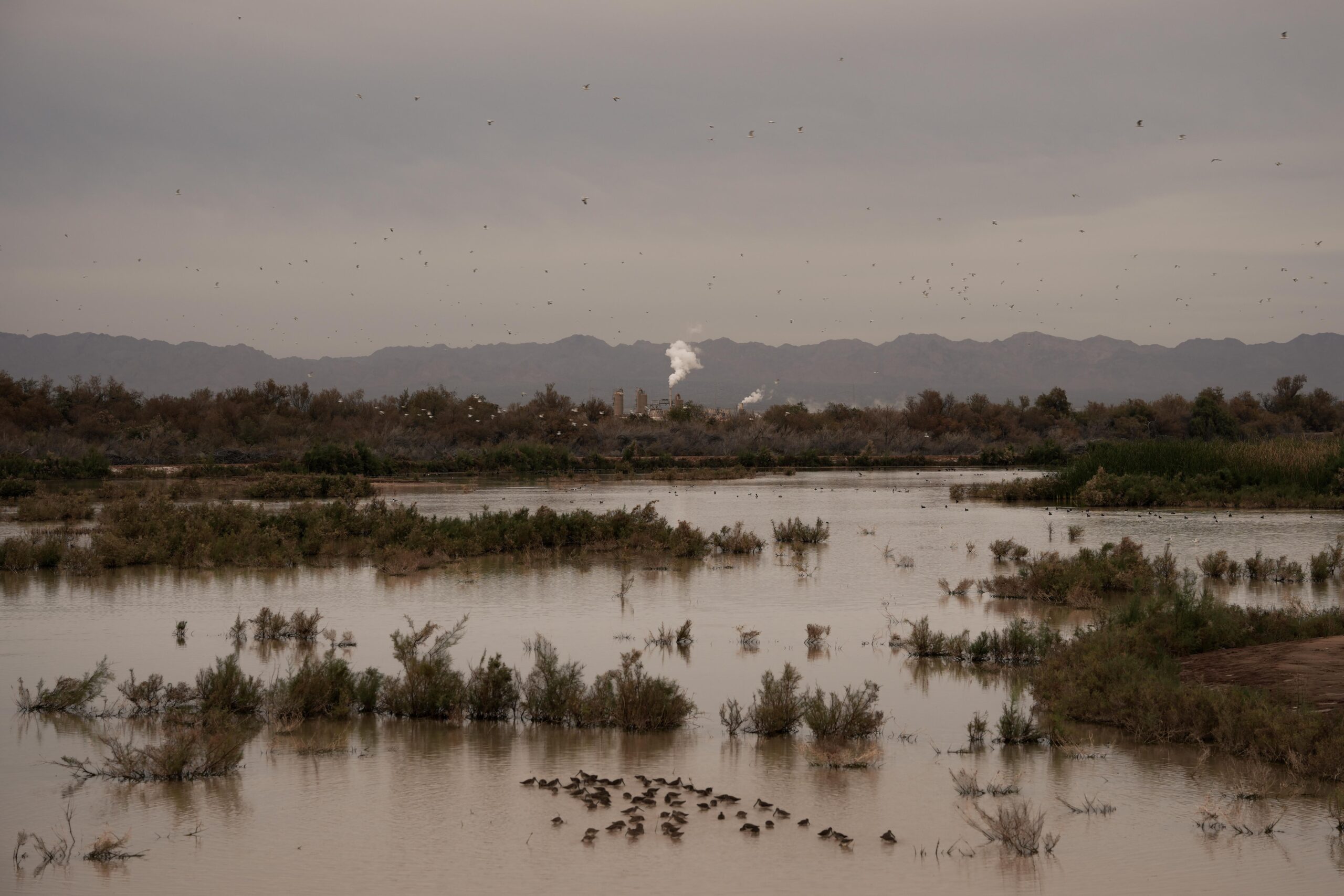
Various bird species make use of water near a power station.
The footprint of the projects outlined in the county’s plan will be more than triple the size of Manhattan, and its development will require changing the zoning of some land designated for agricultural use to commercial and industrial use. The area’s farm owners would need to agree to curtail their farming operations in order to satisfy the project’s needs, Kelley said.
Lithium extraction isn’t the only emerging industry looking to tap into the region’s water supply. On the horizon are AI data centers, which in addition to consuming large amounts of power will require their own supplies of water to operate.
Data Drain
On the border of the City of Imperial, beyond a wooden fence he built when his children were young, Francisco Leal looked out onto a barren lot of dirt and salt. The site has been empty for decades but is now the proposed location for what would be the largest AI data center in California. That’s according to Sebastian Rucci, the founder and chief executive officer of Imperial Valley Computer Manufacturing LLC, which is developing the project.
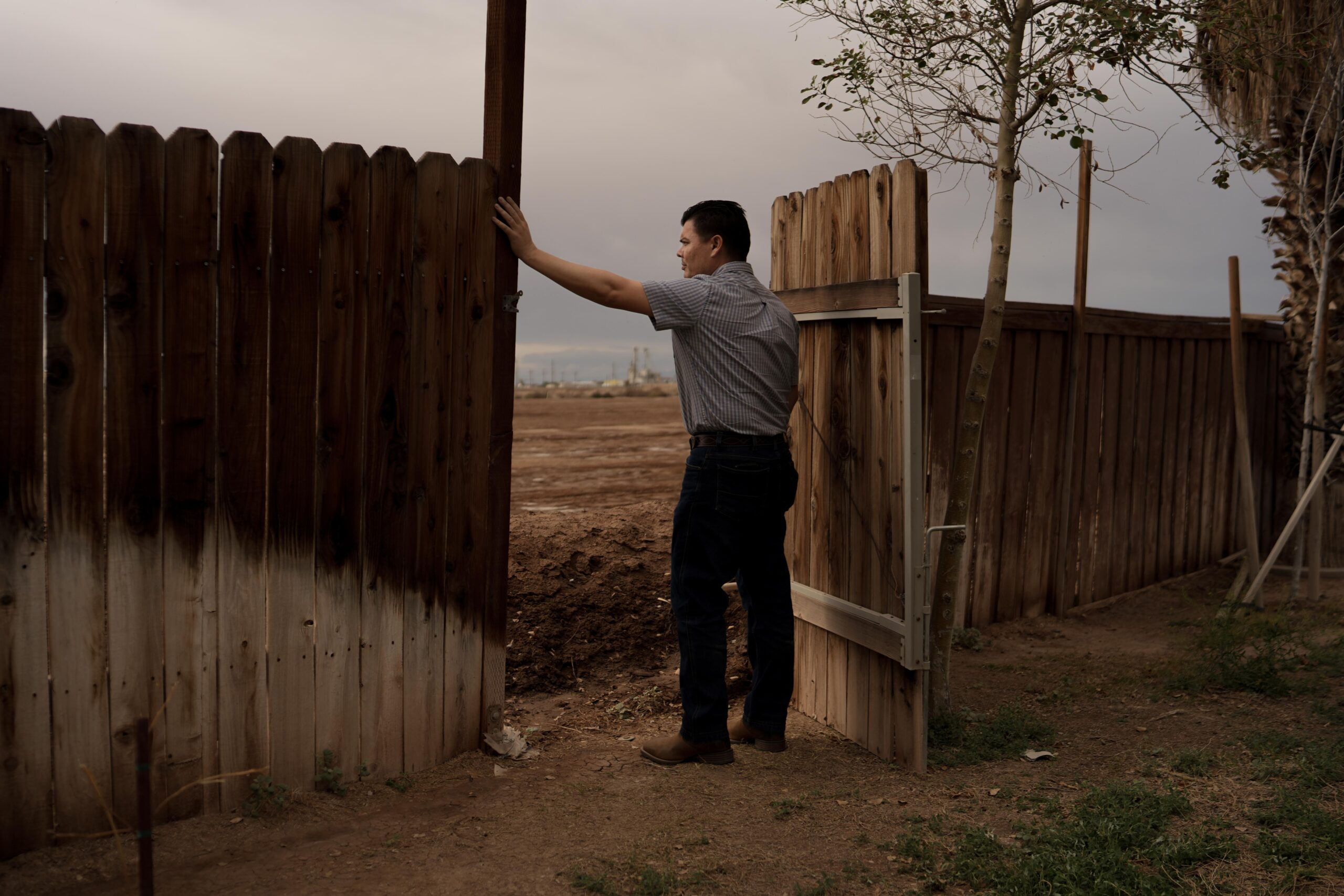
Francisco Leal leans on his backyard fence overlooking the site of a proposed AI data center near Imperial, California.
Rucci said the facility would consume 750,000 gallons each day — about as much as is used by 2,500 nearby homes. Though its expected water use is significantly less than what the area’s sprawling farms or emerging lithium and geothermal industries require, it has nevertheless become a flashpoint in the region’s larger resource struggle.
“Every year, we’re reminded to conserve, conserve, conserve water … that we’re in a drought,” Leal said. “All of a sudden it’s not a problem for an AI data center?”
Leal has become an outspoken critic of the data center, helping found the anti-development group NIMBY Imperial and joining neighbors at a recent meeting of the Imperial County Board of Supervisors in chanting “no data centers” while Rucci presented plans for his project.
In response to the kind of resource concerns leveled by Leal, Rucci said in an interview that his project would likely obtain its needed gallons from wastewater produced by the nearby cities of Imperial and El Centro instead of directly from the Colorado River.

Sebastian Rucci drinks water outside his home near Palm Springs.
But securing that wastewater has proved to be more difficult than Rucci expected. In December, the city of El Centro released a statement saying officials had not yet agreed to provide any data center developer with water.
The City of Imperial went further: In December, it sued the county, challenging its decision to exempt Rucci’s development from environmental review. The following month, Rucci sued the City of Imperial, alleging it improperly worked to block the project.
Rucci told Capital & Main that if securing wastewater from nearby cities becomes too burdensome, he may request water from Imperial Irrigation District’s industrial supply, the same water allotment being eyed by lithium extractors.
Schettler declined to comment on whether the Imperial Irrigation District would supply the data center project with water.
As emerging industries demand a growing share of Imperial County’s water supply to build batteries and to power AI, Leal has become increasingly alarmed.
“We should be using that water for our homes or growing crops, but not for machines,” Leal said.
In spite of the region’s water woes, Rucci is confident he will be able to secure the resources he needs. In fact, he told Capital & Main that he’s in the early stages of developing other data centers in the area.
The Quechans’ Living River
For centuries, the Quechan Indians have lived by the flood plains of the Colorado River between California and Arizona — what is today the site of the Fort Yuma Quechan Reservation.
Frank Venegas, the tribe’s water technician, is in charge of managing its nearly 78,000 acre-feet allotment of Colorado River water. He grew up fishing on the Colorado River with his uncles. Now, with stakeholders negotiating its future, Venegas worries what cuts could mean for his community and whether the next generation of Quechans will be able to enjoy the river as he did.
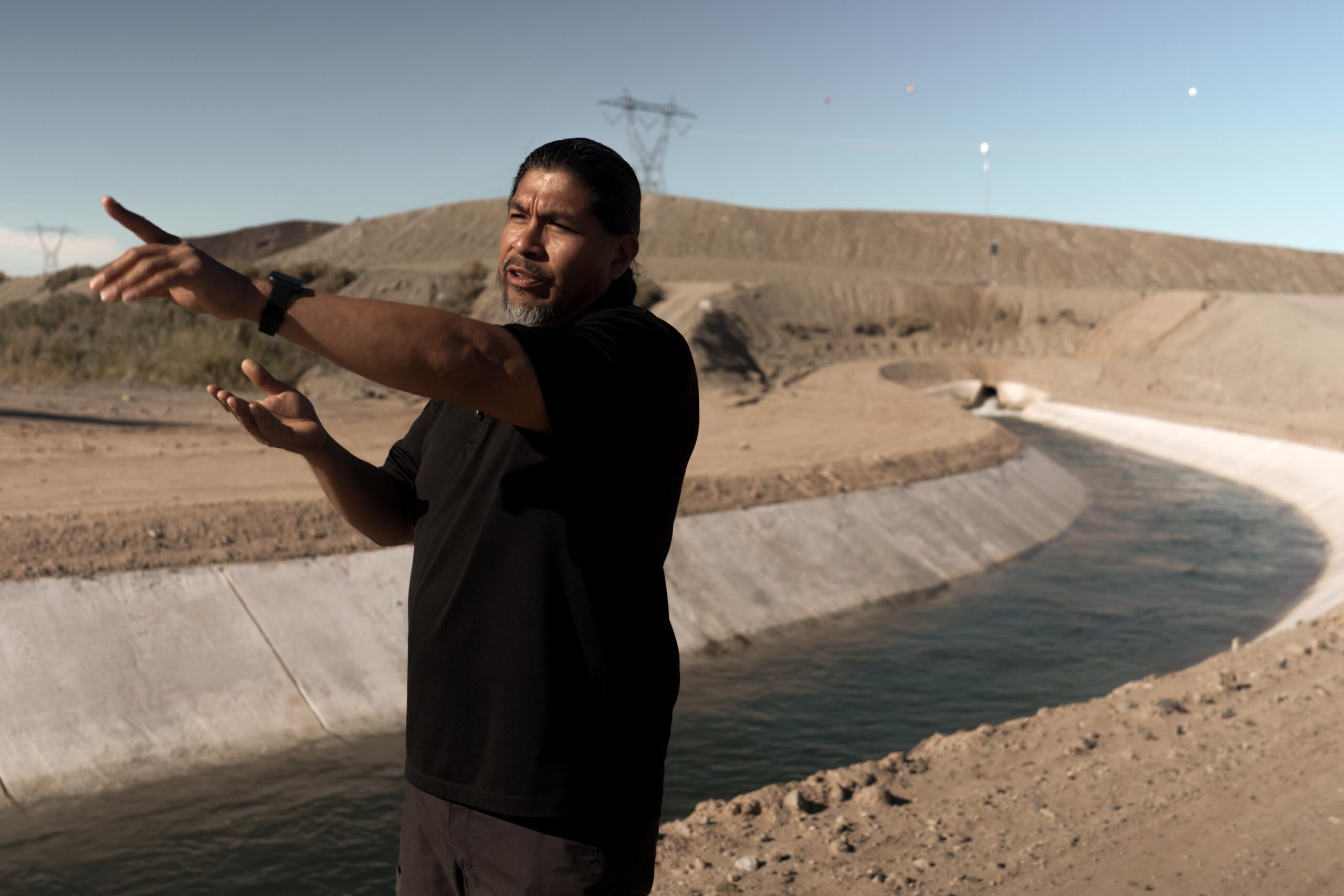
Frank Venegas stands by the main canal of the Fort Yuma Quechan Reservation.
“Agriculture is a big part of our everyday life,” Venegas said. “If we get cut in any way, there’s going to be damage; it could alter lives. That’s a major impact that this department is trying to avoid.”
As river levels have declined, the Quechan tribe has already instituted measures to cut back on water use, including a fallowing program that encourages farmers to leave fields unirrigated during the hottest months of the year.
In an effort to further improve its water efficiency, the Quechan tribe has lined some canals on its land with concrete to reduce water loss into the soil, a project estimated to conserve 800 acre-feet of water annually. But that’s less than half of the tribe’s original goal, Venegas said. Work on the project stalled after President Donald Trump froze $4 billion that was set aside by the Inflation Reduction Act to conserve the Colorado River. The still-unfinished lining project depended on those now-frozen funds.
Nevertheless, Venegas said he is still working to improve the reservation’s water efficiency, not just to maintain the viability of local farmland but also to safeguard the very identity of his tribe.
The Quechan people use plants that grow along the Colorado — including mesquite and cottonwood trees — in tribal practices that include making baskets and baby-carrying cradleboards, as well as cremation of the dead. “If we don’t have a living river, it takes away our cultural identity, literally who we are as Quechans,” Venegas said.
Venegas, like other water experts, warned that without drastic cuts, the Colorado River system that feeds Imperial County and much of the West will collapse. That would decimate downstream agriculture, paralyze industrial development and lead to mass migrations out of the region for everyone, except tribes like the Quechan who have long since learned how to live with what nature provides, Venegas said.
“Basic human needs, that’s all it’s going to come down to,” Venegas said. If the river isn’t saved, “nobody wins. That’s just the end of it.”
Copyright 2026 Capital & Main. All Photos by Jeremy Lindenfeld.
Jeremy Lindenfeld is a California Local News Fellow.
This story has been updated to clarify that this winter was the warmest on record for much of the Western United States.
An earlier version of this story incorrectly stated that Imperial Valley’s agricultural industry used 97% of Imperial Irrigation District’s annual Colorado River water entitlement of 3.1 million acre-feet. The industry uses 97% of the roughly 2.5 million acre-feet of water the district delivers to the region each year.

-

 Imperial DivideJune 3, 2026
California’s Lithium Valley Dreams Meet Reality at the Only Restaurant in Town
-

 Latest NewsJune 1, 2026
Deep Cuts to Civilian Support Staff for Families of Deployed Marines Raise Concerns
-

 Column - State of InequalityJune 4, 2026
California’s Economy Runs on Labor Trump Wants to Deport
-

 Featured VideoJune 5, 2026
At This New Mexico Park, Mountain Bikers Pedal Amid Hundreds of Oil Wells
-

 The SlickJune 10, 2026
Data Centers Are on the Ballot — This Pennsylvania Candidate Won Her Primary Keeping Them Top of Mind
-

 Latest NewsJune 9, 2026
Ousted by the Trump Administration, U.S. Immigrants Remain Locked up in African Kingdom
-

 Latest NewsJune 8, 2026
The Glacier May Be Gone, but the Love Isn’t
-
 Latest NewsJune 12, 2026
California Town Lets Private ICE Detention Centers Police Themselves