
Imperial Divide
Newsom Promised California a Lithium Bonanza. It Still Hasn’t Arrived.
Local officials blame environmentalists for long delays, but politics, technology and markets are the culprits.
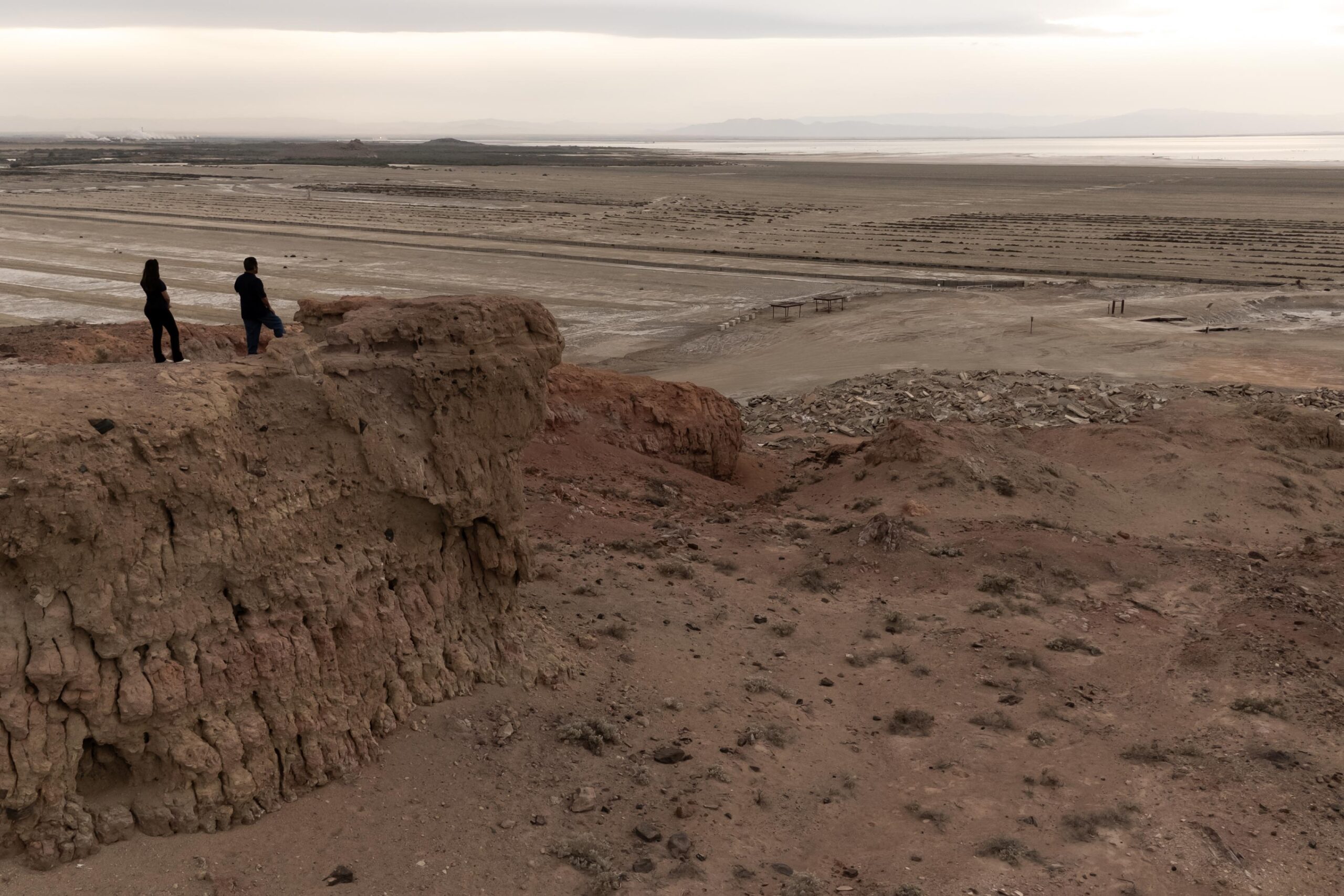

In one of California’s poorest corners, jagged rocks rise like Godzilla’s scales along a muddy lakeshore. The glassy Obsidian Butte forms the remains of an all-knowing snake called Arse-weeuv, according to the Quechan tribe, which has inhabited this land since long before colonization. When the snake burned in a ceremony, its smoke infused the mountains with ancestral knowledge.
The butte lies on the southern edge of the bluish-green Salton Sea in an expanse of thousands of acres that California wants to dot with clean energy power plants, wastewater facilities, data centers, battery factories and more. The plan would transform Imperial Valley, a sunken desert landscape bordering Mexico and Arizona where the Colorado River is drained by canals to grow vegetables for millions of Americans.
The sun-drenched valley, most of it in Imperial County, is slightly larger than Los Angeles County in square miles but has only 1.8% of its population. The communities near the Salton Sea are rural and dispersed, while towns closer to the Mexican border are bustling with storefronts and cross-border traffic. Eighty-five percent of residents are Latino, and many have deep cultural and familial ties to Mexicali across the border.
The valley is no stranger to 21st century plans that arrive with great promise but do little to benefit locals. Since 2010, solar companies have laid out massive complexes of panels, and coastal utility San Diego Gas & Electric continues to pursue battery-based electricity. Yet solar projects have collapsed or resulted in few jobs or tax dollars, while SDG&E sends the energy from its Westside Canal battery park for use outside the valley. County officials say that this time will be different and that new industries will bring residents the jobs, money and clean energy they’ve been promised for so long.
It was only three years ago, at a press conference, that state and federal lawmakers and business figures were touting the area’s great promise for extracting lithium, a mineral critical for batteries in electric cars, smartphones and industrial power systems, from volcanic layers deep in the ground.
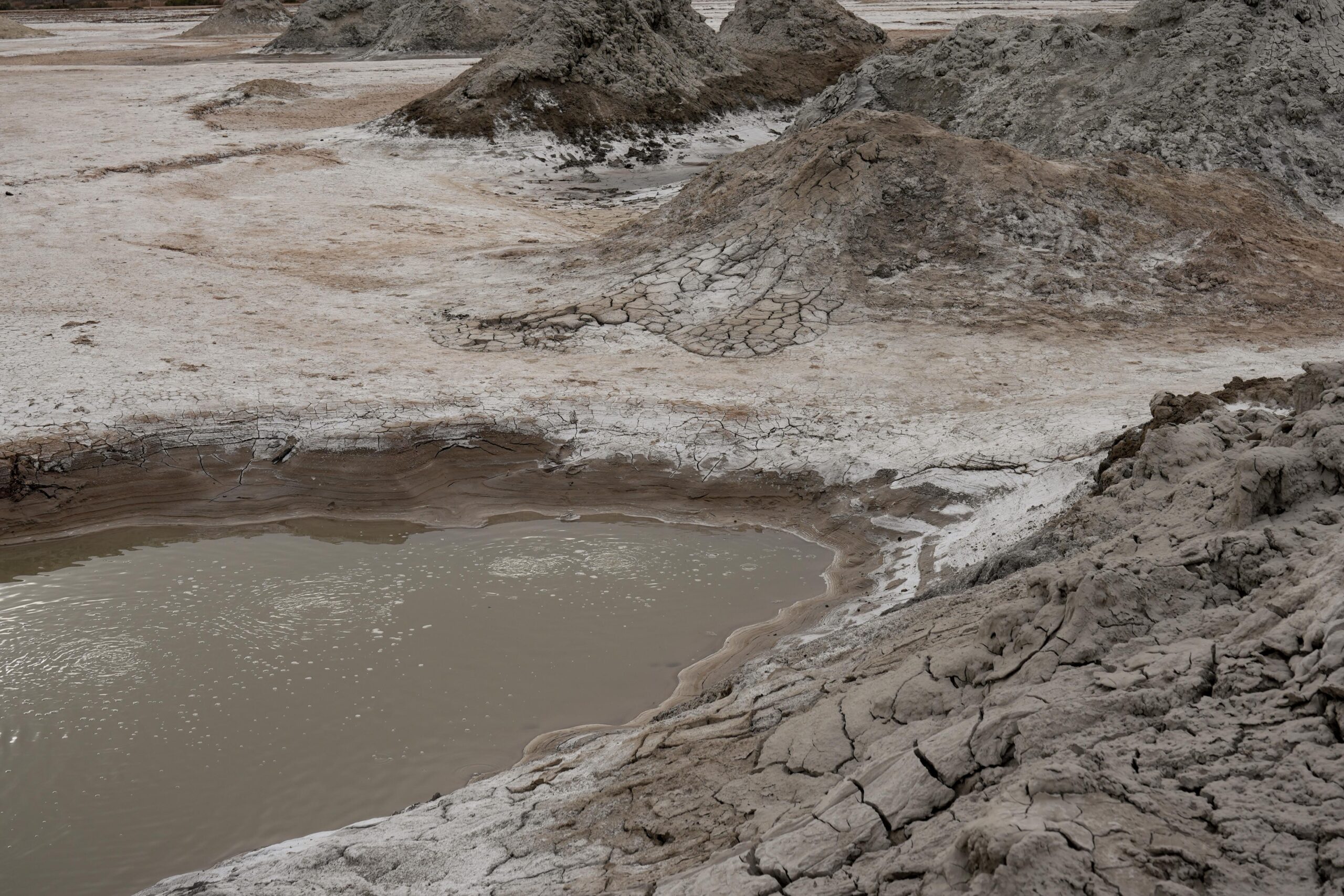
Mudpots and bubbling pools above a reservoir of geothermal brine.
Rod Colwell, an ambitious mining executive who oversees what’s known as the Hell’s Kitchen lithium project in Imperial County, told those gathered at the press event that there were enough deposits in geothermal reservoirs far below the southeast region of the Salton Sea to support batteries for millions of electric vehicles and provide jobs for 12,000 workers. Painting a dire picture of California’s climate — pinging from wet to dry extremes — Gov. Gavin Newsom boasted that the valley’s renewable energy treasures could help alleviate the climate crisis.
“I can’t make up for the last 40, 50 years,” Newsom said in a nod to unfulfilled promises to tackle poverty and unemployment among the area’s largely Latino population. “What I can do is take responsibility for the moments we’re living in.”
Today is different. Yes, there are world-changing amounts of minerals underneath “Lithium Valley.” But extracting them has proven difficult. The state-federal partnership to kickstart clean energy, forged under President Joe Biden, has been replaced by hostility between Newsom and President Donald Trump, while low lithium prices have slowed outside investment.
The lithium mining plans, which three companies are pursuing, may not be fully realized for decades and are now mired by competing visions for the future and an unclear sense of the projects’ costs. Not only did two nonprofits sue over what they believed were shoddy environmental reviews, but the county and the Imperial Irrigation District, the major utility in the region, disagree over how to supply the huge amounts of water and power necessary for lithium extraction and other industries. Hanging in the balance is a vast and thirsty farming region enduring the slow-motion devastation of climate change.
A palette of blue skies, green fields and red soils, the valley spans 30 miles from the Salton Sea down to the U.S.-Mexico border. The north has sprawling farms, yet residents in nearby Westmorland and Niland, with combined populations just over 3,000, struggle to find fresh produce. In Calexico, a border town of 40,000 with streetscapes that look like the Old West, there are few jobs apart from providing services for visitors from Mexico. Mountains trap in the foul air from crop burning and jammed vehicles, while dusty winds whip pollution across the valley.
The county is getting younger, but also tends to drive away its young. A 2022 report by a Lithium Valley Blue Ribbon Commission said the area’s poverty rate was 18.1%, while unemployment was the highest in the state and among the worst nationally.
“I was told repeatedly to get out of the valley if I want to succeed,” said Anahi Araiza, an El Centro resident and policy researcher at Imperial Valley Equity & Justice.
Beyond the farms, one of the few employers in the valley are 11 geothermal power plants, giant clusters of coiled steel that spin turbines using flashed steam from hot brine, a very salty concentration of water, pulled from a mile below ground. Most of the plants are owned by longtime operator BHE Renewables. EnergySource Minerals owns another, and the newest entrant, Controlled Thermal Resources, has none in commercial operation but hopes to eventually be a big player.
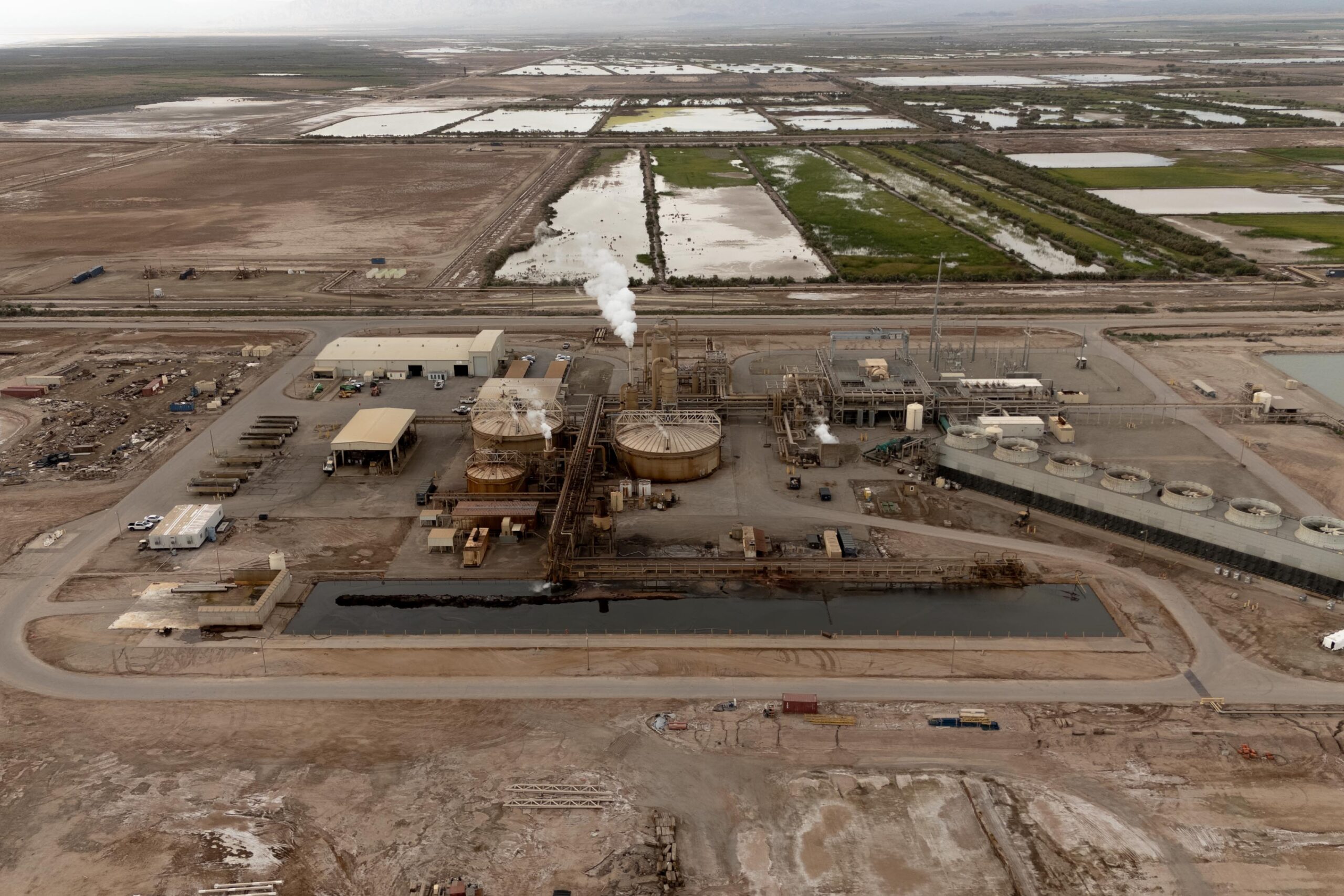
The John L. Featherstone geothermal power plant, owned by EnergySource Minerals, near the Salton Sea.
Extracting lithium from the brine, which the geothermal companies intend to do in addition to producing electricity, would accelerate the onshoring of a mineral considered vital to national security. Currently, lithium is mined outside the U.S., refined into a mineral slurry in China and purchased by battery factories, which coat thin layers of the element onto aluminum to form cathodes that produce electric currents. Imperial Valley, some believe, could be a global linchpin for this market.
Colwell, the CEO of Controlled Thermal Resources who oversees the proposed Hell’s Kitchen lithium development, has adapted his pitch to the times. He once talked up electric vehicles but now emphasizes other minerals — zinc for steel, potash for fertilizer — and loads of geothermal-based electricity to power data centers for artificial intelligence. The company has raised $285 million in private investment and said it will be publicly listed on the Nasdaq.
“Ironically it was all about lithium, and power wasn’t so much part of it. Now the big hand has caught up with the little hand,” Colwell said in an interview with Capital & Main.
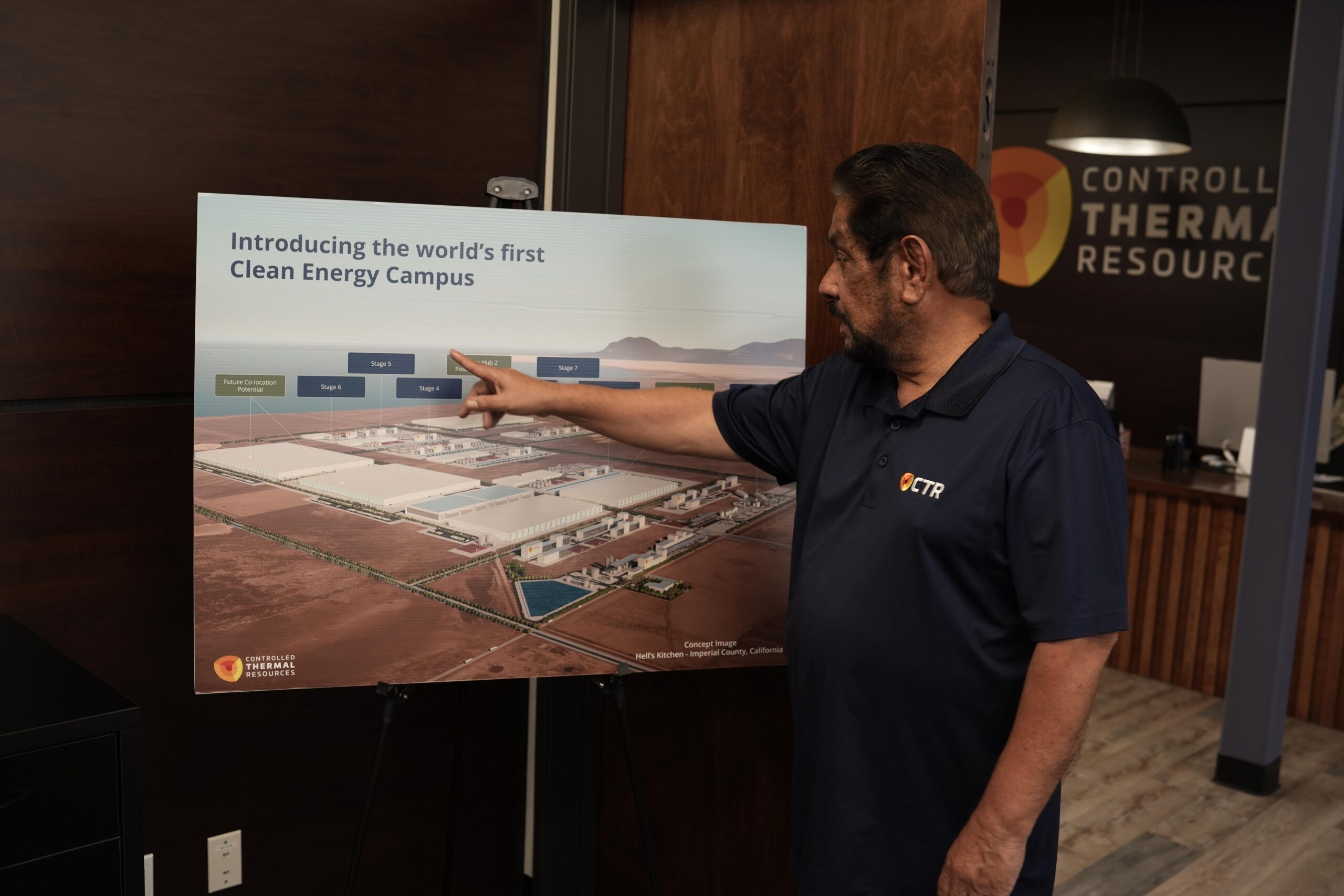
Sergio Cabanas, director of EHS and Laboratories at Controlled Thermal Resources, points to a proposed map of the Hell’s Kitchen project.
Early in Trump’s second term, the U.S. Army Corps of Engineers designated the Hell’s Kitchen project for fast-tracked permits that still haven’t been issued. Colwell hopes for direct federal investment similar to that for Lithium America’s Thacker Pass project in Nevada, which received more than $100 million after the U.S. bought a 10% combined stake in the company and its open pit mine.
Yet it remains challenging to extract lithium from brine, despite $27 million invested in research by the state. Other processes require excavating the lithium by crushing rocks in open pits or creating salt ponds by pumping brine into large sumps and letting the water evaporate, a months-long process. These are easier techniques, but they would result in the destruction of vast tracts of land and wildlife habitats. Brine extraction does not.
In the early 2020s, when lithium prices were high, car companies bet on the emerging technology. General Motors announced in 2021 that it would purchase lithium from Hell’s Kitchen, and Controlled Thermal Resources received an undisclosed amount of funds from the automaker that were “integral to advancing the project,” said spokesperson Lauren Rose.
In 2025 President Trump reduced a manufacturing tax credit for green technologies, one of many efforts to disrupt the expansion of renewable energy. Republicans also killed a tax credit for electric vehicles and targeted federal and state rules encouraging their use. Perhaps as a result, General Motors and other U.S. automakers are pivoting to making large batteries to store and supply energy for electric grids as they lose billions on EV investments.
But lithium demand alone cannot solve the problem of harvesting it. BHE Renewables built a pilot plant in Calipatria near the Salton Sea, only for dissolved solids in the brine to gunk up the equipment meant to filter out the lithium. It is preparing for a new demonstration, but “there’s no guarantee that the commercial phase of the project will move forward,” said Christina Fleming, BHE Renewables’ vice president of mineral development. And, so far, Controlled Thermal Resources’ Hell’s Kitchen has captured only small amounts of lithium.
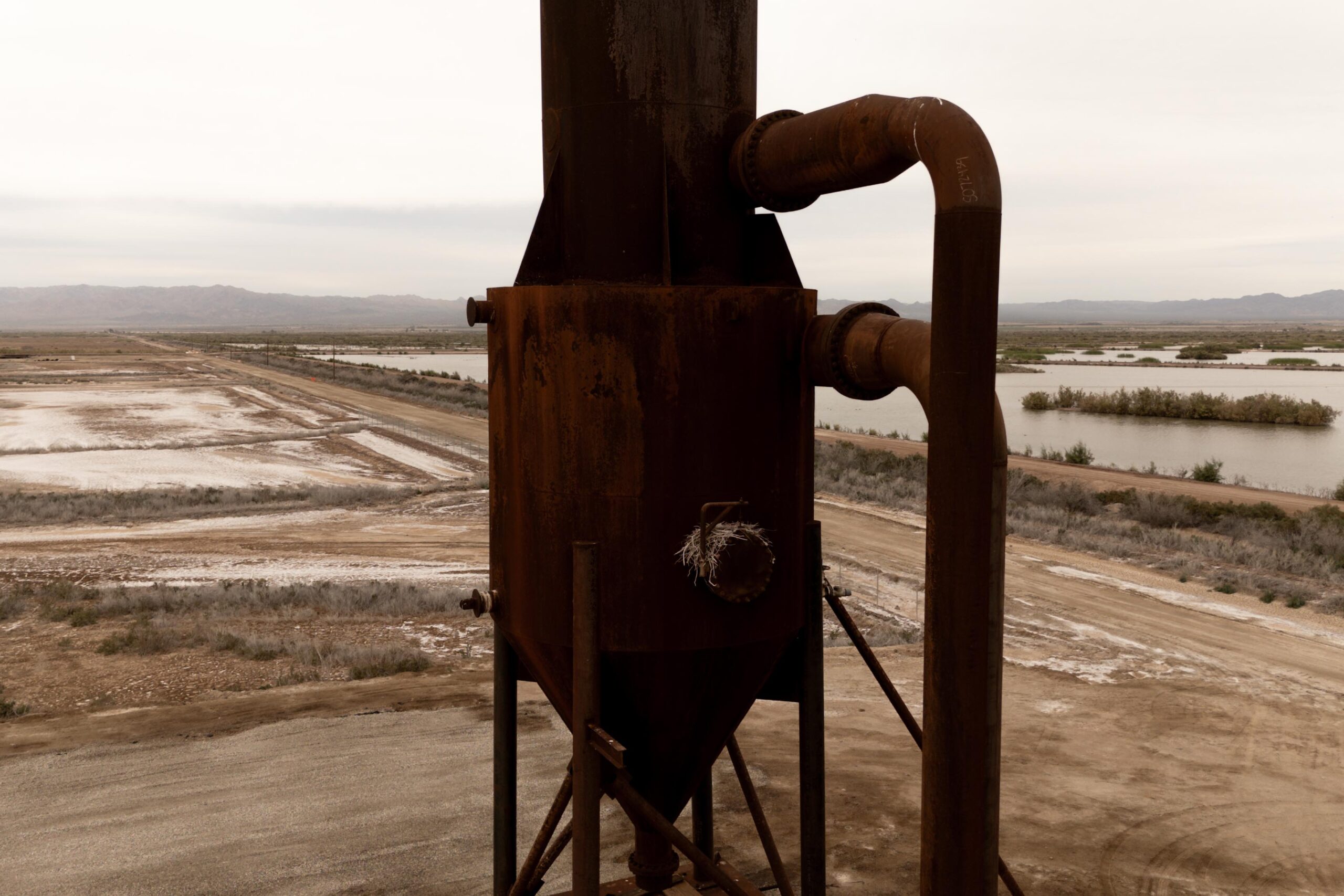
Hell’s Kitchen geothermal well near the Salton Sea.
The plans could also raise local tensions. According to a county analysis, thousands of acres of farmland might need to be abandoned to make room for data centers, battery makers and more geothermal plants, as well as required infrastructure such as roads and substations. Yet the Imperial Irrigation District, which supplies water to farms and residents, warned that the power and water needs of those industries “would so significantly change” its system that detailed planning was impossible.
Most concerning for residents is that the plan could result in dirtier air. Nearly a third of the water for farms in the Lithium Valley region ends up as runoff for the Salton Sea, so less agriculture would result in its shrinking — exposing more dusty lake bed. A study by researchers at USC and UC Irvine found children’s lungs were weaker on days when levels of PM2.5 and PM10 — two airborne pollutants that can trigger respiratory problems — were highest at the lake.
It’s just another way the community will be sacrificed for private gain, said Araiza, the El Centro policy researcher. Still, few outright oppose development. “We want a slow and methodical process to ensure that things are done well,” Araiza said.
The county blamed the slow rollout of lithium mining on environmentalists after two groups, Earthworks and Comite Civico del Valle, filed a lawsuit over what they said was a “deeply flawed” environmental review. In the suit the two groups claimed the county excluded potential pollution sources, overlooked health risks and glossed over difficulties of getting water as the Colorado River continues to shrink.
“The big cumulative impact we’re concerned about is how water consumption will impact the Salton Sea” and result in more dust, said Jared Naimark of Earthworks. There would also be pre-approved permits for other industries, such as dairy farms capturing manure methane using digesters — a polluting, water-intensive technology.
Residents such as Araiza voice other concerns. A county analysis released in December, which is newer than the one subject to the litigation, recommends cursory reviews for data centers up to 1.3 million square feet — much larger than one proposed in the small town of Imperial that has angered residents — and paving over landscapes important to both the Quechan and Kwaaymii tribes.
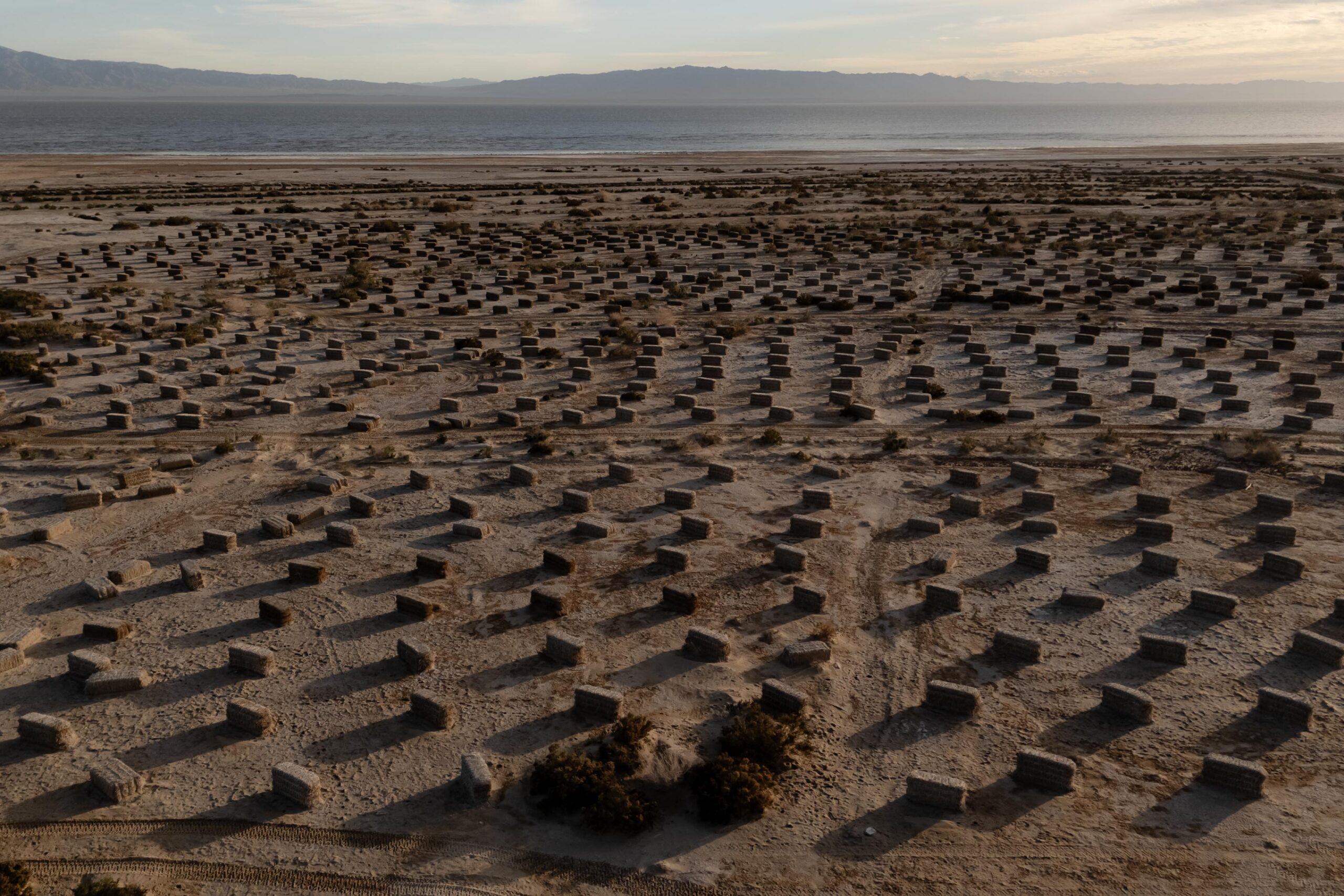
Hay bales dot the exposed Salton Sea lakebed to suppress toxic dust from becoming airborne.
The county and Controlled Thermal Resources, which is also party to the lawsuit over its proposed Hell’s Kitchen complex, claim the real issue is money. Earthworks and Comite Civico del Valle want Controlled Thermal Resources to pay an annual $2.75 million fee tied to its water consumption, with details worked out by a joint power authority overseen by “directly affected communities.”
The money would go to the newly created authority, not the nonprofits. Still, critics have called it “extortion.” Colwell went further, telling Capital & Main that the groups are “parasites” trying to stop development. Luis Olmedo, executive director of Comite Civico del Valle, wrote in an op-ed that such labels misrepresent community benefit agreements.
Since the court has not issued an injunction, there is no evidence the lawsuit has halted progress. Neither BHE Renewables nor Controlled Thermal Resources have lined up financing; EnergySource Minerals, another company developing lithium, didn’t respond to inquiries from Capital & Main. None has begun commercially extracting lithium, though the county contends they could have started work last year.
When they do, California has readied an excise tax per ton of produced lithium to fund health, child and transportation services, among others, and Salton Sea dust suppression. Newsom’s proposed budget this year originally included $26 million in expected revenues from the tax. It will now show zero after Capital & Main inquired. Past budgets were also revised as production timelines were delayed, said H.D. Palmer, a spokesperson for the state Department of Finance.
It could take a decade or two for the lithium to start flowing, said Fleming, the BHE Renewables vice president. Just obtaining the correct pipes and extractors can take years, she said. Aligning technology and financing and building up a workforce also takes time, said Celina Mikolajczak, a battery engineer formerly with Tesla and Panasonic. Although San Diego State University opened a science campus in Brawley, graduating students will not find local lithium jobs any time soon.
Battery manufacturing, which the county hopes to entice, requires years of on-site training to perfect precise and very fast techniques, Mikolajczak said. Up to 4,316 high-wage, blue-collar jobs can be generated if a battery supply chain opens up, according to a UC San Diego and Comite Civico del Valle report. Done correctly, California could eventually “put the U.S. into a powerful position while developing an underserved region,” Mikolajczak said.
Tribes including the Kwaaymii Laguna Band of Indians have applied to designate parts of the Salton Sea shore as a historic district (to the county’s ire). With the land’s mudpots and volcanic domes, the Kwaaymii say the area’s hissing eruptions offer a glimpse of the Earth’s heartbeat. Now many hope it will be the heart of a new era for Imperial Valley — if the stars align.
Copyright 2026 Capital & Main.
All photos by Jeremy Lindenfeld.


-
 Imperial DivideJune 3, 2026
California’s Lithium Valley Dreams Meet Reality at the Only Restaurant in Town
-

 Latest NewsJune 1, 2026
Deep Cuts to Civilian Support Staff for Families of Deployed Marines Raise Concerns
-

 Column - State of InequalityJune 4, 2026
California’s Economy Runs on Labor Trump Wants to Deport
-
 Featured VideoJune 5, 2026
At This New Mexico Park, Mountain Bikers Pedal Amid Hundreds of Oil Wells
-

 Latest NewsJune 9, 2026
Ousted by the Trump Administration, U.S. Immigrants Remain Locked up in African Kingdom
-
 The SlickJune 10, 2026
Data Centers Are on the Ballot — This Pennsylvania Candidate Won Her Primary Keeping Them Top of Mind
-

 Latest NewsJune 8, 2026
The Glacier May Be Gone, but the Love Isn’t
-
 Latest NewsJune 12, 2026
California Town Lets Private ICE Detention Centers Police Themselves