
Latest News
Oakland Housing Crisis: Will City Leaders Listen to Their Homeless Community?
Oakland’s homeless groups and local government are struggling to find common ground. The process has not been easy.


By Ariel Boone
Editor’s note: This article is co-published by Capital & Main and Community Based News Room (CBNR). It is part of “The Right to a Home,” a CBNR series that examines homelessness issues across the United States. CBNR, which partnered on the story with Street Spirit, a street media paper in Berkeley, California, is a project of Law@the Margins. This eight-part series is supported by a Solutions Journalism Network grant.
OAKLAND, California — Needa Bee says it was her idea to build the tiny houses.
Three years ago, Bee was “one precarious situation away” from losing her housing again. She had been homeless before, when she was pregnant with her daughter, and she was paying $1,000 per month for half of a basement — “an illegal unit with no ventilation that flooded and had black mold everywhere,” she recalls.
Then one night, she huddled around a car with fellow activists after distributing food in encampments in Oakland. It was the coldest part of the year.

An Oakland tiny home. (Photo: Ariel Boone)
“Our friends were either in the hospital or sick with pneumonia,” Bee, 48, remembers. “It was so cold, and our people were suffering or sick. And I said, ‘F— it. Let’s build folks housing. No, really. We gotta just take some land and build houses.’”
That conversation between shivering housing advocates took place in December 2016. One month later, the week of Donald Trump’s inauguration, the activist group called The Village took over a portion of a city park to build autonomous housing and start a community.
Bee, whose legal name is Anita De Asis Miralle, is the lead organizer for The Village. She had been following the “tiny home” fad, and knew that Bay Area homeowners were building accessory dwelling units (also known as in-law units, or granny flats), on their properties. She knew small units could be useful for unhoused people. But she was stumped on how to build them: “I know how to build Ikea furniture, and even that’s a challenge for me sometimes.”
Then an activist named Io, from the group Asians 4 Black Lives, stepped in and offered construction expertise to The Village. Things moved quickly. The structures were built in a backyard, with reused wood and insulation from newspaper and old clothes. By the time The Village moved into Grove Shafter Park — known to many locals as Marcus Garvey Park — they had built three frames for houses. An RV moved in, and a camper, and several tents.
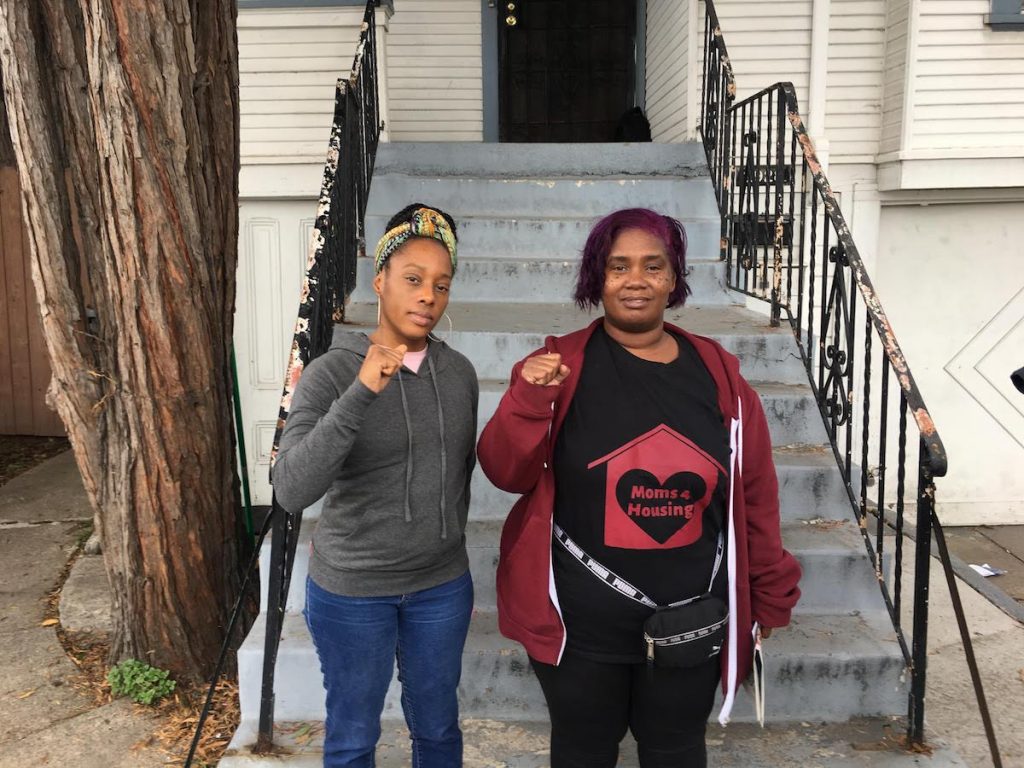
Moms 4 Housing co-founders Dominique Walker, left, and Sharena Thomas. (Photo: Ariel Boone)
“For people who needed safety and sanctuary, for people who didn’t feel safe in an encampment or by themselves, 13 folks moved there together,” says Needa, who is homeless again today after losing her housing in an eviction, and now lives in a camper with her family. “In the end, we had six houses, and two more on the way. The response from the community was amazing. We really ran this thing on EBT [electronic benefit transfer] cards and Home Depot cards.”
They built a shared kitchen and had a supply distribution system, where residents could leave and take items they needed. Village volunteers also combed the park for trash and removed weeds. “We cleaned out the drainage system,” says Bee.”We cleaned out the sewage system.”
Then, on Thursday, Feb. 2, 2017, Oakland’s Public Works Department arrived and carried out orders to tear it all down.
‘Tuff Sheds’ vs. Self-Governed Communities
The homeless community in Oakland and local government are struggling to find common ground. “I’ve been very clear about my approach to homelessness,” Oakland Mayor Libby Schaaf told CBS affiliate station KPIX 5 in June. “It is compassionate and it is effective, but it is not lenient or the wild west.”
Under Schaaf’s policies, Oakland’s Public Works Department has carried out 133 work orders to close or evict encampments in Oakland so far in 2019.
Since 2017, the number of unhoused people overall in Oakland has spiked by 47 percent, according to the annual Point-in-Time count performed on a single day each January. In Alameda County, where Oakland is located, homelessness has increased by 100 percent since 2015. At least 4,071 people are unhoused, a number advocates say is inaccurately low, and at least 127 encampments of two or more tents, RVs or structures are across the city, according to a recent survey by Street Spirit editor Alastair Boone.
The city of Oakland allocated $40 million toward homelessness services in fiscal years 2017-2018 and 2018-2019. A public records request showed it spent over $1 million between 2018 and 2019 on evictions and so-called “clean and clear” operations at over 200 encampment locations. The city’s Encampment Management Policy describes “clean and clears” as “temporarily moving an encampment so that the location can be cleaned to resolve health and hygiene issues and then allowing the encampment residents to return.” But encampment residents say their tents and belongings are often hauled away, too — and that many of these operations leave them without shelter. Once evicted, they must decide whether to wait and return, or move to another curbside location in the city.
Schaaf’s signature program to address homelessness involves small, prefabricated structures that the city calls “community cabins,” but they are more commonly known as “Tuff Sheds” — named after the company that manufactures many of the sheds.
Tuff Sheds are a product marketed to the public as outdoor garden storage, but the city purchased them with private donations to serve as emergency shelter for humans starting in December 2017. They have no electricity, plumbing or heating. The sites have port-a-potties and contract with a nonprofit to provide weekly mobile shower trucks. Currently, five Tuff Shed sites operate in the city. On the lots where they’re located, some under looming freeway overpasses, the austere shells of the garden sheds are lined up like barracks, on bare pavement, surrounded by chain-link fence. The interiors of the sheds are metallic and industrial, with bare wood beams.
Since city officials have embraced Tuff Sheds as a solution to homelessnes, encampment evictions in Oakland have skyrocketed. In the second half of 2018, the city conducted an average of six encampment closures per month. In 2019, that monthly average doubled, with a high of 20 closures in April.
While Tuff Sheds have worked for some, the homeless community has been vocal about the reasons why they are a poor fit for many. No children are allowed to live in the Tuff Sheds, and residents are expelled for altercations or drug use. Each has a locked gate at all hours, and the media is denied entry. Residents are paired with a roommate — often a stranger — in a space that is 10 feet deep by 12 feet long.
In late January 2019, Oakland’s assistant city administrator Joe DeVries declared the first Tuff Shed site a victory after just one year, claiming that 76 percent of its 74 residents had exited the site into permanent or transitional housing. But journalists are challenging the city’s early optimism about the program.
A public records request revealed that of the 338 people served by Tuff Sheds between 2017 and July 2019, 237 have exited the program. Of those who have exited, 21 percent ended up in places unsuited for human habitation — cars, RVs, abandoned houses, tents on the street. Just 51 percent of people who have left the Tuff Sheds were headed toward “positive housing destinations.” Some of those who exited to rental housing had to move far away from Oakland. And five people who exited the Tuff Sheds were sent to jail or prison.
Homeless advocates say that the pace of evictions and the creation of the Tuff Sheds encampments is part of a plan to make unhoused people more invisible and quickly clear the streets of encampments.
Oakland claims its policy is to avoid closing encampments and impounding RVs unless the city can offer a parking site or a place to sleep. But unhoused residents say the city’s claim isn’t true — and that living in the Tuff Sheds is no choice at all.
Homeless Communities Can Help Themselves
On a December night, as the sun set and the temperature plummeted in East Oakland, a volunteer named Paul continued working by flashlight, putting the finishing touches on a door and a locking deadbolt on a new 8-by-12-foot home for a 61-year-old unhoused Oakland man named Eric DeGuzman, while cars zoomed by. The new home stands next to a tree and a busy road, in the middle of an encampment.
Paul showed off the space, which he has been building for three weeks. It had two windows and a door, and Paul planned to build a loft so DeGuzman would have more storage space. Many of the materials, like walls and beams, came from donations of Home Depot gift cards. But the windows were a special find from a salvage store in Berkeley. This is at least the ninth home Paul has helped build for The Village.
DeGuzman pulled up on his bicycle and checked out Paul’s handiwork. He stepped inside and put his thumbs and forefingers up, framing a view of the inner wall of his new home. “The tennis courts go over here,” he joked.
Tiny homes are often a part of encampments. They exist within them and give people a chance to sleep safely and secure their possessions.
Those who have experienced homelessness say there’s no comparison between Tuff Sheds and the homes The Village is building. “This is far more beautiful,” said DeGuzman, who had been sleeping in his new sanctuary for three nights. “This is more livable, more comfortable.”
One of DeGuzman’s neighbors, a man named Hassan, says he has lived on this stretch of land through four city evictions.
Paul would like to see the city come pick up the trash. “Give us human necessities like showers,” DeGuzman adds. Whatever the request, the message is clear: Give more to, don’t take away from, the people living here.
An outsider might not be able to tell the difference between a Tuff Shed and a tiny home. But The Village builds its guerrilla housing with its occupants in mind, including one model for people who have survived violence or incarceration. Bee calls it “crisis-informed housing.” She remembers explaining to students at Laney College, who were assisting with construction, why a tiny home would need more windows and doors. “The reason we created two doors was for it not to feel like a jail cell,” she explains. “And if you’re out there, you don’t want to feel cornered.”
“The city needs to leave us alone,” suggests DeGuzman, who knows that the city could threaten the demolition of his home at any time.
Members of The Village fight for housing rights, attempt to stop evictions and deliver public comment at city council meetings. The group also wants to see the city stop demolishing and policing encampments, start providing crucial sanitation and health services, and allow community members to maintain self-governed encampments, including ones with tiny homes.
“The city could never do what we do, because we don’t just build shelter,” Bee says. “We build community.”
Volunteers find great purpose in their work with The Village. Ayat, a private carpenter who was born to Black Panther parents in San Francisco, is a 46-year-old father of six and currently unhoused in Oakland. He has struggled with mental health issues and does carpentry as a volunteer for The Village. “It keeps me going,” Ayat says. “[It] gives me a sense of being part of something.”
Bee remains protective of The Village’s future plans for rebellious housing — especially since the city has torn down 70 percent of the homes The Village has erected. But while reporting this story, at least one more tiny home went up. Some people have moved their tiny homes from one encampment to another using forklifts, to escape demolition. Bee estimates The Village has built 23 tiny homes since January 2017, and roughly seven are still standing.
Bee is the lead plaintiff in Miralle vs. The City of Oakland, an ongoing lawsuit that claims the city’s eviction and demolition of a housing justice encampment in October 2018 was illegal. The encampment was called the “Housing and Dignity Village,” erected in Deep East Oakland in October 2018 and demolished six weeks later. This “Housing and Dignity Village” was created by activists with The Village and the East Oakland Collective to denounce the city’s inaction on human rights for unsheltered people.
She is outraged that the city is so resistant to allowing unhoused people to run their own, self-governed communities. Attempts to build tiny homes continue to be met with bulldozers. “There are so many different ways that the mayor and [assistant city administrator] Joe DeVries could have directed and allowed the encampment management team to address the entire approach of homelessness,” she says, “from tents to self-built homes, to Village homes, to use of public land.”
At the time of publication, the city was not immediately available for comment.
Instead of investing in self-governance, the city developed the Tuff Shed program.
“You’re telling us you had multiple millions of dollars and took our idea and made it worse?”
A New Councilmember Promises Progress
Nikki Fortunato Bas was elected in 2018 to represent Oakland’s City Council District 2, unseating an incumbent on a progressive platform of advocating for affordable housing and tenant protections, and for police accountability and racial justice. In May, Bas introduced a plan to reform Oakland’s encampment management process. The council later approved it, and her actions have won over some homeless justice activists in the city.
Bas has vociferously backed several major policy changes, from homelessness prevention, to identifying vacant land and buildings for sanctioned encampments where the city won’t conduct evictions, to eliminating California’s rent-control-killing Costa-Hawkins Act and working with the Oakland Community Land Trust to assist renters in Oakland with buying their homes, to avoid displacement.
She pushed for the city to audit its encampment policies. She says closing encampments should be a “last resort,” and she calls for a moratorium on encampment evictions during extreme weather events like rain, and smoke from wildfires. She has called for the city to assess the cost of providing basic services to all encampments, including showers, drinking water, toilets, trash pickup, needle collection and fire extinguishers. She successfully pushed for a new policy that has eviction and “clean and clear” notices posted in multiple languages.
At a recent city council meeting where elected officials and the public sparred over Oakland’s five-year plan to address homelessness, Bas called the plan not ambitious enough because it aims for a homeless population of 3,000 by 2021.
“We need to set a goal that’s about ending homelessness,” Bas said. “Unless we actually set the goal to be high and aspirational, we’re not going to actually do the work trying to meet that goal.”
Bas commissioned an Oakland policy and planning organization, Just Cities, to draw up a memo that reviewed the city’s plan. Just Cities recommended three programs that are reducing and preventing homelessness in other cities. The first is having one unified collaborative in a city, of government and service providers, to all tackle homelessness together. Second, Just Cities suggests creating a permanent housing subsidy program to address the gap between income and housing. Third is implementing homelessness prevention strategies like landlord/tenant mediation and eviction protections.
Bas also wants the city to clarify which types of structures are allowable. She calls for greater “clarity” on building codes and fire codes, to protect residents and avoid the demolition of tiny homes like the ones built by The Village. And she is crystal clear on another thing: The city must focus on building affordable housing at 0 percent-20 percent of the area median income (AMI), and it has an immediate responsibility to house people for several years while the city invests in that new housing.
“We have to use vacant land or buildings for longer-term, meaning three to five years, transitional housing,” Bas says. “That could include sanctioned encampments, co-governed encampments. It could be tiny homes that the Youth Employment Partnership, or The Village, or some other organization build with solar power, so that there’s electricity, there’s a shared kitchen, there’s an actual bathroom with showers. Because it’s been something that the city has talked about for many years and it has not yet come to fruition. I don’t know how much of the rest of the other parts of the city agree with that.”
All of the city’s leaders must be committed to ending this crisis, Bas adds, in order to build the public will to make radical changes and end homelessness. “What we’ve got right now isn’t doing enough to help those people. So I am frustrated that [using vacant land] has not yet happened, even though it’s something the city’s been talking about for years.”
As the Housing Shortage Persists, the Community Keeps Building
East Bay residents are busy housing themselves while conditions worsen and policy change is slow to implementation. The Village isn’t the only group embracing micro housing. Other community groups have started to build tiny homes as well.
Berkeley-based nonprofit Youth Spirit Artworks (YSA), Street Spirit’s publisher, is currently building the first-in-the-U.S. village of tiny homes for homeless youth. This project has prioritized unhoused youth throughout the planning process, from designing the layout of the space and writing community agreements to building the tiny homes themselves. Once finished, a total of 26 homes will be available for homeless young people and their resident assistants. The proposed move-in date is July 2020.
Elsewhere in the East Bay, unhoused people are taking direct action, and it’s reaching a fever pitch.
Just before Thanksgiving, a group of moms and children took over a vacant investor-owned house in West Oakland on Magnolia Street. They’re calling it “Mom’s House,” and they are cofounders of the new group Moms 4 Housing, created in November 2019 to demand safe and affordable housing for moms and children.
Moms 4 Housing is now fighting an eviction notice from Wedgewood Properties, the investor that kept the West Oakland house where they reside empty for 18 months. Wedgewood describes itself as a “leading acquirer of distressed residential real estate,” which, homeless advocates say, is central to the housing crisis in Oakland. Moms 4 Housing points out that there are nearly four times as many vacant units in Oakland as there are unhoused people — or about 15,571 vacancies. At a recent city council meeting, Walker addressed the council members, calling for the city to house homeless mothers and children in the vacant properties it can identify.
“Our goal is to reclaim vacant properties owned by speculators [and put them] back into the hands of the community,” Moms 4 Housing co-founder Dominique Walker explains. “Housing is a human right. Everybody deserves the right to shelter.”
“We want to see a change. Shacks are not a solution,” she said, referencing Tuff Sheds. “People deserve housing. And our organization is going to fight until we all have housing. Whether y’all do something or not, we’re here and we’re fighting.”
Walker has said her youngest child took their first steps, and spoke their first words, in the house that the moms have reclaimed in West Oakland.
Just one mile away, a young woman named Stefani Echeverría-Fenn oversees the 37 MLK encampment, which is on fenced-off, city-owned land. A large sign outside acknowledges that it is stolen Ohlone land, and signs inside name the encampment’s pathways for Sylvia Rivera and Marsha P. Johnson, pioneering transgender activists dedicated to helping queer homeless youth. Echeverría-Fenn founded this encampment for longtime residents of her neighborhood, especially black women, who have been displaced and now face homelessness.
“Our lot can’t hold all the people that want to stay there,” Echeverría-Fenn says of the impressive space, which has chickens, and fruit trees, and sit-down toilets, and trust between residents. “It’s proof that our project is a success, but also that our project is not enough.”
She would like to receive structures like Tuff Sheds from the city, because the harsh rains this year create issues for tents. But the last thing she wants is a city takeover. “Anything not run by homeless people is not going to be responsive.”
What Echeverría-Fenn wants is simple.
“If I could get anything from the city tomorrow, I would love to be granted that land and Tuff Sheds,” she shares. “But instead of being run by outsiders, run by our community of homeless and precariously housed people.”
Ariel Boone is a freelance journalist and reporter for KPFA News in Oakland, California. She previously worked at Democracy Now! in New York.


-

 Column - State of InequalityMay 21, 2026
In California Governor’s Race, Xavier Becerra Walks Away From Single-Payer
-

 Latest NewsMay 22, 2026
Where California’s Gubernatorial Candidates Stand on Climate and Taking Big Oil Money
-

 The SlickMay 20, 2026
70-Foot Wastewater Geyser Reflects New Mexico’s Latest Oilfield Challenge
-

 The SlickMay 29, 2026
Feds to Open Tens of Thousands of Acres of Colorado Wilderness to Oil Drilling
-

 Latest NewsMay 18, 2026
Budget Cuts Threaten Program That Doubles Food Dollars for Californians in Need
-

 Deadly Dust: The Silicosis EpidemicMay 27, 2026
California Moves to Ban Quartz Countertop Fabrication to Combat Silicosis Epidemic
-

 Latest NewsMay 26, 2026
Conditions at California ICE Detention Centers Are Getting Worse, Inspections Find
-
 Imperial DivideJune 3, 2026
California’s Lithium Valley Dreams Meet Reality at the Only Restaurant in Town