Labor & Economy
Why 2012 Was the One Percent’s Favorite Year Since 1928

Are our rich content? It’s a question that bounces back and forth in the blogosphere. Are elites, economic and otherwise, happy with the pace of the weak recovery? Are they indifferent? Or are they actively worse off than they would be if unemployment were lower?
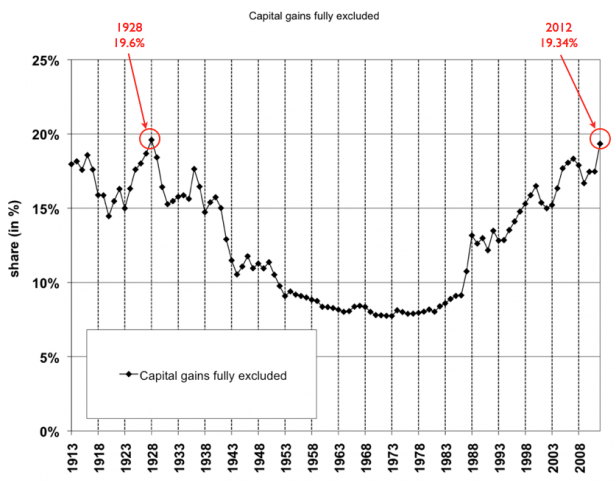
This question comes up when Emmanuel Saez updates his data on the incomes of the top one percent. Most of the coverage has focused on the rate of change for incomes of the top one percent, particularly the fact that the top one percent have enjoyed 95 percent of all income growth from 2009 to 2012. But I want to focus on levels. I’m going to modify one of Saez’s charts to show something I don’t think has been pointed out:
This is the percentage of all income, excluding capital gains, that goes to the top one percent. And as you can see, it’s not just back where it was before the recession; it’s far exceeded that benchmark. And it’s exceeded all the years on record, with the one exception of 1928.
Over the past 20 years, this percentage dropped after each recession. If you look, you can see it drop in the early 1990s and 2000s. However, it then recovered and exceeded the old rates.
We saw this rate fall in the Great Recession. The obvious question was whether this would be a permanent break or whether it would recover and exceed the old rate. That question is now answered. As noted, the only year on record in which the top one percent took home a larger piece of the economic pie was in 1928, and then only barely.
This excludes volatile capital income, in part to see a cleaner trend and in part because tax changes from the fiscal cliff and Obamacare probably influenced the 2012 results. But the trend is nearly the same with capital gains, where this year’s 22.4 percent share for the top one percent is closing in on 2007’s 23.5 percent share (and 1928’s record high 23.9 percent). This pattern is also true when using average incomes.
But this one chart is something I’ve particularly watched during the Great Recession. Because you could, at one point, say that the rich had taken a huge fall in the Great Recession, and therefore it was in everyone’s interest to get the economy back on track. That is harder to say today, and it will be harder to say next year as these trends continue in the absence of policy action.
(Mike Konczal is a fellow with the Roosevelt Institute, on whose blog his post first appeared. Republished with permission.)


-
 Column - State of InequalityMay 21, 2026
In California Governor’s Race, Xavier Becerra Walks Away From Single-Payer
-

 Latest NewsMay 22, 2026
Where California’s Gubernatorial Candidates Stand on Climate and Taking Big Oil Money
-

 The SlickMay 20, 2026
70-Foot Wastewater Geyser Reflects New Mexico’s Latest Oilfield Challenge
-

 The SlickMay 29, 2026
Feds to Open Tens of Thousands of Acres of Colorado Wilderness to Oil Drilling
-

 Latest NewsMay 18, 2026
Budget Cuts Threaten Program That Doubles Food Dollars for Californians in Need
-
 Deadly Dust: The Silicosis EpidemicMay 27, 2026
California Moves to Ban Quartz Countertop Fabrication to Combat Silicosis Epidemic
-
 Latest NewsMay 26, 2026
Conditions at California ICE Detention Centers Are Getting Worse, Inspections Find
-

 Imperial DivideJune 3, 2026
California’s Lithium Valley Dreams Meet Reality at the Only Restaurant in Town