
Latest News
In One of L.A.’s Food Deserts, ‘Hands That Harmed Are Now Hands That Heal’
At an urban farm in Compton, the formerly incarcerated nourish residents hit by rising costs and cuts. Their “pay what you can” markets draw hundreds.
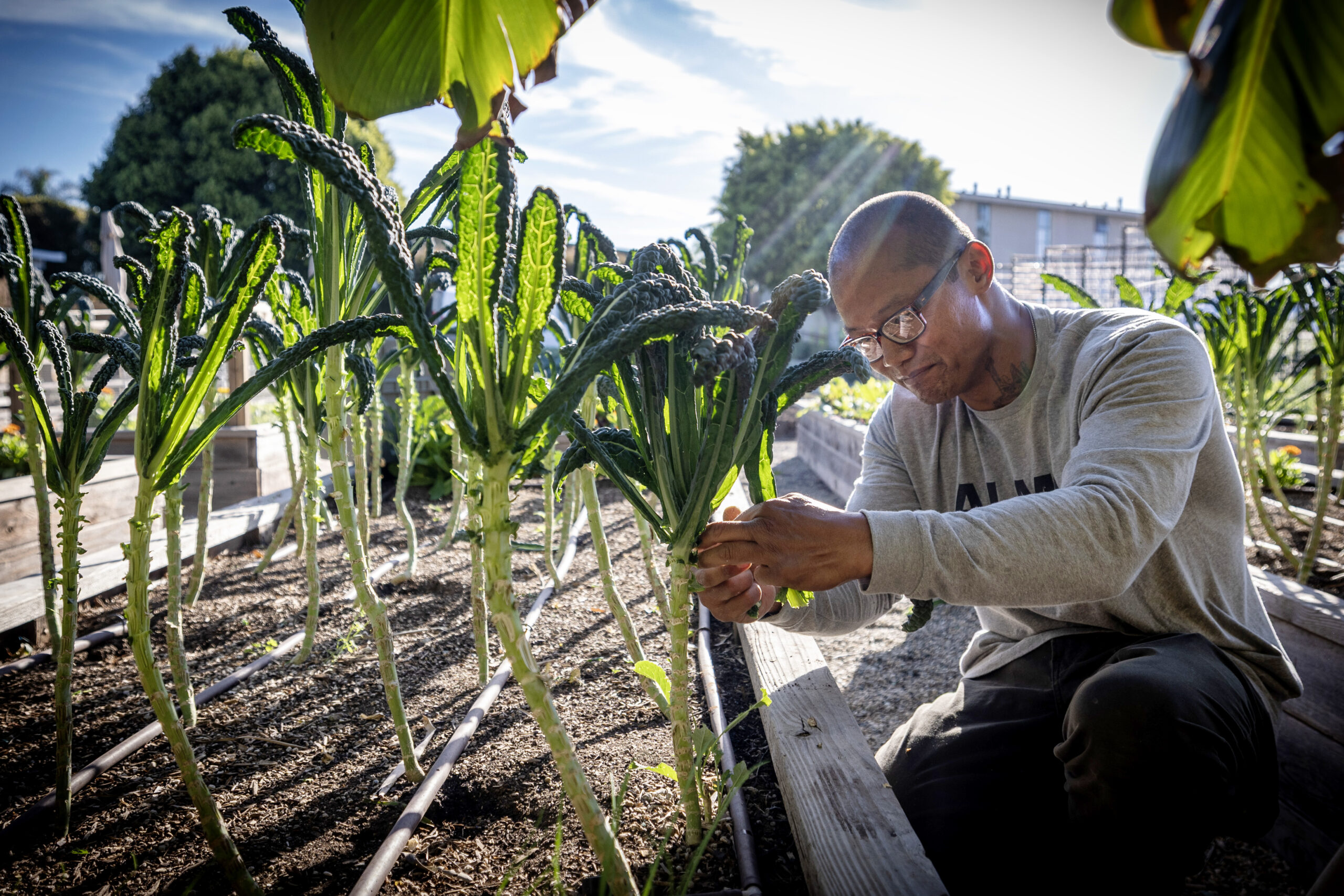

Twice a month on Sunday mornings, hundreds of people stream through a chain link fence into a formerly overgrown softball field in Compton for fresh produce, vibrant flowers, tasty brunch and human connection.
Rows and rows of garden beds full of lush root vegetable greens poking out of the soil, broccoli and cauliflower heads on stalks and kale reaching for the blue sky greet visitors at ALMA Backyard Farms, an urban oasis tended largely by formerly incarcerated people seeking purpose in a community where one in three people live in a household with food insecurity.
“People come for connection — to the land, to plants, to others and to good food,” said ALMA co-founder Erika Cuellar. “This is a place that feeds your soul.”
The urban farm blooms on just under an acre of land belonging to St. Albert the Great Catholic Church, surrounded by low-slung single family homes, wide boulevards and warehouses and factories just blocks away.
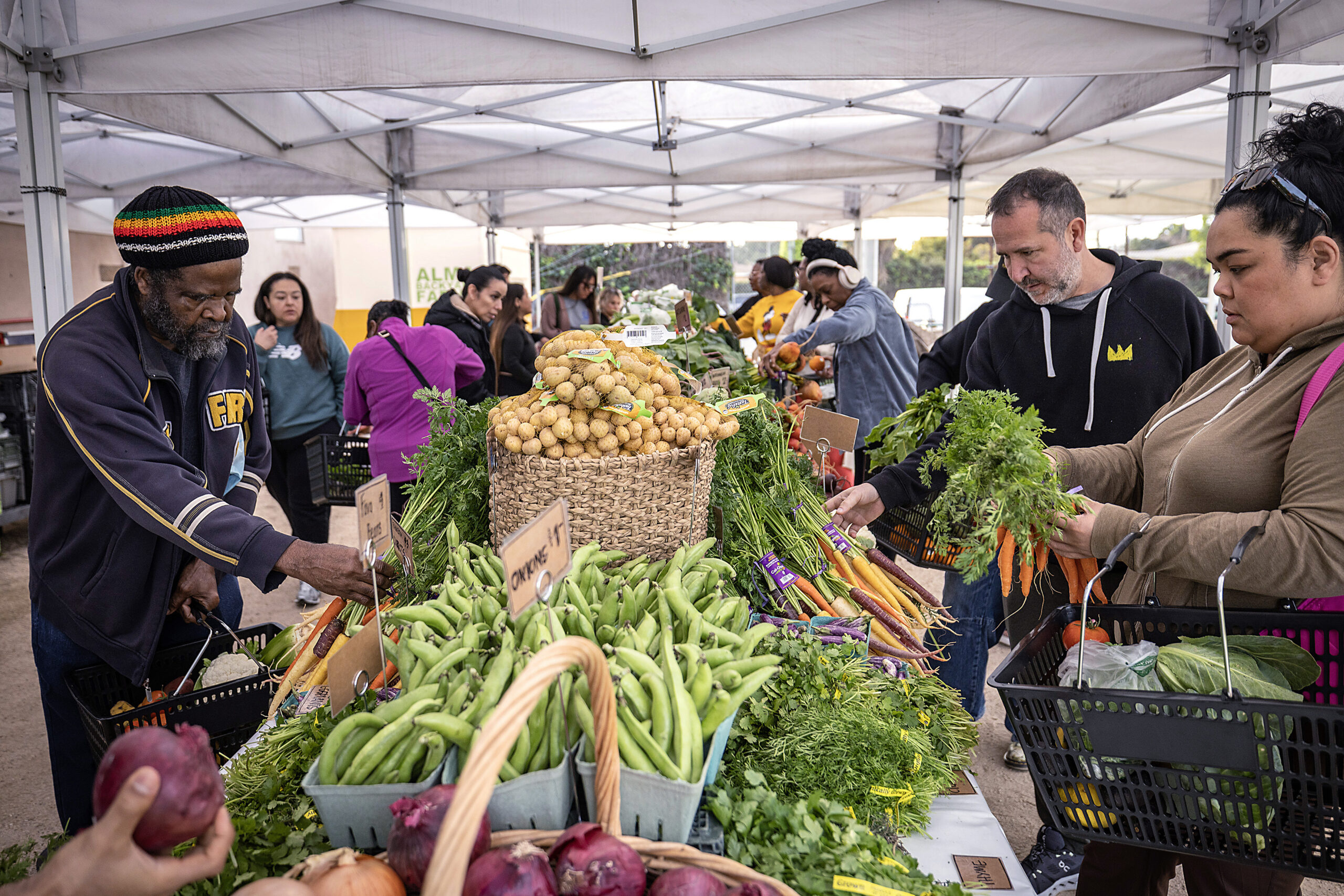
Visitors browse fresh produce at ALMA’s pay-what-you-can market in Compton.
ALMA’s market, which springs to life every other Sunday, has become a ritual for hundreds of visitors and dozens of workers and volunteers. Some arrive for the beautiful collard greens and carrots. Some visit just for the farm-fresh brunch made by a chef who learned her trade at the knee of her Salvadoran grandmother. Others come to work the soil — finding a way to replant themselves in the process.
ALMA operates under a pay-what-you-can model that has become especially meaningful at a time when Southern California families are feeling the squeeze of skyrocketing gas and grocery prices, federal cuts to safety-net programs and aggressive immigration raids.
“If someone is hungry, they’re not turned away. If someone is feeling economic distress or challenges, they’re not questioned,” said Cuellar, the daughter of Mexican immigrants who grew up in nearby Watts. “They deserve the same food, the same ingredients, that anybody else does, and we’ve created a space that allows people to come together.”
Cuellar, 40, and her husband Richard Garcia, 46, founded ALMA more than a decade ago and built it into a growing nonprofit. For them, the farm addresses two overlapping crises in the Los Angeles area: People leaving incarceration with few places to find meaningful work and neighborhoods, known as food deserts, that have limited access to healthy and affordable food.
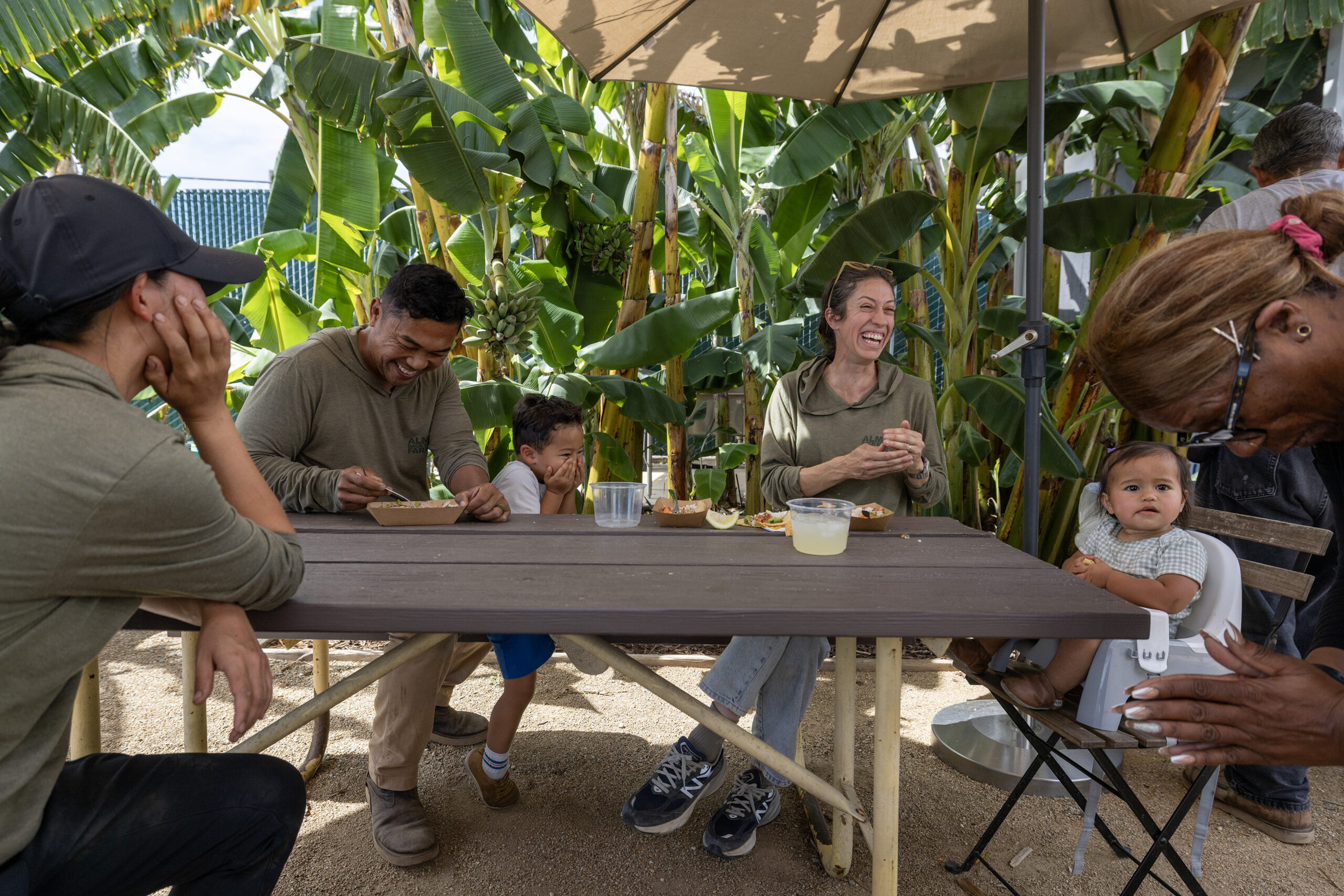
ALMA founders Richard Garcia and Erika Cuellar burst out laughing as Farm Stand Associate Briley “Journey” Presley entertains the couple’s children during a lunch break.
* * *
Right now the farm is meeting many more needs.
As the Trump administration’s immigration raids continue across Los Angeles, state and federal cuts have pushed people off Medi-Cal, and Republicans in Congress voted to slash SNAP food benefits, the farm is a place where people can affordably eat and buy fresh food but also gather and feel useful.
The farm’s market in Compton draws around 700 visitors and serves about 200 brunch plates. On alternating Sundays ALMA hosts a market at a second farm in San Pedro.
On market Sundays, Cuellar said the crew swells to more than 30 people, including eight full-time staff members, six part-time workers and trainees from reentry programs who receive stipends plus many more volunteers. About 60% of those on the team are formerly incarcerated.
“We found our freedom working with folks who are formerly incarcerated,” said Garcia, the son of Filipino immigrants who grew up in Koreatown. “People come and find hospitality here, and it’s the formerly incarcerated who are providing, giving, that hospitality.”
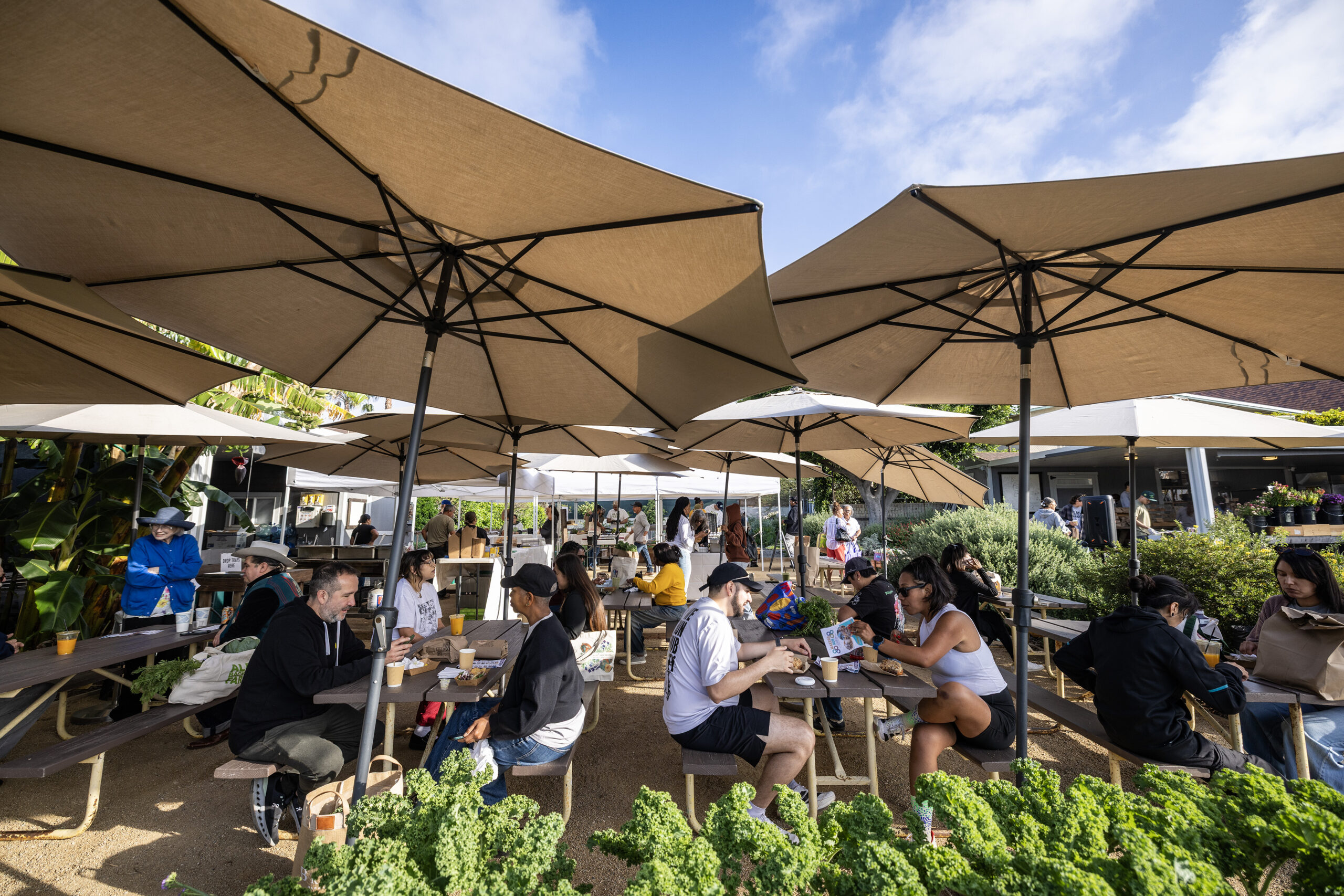
Visitors enjoy brunch made with produce grown on-site at ALMA in Compton.
Several times a year, the farm offers food giveaways and on those days, Cuellar said, the line snakes around the block. They do not ask questions of those who arrive to pick up a precious bag of green and colorful goodness. They know people need to eat and feed their children.
This matters in Compton, where 36% of children and 31% of adults live in households with food insecurity, according to the Los Angeles County Department of Public Health Community Health Profiles.
ALMA sits in a food desert, surrounded on one side by residential neighborhoods home to blue collar and low-income wage workers and on the other side by large warehouses and factories in a commercial district that stretches along the 101 freeway. The closest restaurant is a McDonald’s, and two outlet discount grocery stores stand within a few miles. Otherwise, options are sparse, and to find quality or organic ingredients the farm chef often has to travel to nearby cities to find larger grocery stores.
* * *
The idea for the farm was seeded years ago when Garcia and Cuellar worked at Homeboy Industries. During the peak of the farm-to-table trend, Homeboy started a small farm project and Garcia managed it. At the time, Cuellar managed Homegirl Cafe, where the produce and other garden-grown items were used in the kitchen. For Cuellar and, especially, Garcia, watching how the interaction with soil and plant life impacted formerly incarcerated individuals changed their trajectory.
“Hands that harmed are now hands that heal,” Garcia said.
It’s a common refrain from Garcia and Cuellar.
ALMA Backyard Farm was born in 2013 after Garcia and Cuellar left Homeboy Industries to begin a backyard garden. At first, the couple and a few formerly incarcerated workers planted gardens in private backyards in East Los Angeles.
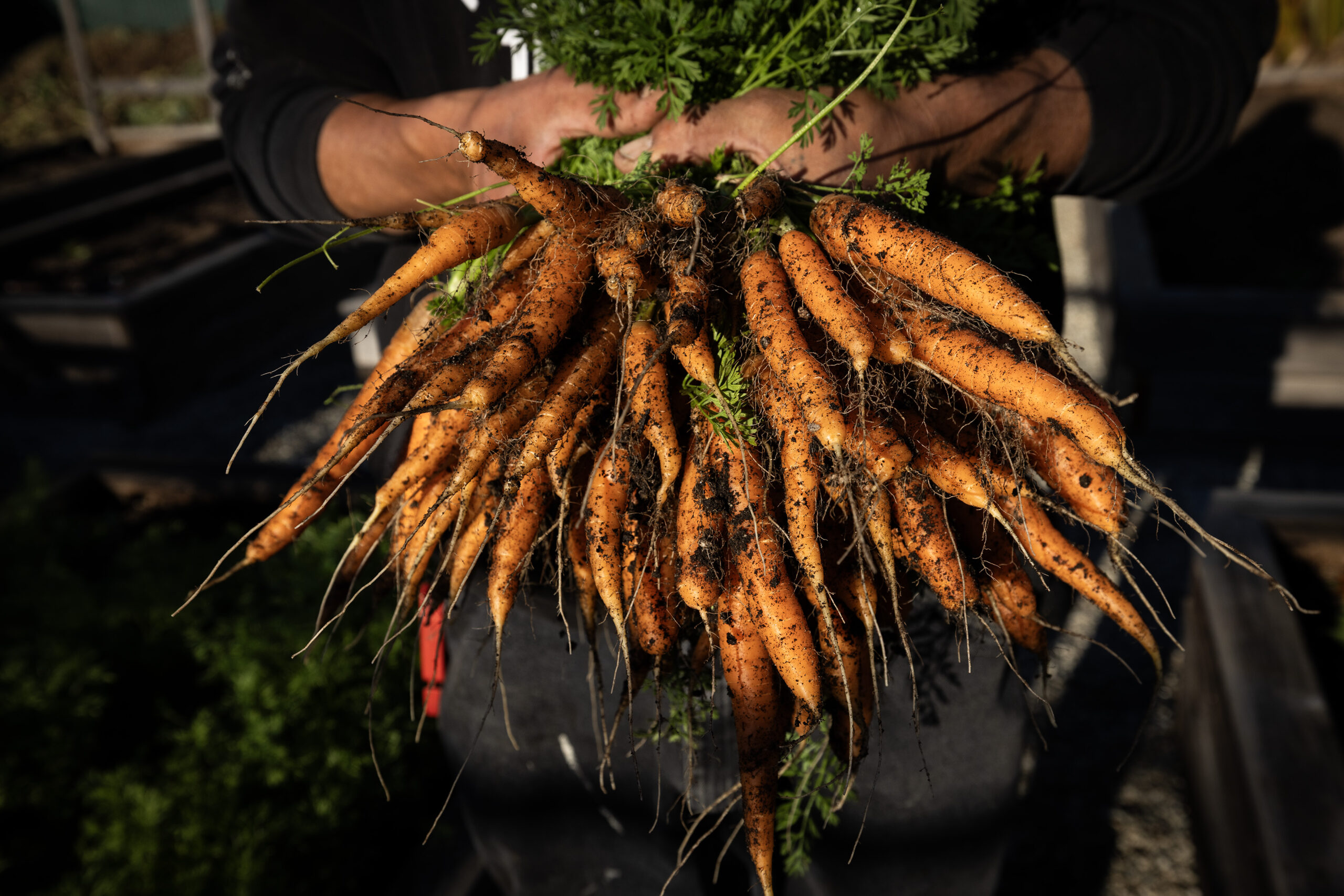
An ALMA employee holds freshly harvested carrots.
Growing a backyard farm nonprofit was not in either Cuellar’s or Garcia’s early career dreams. Garcia had intended to become a priest and attended seminary focused on Jesuit values of social justice. Cuellar had studied to become an elementary school teacher.
They met in 2004 at Dolores Mission Church in downtown when Cuellar was a college volunteer and Garcia ran the youth programs at the church school. They were friends for years, even into the founding of ALMA. Garcia was still considering priesthood. Eventually, they became a couple, married and now have two small children running and crawling around the garden while they work.
While their vocation today looks different than what they envisioned long before they met, the pair still minister to and teach children who attend summer camps; market vendors and visitors; and, especially, their crew of workers and volunteers.
The couple like to say agriculture is in their blood. Garcia recalls watching his mother tend her plants after long nursing shifts. His dad had been a migrant farm laborer years earlier as a young man. Cuellar’s parents grew up in agricultural Mexico, and worked as a janitor and plumber in Los Angeles.
In 2016, ALMA began renting the weedy and overgrown land in Compton from the church. The team worked to transform the parcel into a lush garden with dozens of raised beds, rows of vegetables, herbs and flowers. Guava trees from Garcia’s late mother, plus banana, citrus and plum and peach trees line the perimeter. A flock of 15 Coturnix quail recently moved in to supply eggs. The quiet birds stand 5 to 7 inches high and live in a coop in the garden. The resident cat, Julia Fox, often basks in the sun.
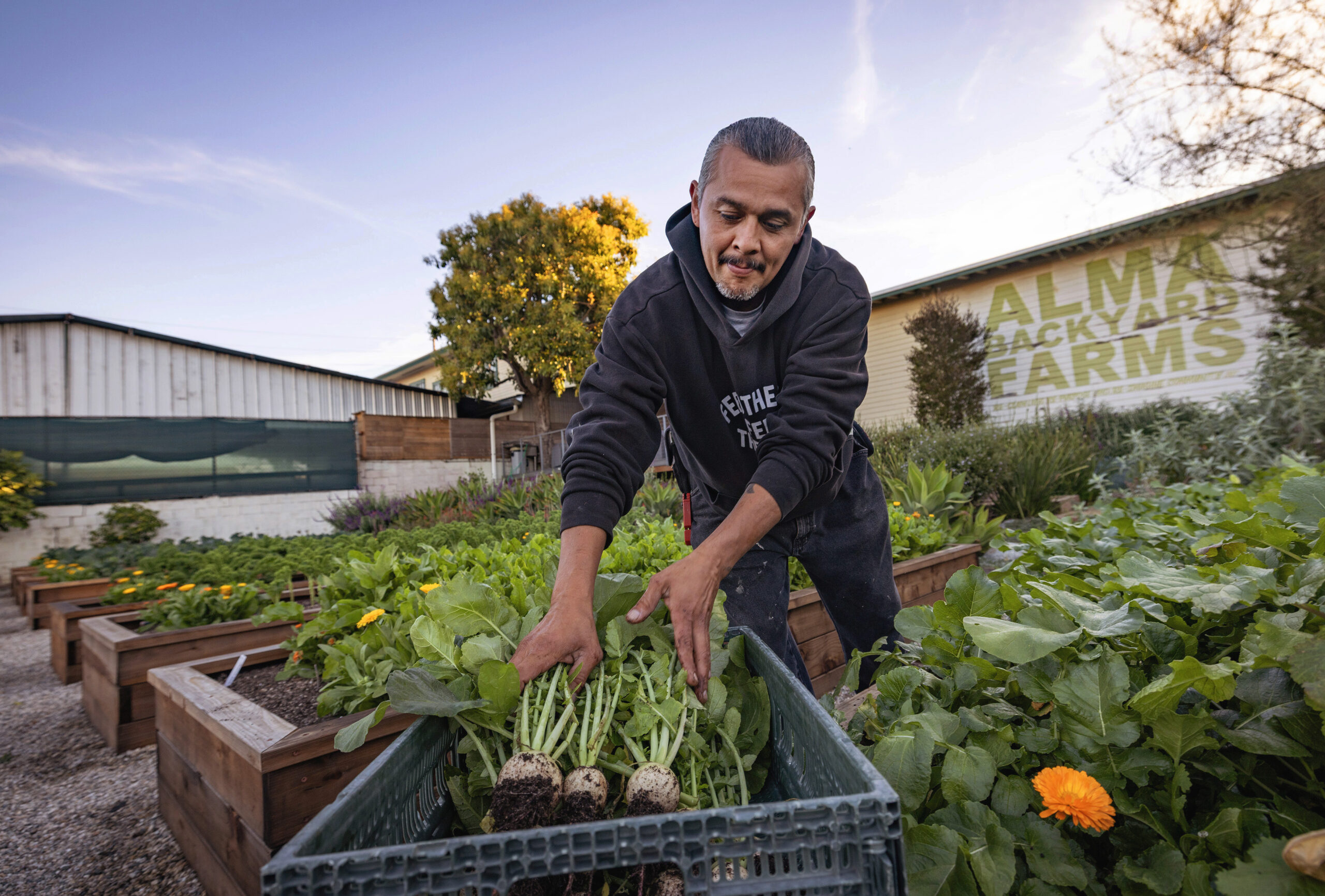
Erik Avalos, a farm hand trainee, harvests vegetables.
Now, more than a full decade later, the backyard farm has become a $2 million nonprofit operation, funded mostly by small family foundations. But the farm has been feeling some of the same cost pressures as the communities it serves. Due to rising rent at the current location, ALMA recently purchased its first property in nearby Carson in a bid to be more financially independent. ALMA is raising funds toward a $10 million goal to pay for the new land and to expand reach, fund growth and provide for more people and plants. Garcia said they plan to continue in Compton for as long as possible, but may have to move operations to Carson in the future.
Garcia said, ”We’ve found particularly high value in farming because it’s living beings dealing with living beings and learning to grow in relationships.”
* * *
One thing that happens at the farm is that people who have spent years locked away for crimes committed in their youth start to talk about their transformation through the language of plants. They describe being uprooted, needing to transplant, figuring out how to grow again in unfamiliar ground, Garcia said.
“Like a seedling has to root and transform to emerge — it’s intense,” said Garcia, who wears work boots, sports a dark tan and shares philosophical and religious outlooks with the crew. “Everyone becomes a scientist here.”
Among them is David Ry, 41, who has been at the farm for about three months. He learned about ALMA from a prison friend.
Ry, who expertly bundled large stalks of curly kale while he talked, has spent 25 years behind bars, starting at 11 years old. He was released a year ago after 16 years. At the farm, he is working to make amends for his violent past.
“It’s like a full circle moment,” said Ry, the child of Cambodian refugees whose father left when he was 6. “When I’m in the bushes, cutting or weeding, I’m usually just thinking and praying and in dialogue with myself how I’m going to be a better person.”
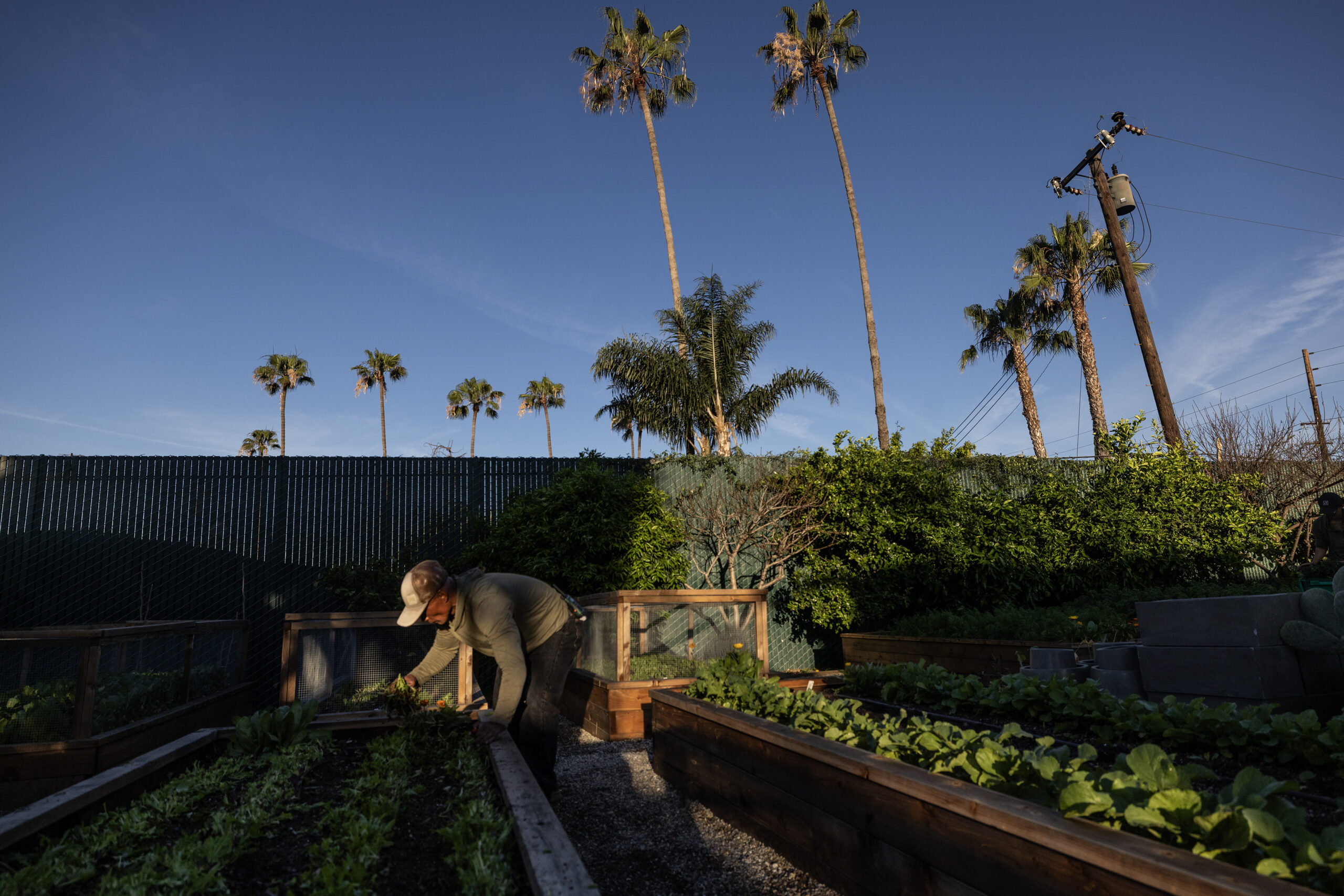
Associate Farm Manager Dennis Meman harvests lettuce.
Dennis Meman, 53, started at ALMA five years ago after serving 27 years in prison. He is associate manager and oversees the San Pedro farm.
“When you have been incarcerated for a long time, and you see such a beautiful place as this, you are enchanted,” he said. It reminds him of his childhood in a farming region in the Philippines.
It’s not just about pride, said Meman. He found his “lifeline.” The team has become his second family, and through the work he aims to make amends for a violent crime he committed many years ago.
“I can only weigh every day with my actions, how I speak to people, how I act with people, doing something good every day no matter how hard it gets,” he said.
Glenda Alvarenga, ALMA’s inhouse chef, followed Cuellar and Garcia from Homeboy Industries, where she worked after getting into trouble in her youth.
“They always focus on getting you to where you want to be,” she said about the couple. “Over here, with Erika and Richard, I have that chance, and they’re like my family.”
Alvarenga creates the brunch meals, jams, salsas and aguas frescas served on market days.
This work connects Alvarenga to home and memories of her grandmother, who raised her, growing food in El Salvador.
“It brings me a lot of peace,” she said.
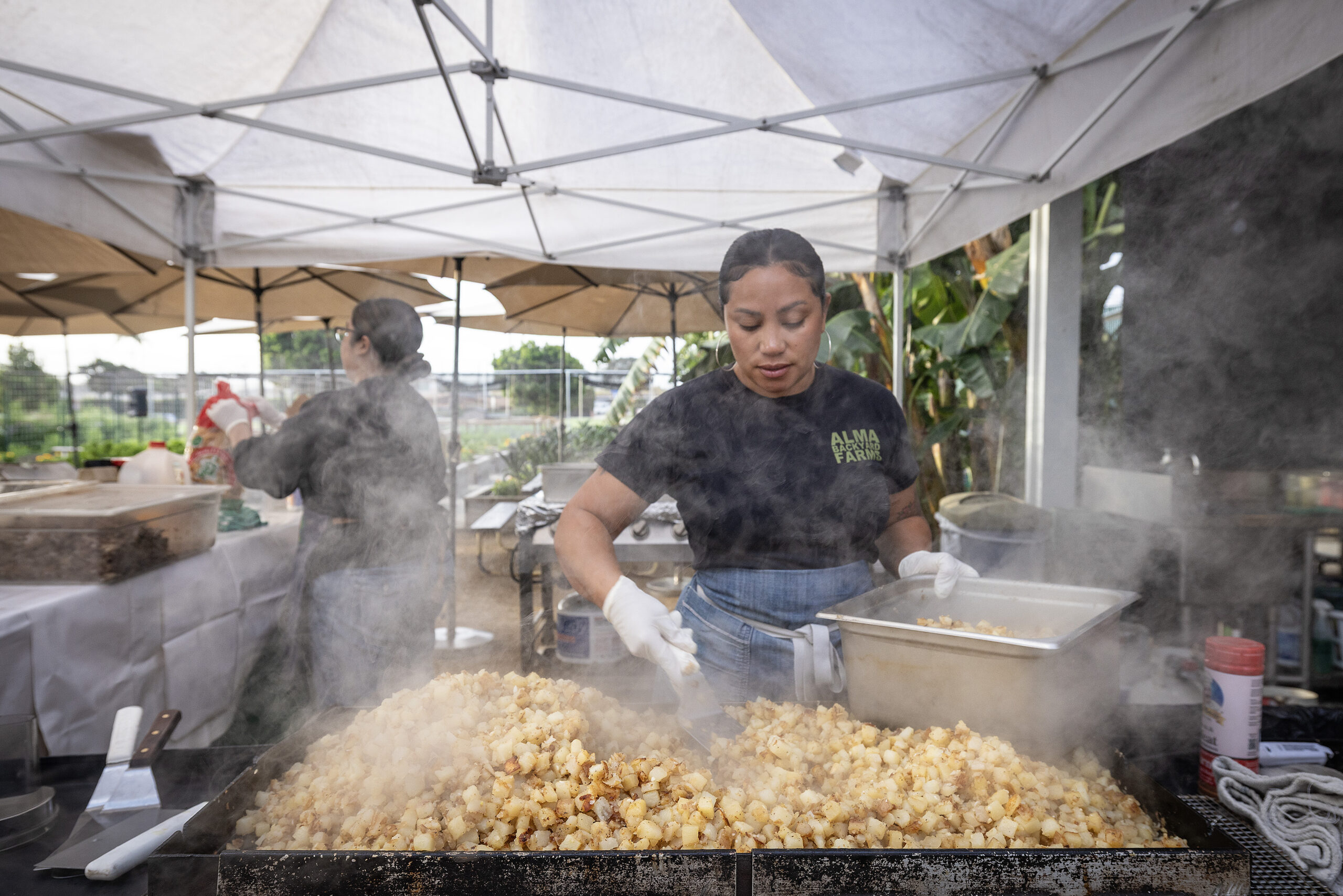
Program Chef Glenda Alvarenga cooks potatoes in preparation for brunch.
* * *
Garcia and Cuellar ascribe their success building ALMA Farms to their upbringings, Roman Catholic education and faith and previous work in restorative justice programs, which focus on accountability, empathy and problem solving.
Cultivating an urban farm in Los Angeles with and for those society often overlooks hasn’t been without its challenges. Team members have been deported. Rents are rising. Family members and friends lost homes to L.A.’s fires. But together, they persist.
Cuellar grew up nearby and as a girl played softball on the field where ALMA’s Compton farm now sits. She’s down to earth in her ALMA baseball cap, often has two toddlers in tow and keeps the team moving on harvest day with wit. The slogan “Feed the soil, feed the soul” is visible across the farm and its people. The work extends in all sorts of ways — through summer camps for children and via tours and classes for the kids who attend school at St. Albert the Great.
Garcia said they cannot be distracted by the politics of this moment or worried about what might happen with immigration or war. Instead, focusing on the day to day helps the crew and those who need the market to make ends meet.
“People just have to decide to live their lives,” he said.

Children play on an open field at ALMA Backyard Farms.
He and Cuellar know these lessons from childhood. Work hard. Don’t be distracted. Do what you can do. Help others. Take advantage of opportunities.
Surveying the scene one recent Sunday, it’s clear ALMA is a much-needed oasis during these tough times.
A yoga teacher leads a class on the field. Dads and their fifth grade daughters, on a tour, make flower bouquets with Cuellar. Alvarenga is dishing out aromatic tacos made with carne asada, achiote chicken or flor de Jamaica (hibiscus flowers). Others harvest bananas to replenish the market table. Children run across the field. Visitors talk with the farmers.
“We grow real good stuff to eat,” Cuellar said. “But at the core, we are building a place for people to come together.”
Copyright 2026 Capital & Main.
Photos by Barbara Davidson.
Editor’s note: This story has been updated to include additional information from Richard Garcia, who said ALMA Backyard Farms will continue to operate in Compton for as long as possible.



-

 Column - State of InequalityMay 21, 2026
In California Governor’s Race, Xavier Becerra Walks Away From Single-Payer
-

 Latest NewsMay 22, 2026
Where California’s Gubernatorial Candidates Stand on Climate and Taking Big Oil Money
-

 The SlickMay 29, 2026
Feds to Open Tens of Thousands of Acres of Colorado Wilderness to Oil Drilling
-
 Deadly Dust: The Silicosis EpidemicMay 27, 2026
California Moves to Ban Quartz Countertop Fabrication to Combat Silicosis Epidemic
-

 Latest NewsMay 26, 2026
Conditions at California ICE Detention Centers Are Getting Worse, Inspections Find
-
 Imperial DivideJune 3, 2026
California’s Lithium Valley Dreams Meet Reality at the Only Restaurant in Town
-

 Column - State of InequalityMay 28, 2026
Top Democratic Candidates Agree on Housing Urgency, Not the Fix
-

 Latest NewsJune 1, 2026
Deep Cuts to Civilian Support Staff for Families of Deployed Marines Raise Concerns