
Education
Charter Schools Have a “Discipline” Problem



A report released March 15 by the University of California, Los Angeles’ Center for Civil Rights Remedies revealed jaw-dropping figures about school discipline at charter schools.
During the 2011-12 academic year—the first year charter schools were required by the federal government to report school discipline data—black students were four times as likely to be suspended from charter schools as white students. And of the 5,250 charter schools studied, 235 suspended more than 50 percent of their enrolled students with disabilities.
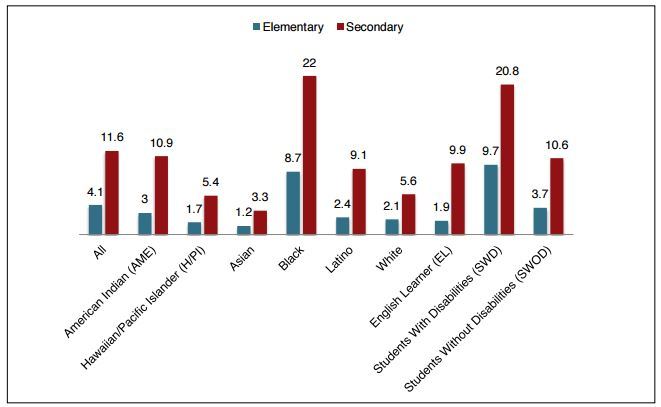
National Average Suspension Rates for Charter Schools at Elementary and Secondary Levels, by Subgroup, 2011-12
We should be deeply troubled by these statistics at any public school, charter or not. But there’s a crucial difference between charter and traditional public schools: Despite being publicly funded, many charter schools are managed by private groups unaccountable to the public.
This lack of accountability makes it harder for communities to address injustice at charter schools, and for parents to have a say in what school “success” looks like.
Take New York City’s Success Academy. The principal of the charter chain’s Fort Greene school recently singled out students he called “disruptive,” putting them on a “Got to Go” list. One 6-year-old student of color on the list was repeatedly suspended for doing what kindergarteners sometimes do — screaming, throwing pencils and running way from teachers.
The chain’s chief executive officer, Eva Moskowitz, doesn’t see a problem. She has said, “We think of discipline as educational.”
After a video recently surfaced of a Success Academy teacher berating a young girl for forgetting how to answer a math problem, the student’s parent went to the New York City Department of Education for help. She was told that she’d have to contact the chain’s unelected board of trustees, made up of hedge fund and private equity investors, lawyers, PR professionals and philanthropists.
Success Academy’s board makes decisions about how to spend taxpayer money, but they aren’t accountable to the public. Faced with no other option, the mother removed her daughter from the school.
At traditional public schools, we can work together to define “success” and fix issues that shouldn’t happen at any school. But at charter schools, all that parents seem to have is a “choice”—whether to leave or not.
(Chart and image are from the Center for Civil Rights Remedies’ Charter Schools, Civil Rights and School Discipline: A Comprehensive Review.)



-

 Latest NewsJune 9, 2026
Ousted by the Trump Administration, U.S. Immigrants Remain Locked up in African Kingdom
-
 The SlickJune 10, 2026
Data Centers Are on the Ballot — This Pennsylvania Candidate Won Her Primary Keeping Them Top of Mind
-

 Latest NewsJune 8, 2026
The Glacier May Be Gone, but the Love Isn’t
-
 Latest NewsJune 12, 2026
California Town Lets Private ICE Detention Centers Police Themselves
-
 Column - State of InequalityJune 11, 2026
County Tax Measures Show Limits of Local Responses to Medicaid Cuts
-

 The SlickJune 16, 2026
Why Coal Will Lead to More Deaths in Colorado
-

 Latest NewsJune 17, 2026
California Rideshare Drivers Move Toward Unionizing, Following Massachusetts
-
 Latest NewsJune 19, 2026
Sheriff’s, Probation Litigation Cost L.A. County Taxpayers $1 Billion, Study Finds