
Column - State of Inequality
California’s Economy Runs on Labor Trump Wants to Deport
Undocumented workers help fund public services, fill essential jobs and generate billions in economic activity, study finds.

The Trump administration’s repeated attacks on California’s immigrant communities over the past year resulted in thousands of deportations and stoked fears of reprisal among those living in the state without authorization, including families afraid for their children. It’s still unclear how many immigrants ultimately will have left the state, either under threat or of their own volition.
That is a humanitarian nightmare, a Cal Lutheran University professor says. But there is another aspect to consider, he adds: California’s economy simply cannot survive any significant loss to its undocumented worker population.
“Even for people and politicians with no humanitarian instincts at all, they have to respect the economic punishment that will ensue,” said Jamshid Damooei, director of the university’s Center for Economics of Social Issues. “You cannot imagine certain industries in California without undocumented workers.”
For years, the Cal Lutheran center has tracked the effects of undocumented workers on the state’s economy. Its most recent findings make a compelling argument that those effects are profoundly positive.
Damooei said the center’s research found the direct value of work produced by undocumented Californians to be nearly 6% of the state’s total domestic gross product, more than $236 billion annually.
But the figure swells when it includes indirect and induced spending — ways that economists measure how much additional business activity and spending that the labor of undocumented immigrants produces, essentially a multiplier effect.
“The best way to think of it is, this is what the work of undocumented immigrants generates for others,” Damooei said. “That’s true whether it’s through their labor driving additional business spending or hiring, or supply chain purchases, or the workers’ own spending for their necessities and paying taxes and so on.”
Add those factors, and undocumented immigrants are responsible for nearly $441 billion in economic impact — more than 11% of California’s GDP.
Those are powerful numbers, but perhaps they shouldn’t be surprising considering the size of the undocumented workforce in the Golden State. The center’s research places that number at more than 1.9 million people, out of an overall undocumented immigrant population of between 2.7 million and 2.9 million.
* * *
If the term “undocumented worker” conjures images of a person stooped over in a farm field, you’re not wrong. Nearly half of all agriculture jobs in the state are held by immigrant laborers, Damooei said — and in places like Santa Barbara and Ventura counties, it’s closer to 70%.
But that image, though compelling, is incomplete. Using information from IMPLAN, the industry standard for economic modeling, Damooei’s work powerfully demonstrates that immigrant labor is propping up multiple industries across the state.
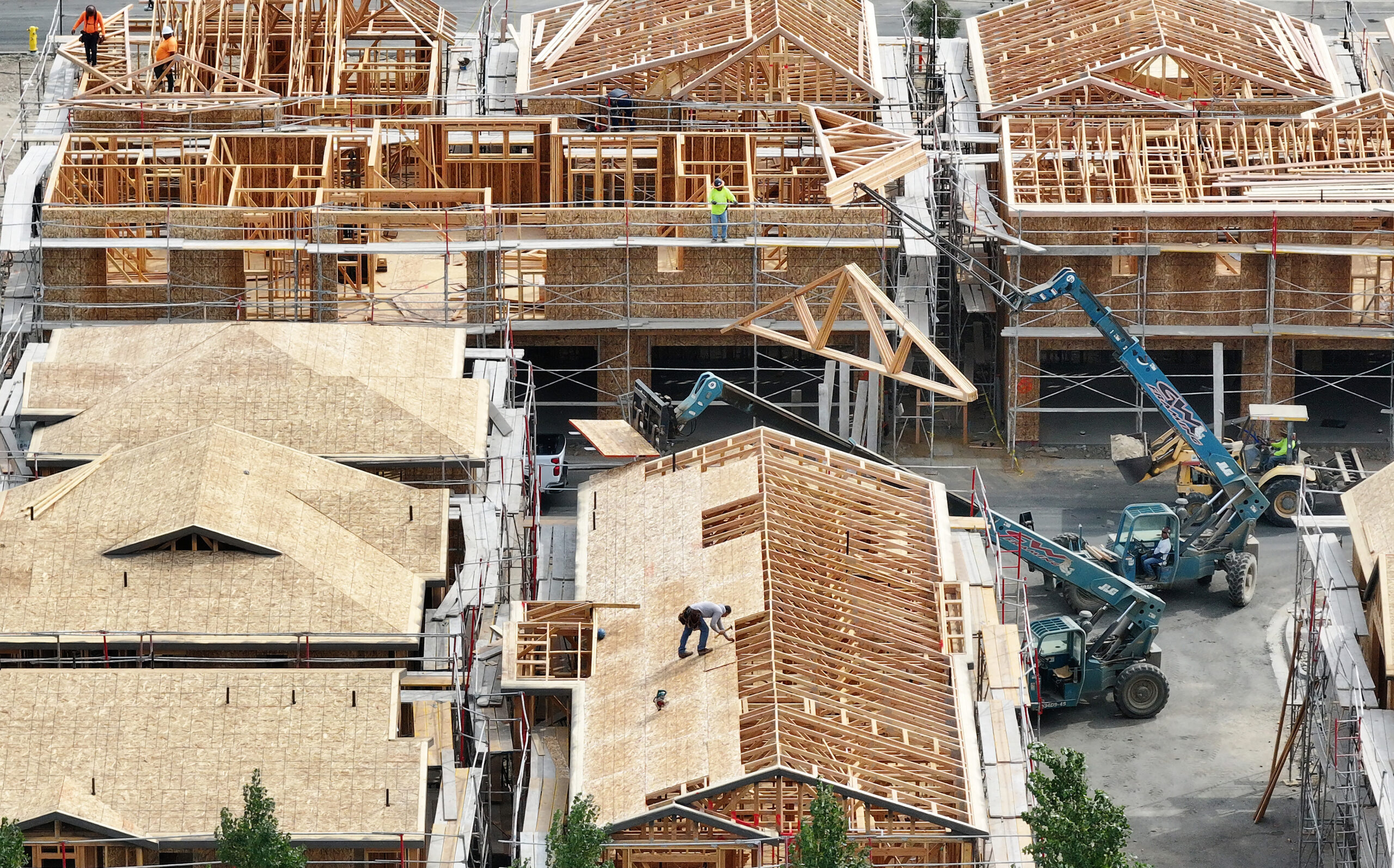
Undocumented workers account for nearly half of what the agriculture industry contributes to California’s GDP — but also 22% of construction’s contribution, 20% of the retail trade and more than 10% of the wholesale trade, according to Damooei’s research. Manufacturing, transportation, warehousing all depend to a significant extent on the labor of undocumented immigrants.
In raw dollars, the numbers are even more striking. Undocumented workers provide $37 billion a year in added value to California’s construction industry, $42 billion to its retail trade, $29 billion in professional services, $23 billion in agriculture, and so on. This is a quasi-invisible workforce producing very tangible results.
The notion of how much in taxes these workers pay is a slippery one, Damooei said, but the amount is substantial. While many immigrants establish individual taxpayer identification numbers to pay the government, others use forged Social Security numbers or fake ID on W-2s, which Damooei called “identity loan.” Both the federal and California governments accept all such tax payments.
A 2024 study by the Institute on Taxation and Economic Policy pegged the total amount of taxes paid by undocumented immigrants in the U.S. at nearly $100 billion. About 16% of all such immigrants live in California.
* * *
That tax aspect of the conversation is often lost amid the shouting over documentation status, Damooei said, but it matters.
Much of the tax money paid by undocumented workers goes to support the same services that all Americans’ tax payments support: Social Security, Medicare, unemployment insurance and so on. But because of their status, those workers and their families cannot access such government services.
In essence, the workers’ taxes help prop up safety-net systems they can’t use. Even in California, a clearly progressive state, Gov. Gavin Newsom chose to roll back an expansion of Medi-Cal benefits to undocumented residents, citing budget constraints.
“The bottom line is that the undocumented pay far more in taxes than the benefits they receive,” Damooei said.
That dynamic is set to remain in California for the long haul, too. The Cal Lutheran research shows that of the high-end estimate of 2.9 million undocumented residents in the state, 1.7 million have lived here for 20 years or more. They represent a stable part of the state’s workforce.
President Donald Trump’s assailing of immigrants, and the ICE raids that have rocked the country since early 2025, may be red meat for some of Trump’s most xenophobic supporters. But as a practical matter in California, chasing undocumented people out of the state isn’t just cruel — it’s a recipe for economic disaster, Damooei said.
“These workers are an inseparable part of California’s economy. That is how decisive the impacts are,” the professor said. “This is who we are — and what we are — as a people.”
Copyright 2026 Capital & Main



-

 The SlickMay 29, 2026
Feds to Open Tens of Thousands of Acres of Colorado Wilderness to Oil Drilling
-
 Imperial DivideJune 3, 2026
California’s Lithium Valley Dreams Meet Reality at the Only Restaurant in Town
-

 Column - State of InequalityMay 28, 2026
Top Democratic Candidates Agree on Housing Urgency, Not the Fix
-

 Latest NewsJune 1, 2026
Deep Cuts to Civilian Support Staff for Families of Deployed Marines Raise Concerns
-

 The SlickJune 5, 2026
At This New Mexico Park, Mountain Bikers Pedal Amid Hundreds of Oil Wells
-
 The SlickJune 10, 2026
Data Centers Are on the Ballot — This Pennsylvania Candidate Won Her Primary Keeping Them Top of Mind
-
 Latest NewsJune 9, 2026
Ousted by the Trump Administration, U.S. Immigrants Remain Locked up in African Kingdom
-
 Latest NewsJune 12, 2026
California Town Lets Private ICE Detention Centers Police Themselves