Latest News
A May Day Push to ‘Shut It Down’ Takes Shape Across the Country
Unions join community groups in planning marches, walkouts and economic actions on May 1 as a show of worker power ahead of the midterm elections.
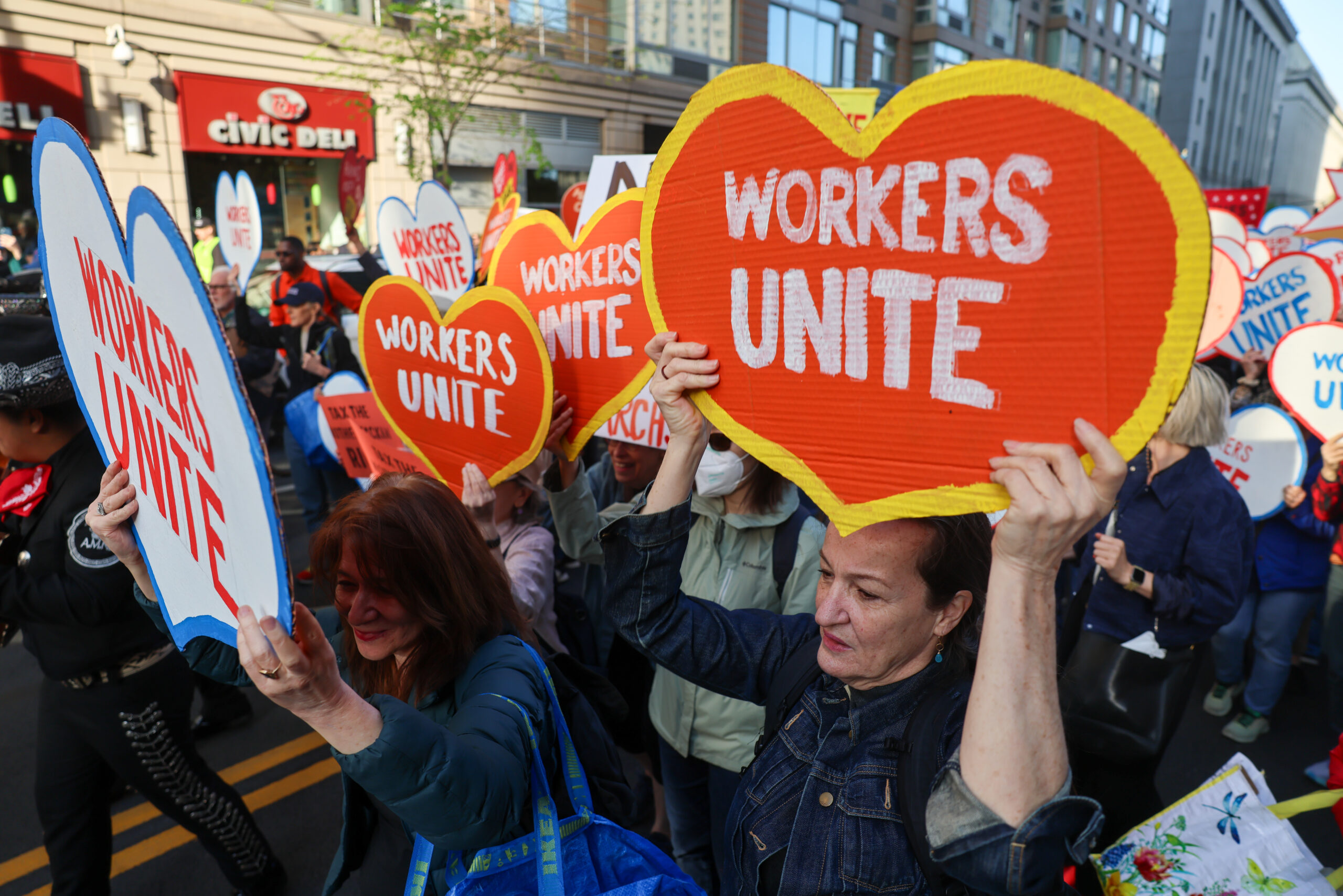

The conference room of the Los Angeles County Federation of Labor was bustling with activity in mid-April. Union organizers distributed flyers in Spanish and English urging, “No Work, No School, and No Shopping on May 1st” and wrangled over the logistics of putting together a march through downtown that they hoped would attract thousands of participants.
Cliff Smith, business manager of Roofers Union Local 36 in Los Angeles, did not mince words when describing the target of the protest: President Donald Trump — the “fascist in the White House” — and the threat facing the country as the midterms approach.
“It’s important to show business leaders if they back an attempt by Trump to steal the elections that we will shut things down in this country,” said Smith. “May Day will show them that we are serious in our threats.”
The nationwide action, which some organizers are calling a “shutdown” or a “general strike,” is expected to take place with unions sponsoring events in scores of cities across the country. And its aim is to demonstrate the power of workers — and their opposition to the Trump administration’s policies and actions — by withholding their labor.
In Los Angeles, the May Day action has a special significance. It was the site of a massive “Day Without an Immigrant” march in 2006, which drew hundreds of thousands of people to the streets and helped defeat a punitive, anti-immigrant bill in the U.S. Senate. It is also home to a powerful labor federation that represents more than 800,000 workers across the county, many of whom are immigrants.
A theme of this year’s action is “Workers Over Billionaires,” and the Los Angeles march will begin in MacArthur Park, the site of a July raid that involved dozens of federal troops in tactical gear descending on a heavily immigrant community.
“It’s International Workers’ Day. It’s important that we remind people about our collective power,” said Neidi Dominguez, the executive director of Organized Power in Numbers, a worker rights organization that is a member of the May Day Strong Coalition. The coalition includes more than 500 labor, community and pro-democracy organizations nationwide. From Washington, Dominguez has helped rally these groups for the May Day action. “We’ve been facing ICE raids, attacks on democracy, wars overseas, and it’s important that on May Day we join with workers all over the world to show the power that we have in fighting Trump,” she said.
* * *
With only 12% of the U.S. workforce belonging to a union, May Day Strong coalition organizers say that alliances with community and racial justice groups are crucial. Indivisible, the progressive group that spearheaded the nationwide No Kings protests, is helping to promote the May 1 action, as are Democratic Socialists of America chapters, climate activists, immigrant rights groups and progressive organizations. In Los Angeles, the county with the largest population of undocumented immigrants in the country, the Coalition for Humane Immigrant Rights is one of the more than 50 labor, faith, community and immigrant rights organizations helping to spread the word.
In Los Angeles, and elsewhere, organizers are urging shop owners to place “No Work, No School, No Shopping” signs in their windows and to shut their doors during May Day.
Minneapolis’ resistance in January to the massive incursion of federal immigration agents remains an inspiration to organizers across the country.
“I think what our friends have pulled off in Minneapolis is a movement gift for the rest of us,” said Dominguez. “Even among their pain and the horrific tragedies that they’ve been surviving, what they’ve given the rest of us is something really powerful and beautiful.”
Following the killing of Renée Good by an ICE agent in Minneapolis, tens of thousands marched in subzero temperatures as major school districts, and more than 800 businesses closed in the city. At least 23% of Minnesota voters said that either they or a loved one participated in the general strike in some way, according to a survey of 1,900 registered Minnesota voters conducted by Blue Rose Research commissioned by the May Day Strong coalition.
* * *
Around the country, major unions are involving their members in the action.
The North Carolina Association of Educators is endorsing mass walkouts statewide on May 1. Already, some of the largest school districts in the state have announced that they would close, including Durham, Chapel Hill, Asheville, Chatham County, Guilford County, Kannapolis City and Winston-Salem. Wake County is home to Raleigh, and its school district has announced that it will allow teachers to use May Day as a preparation day, which will mean students will not have to attend classes.
In New Jersey, a coalition of unions representing more than 1 million members announced that they would also be backing rallies and protests on May Day. For legal reasons, many unions in the coalition and many of their leaders have shied away from using the word “strike,” but they have encouraged their members to take the day off of work to attend union rallies.
While some groups are urging workers to walk out, others are taking a more cautious approach. Many collective bargaining agreements prohibit workers from participating in such an action.
“Because we are a labor union, we are very careful not to ask any union to break their collective bargaining agreement,” said L.A. County Federation of Labor Organizing Director Patricia Recinos. “But you know, there is a sick day, there is a day off. You know, there are things that can happen.”
Joseph McCartin, a labor studies professor and Executive Director of Georgetown’s Kalmanovitz Initiative for Labor and the Working Poor, said mobilizing non-union workers will also be key.
He added that this May Day action, along with work stoppages over safety during the pandemic, point to a new kind of “political” or nontraditional strike that is emerging, even as the labor movement’s power has declined in recent decades. “They start to create a sense again of what it is to exercise collective power — by withholding labor — that’s bound to have an impact within the union movement.”
Back at the L.A. County Federation of Labor headquarters, Recinos was doing the work of turning people out. She had posted several sheets of butcher paper along the wall. In thick black marker, she wrote down commitments from more than two dozen union leaders representing service workers, graduate student workers, interns, residents and others.
“We are saying, ‘Shut it down,’” she said. “We’re not waiting for some politician to come save us. It’s us. We’re going to stand up for ourselves.”
Copyright 2026 Capital & Main



-
 Imperial DivideJune 3, 2026
California’s Lithium Valley Dreams Meet Reality at the Only Restaurant in Town
-

 Latest NewsJune 1, 2026
Deep Cuts to Civilian Support Staff for Families of Deployed Marines Raise Concerns
-

 Column - State of InequalityJune 4, 2026
California’s Economy Runs on Labor Trump Wants to Deport
-

 Featured VideoJune 5, 2026
At This New Mexico Park, Mountain Bikers Pedal Amid Hundreds of Oil Wells
-

 The SlickJune 10, 2026
Data Centers Are on the Ballot — This Pennsylvania Candidate Won Her Primary Keeping Them Top of Mind
-
 Latest NewsJune 9, 2026
Ousted by the Trump Administration, U.S. Immigrants Remain Locked up in African Kingdom
-

 Latest NewsJune 8, 2026
The Glacier May Be Gone, but the Love Isn’t
-
 Latest NewsJune 12, 2026
California Town Lets Private ICE Detention Centers Police Themselves