
Column - California Uncovered
Keeping People With Their Pets Can Help L.A.’s Housing Crisis — and Mental Health
Social worker Jackie Parra intervenes at L.A.’s busiest animal shelter to help people in crisis keep their pets and housing.
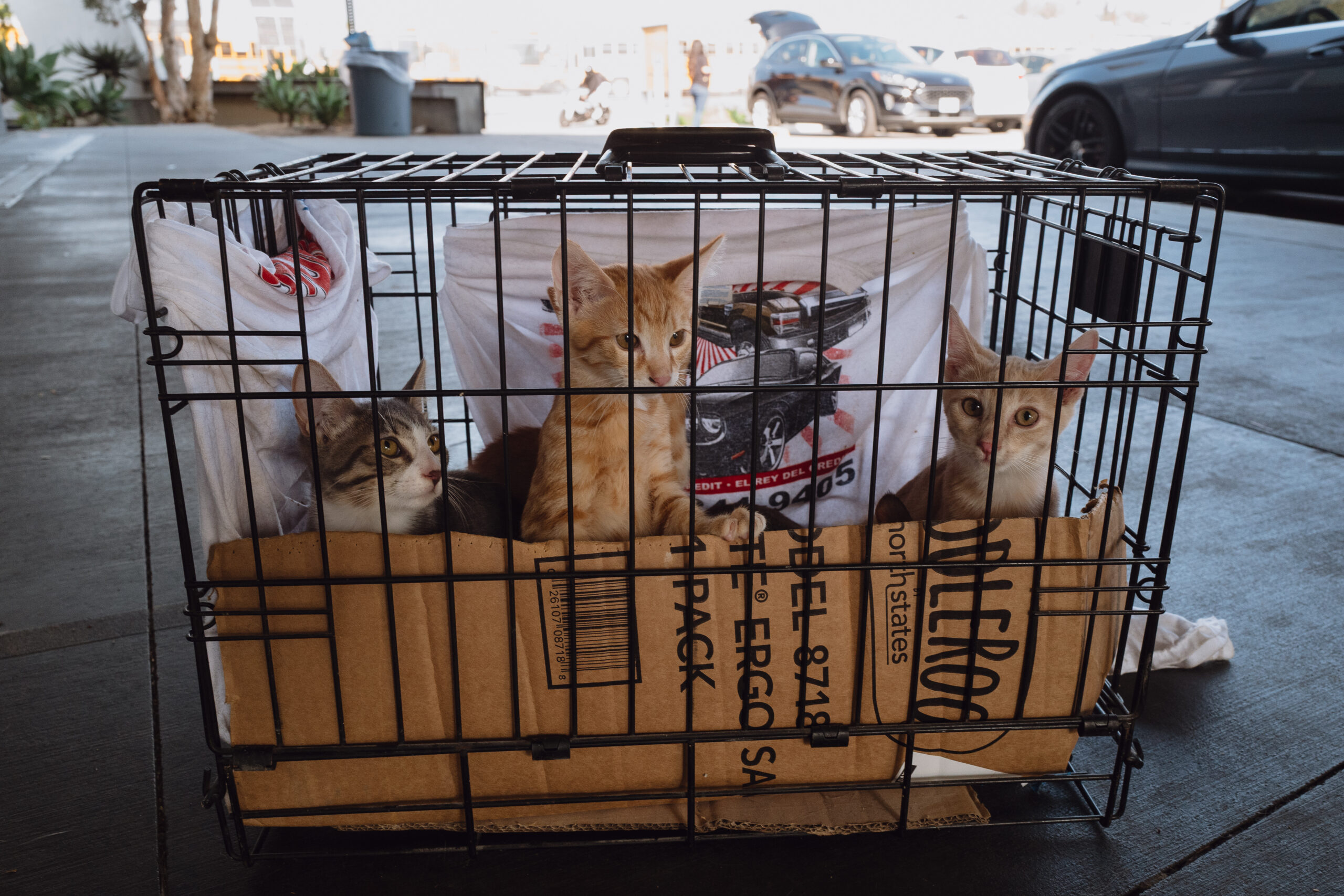

Jackie Parra sits at a card table outside the entrance to the South Los Angeles city animal shelter five days a week, hoping to intercept people who feel they must surrender their beloved pets in order to get housed or keep the housing they have.
“Any person coming to the shelter, this is their last resort,” said Parra, a licensed social worker for the nonprofit Downtown Dog Rescue. “They’ve exhausted all resources, asked family members and friends for help, and they don’t know what to do.”
As Los Angeles struggles to address homelessness, housing access and mental health care, Parra occupies a rare role: helping unhoused people with mental illness keep the pets they rely on for stability and companionship — and, in many cases, secure housing — by navigating the rules around emotional support animals. These animals provide comfort and therapeutic benefits to people diagnosed with mental health conditions, such as anxiety, post traumatic stress disorder and depression. They don’t have the same recognition as trained service animals, but under the Federal Fair Housing Act must be allowed to live with their owners.
Up to 25% of people experiencing homelessness have a pet, according to the Animal Welfare Institute, a Washington, D.C.-based organization focused on improving the treatment of animals. And nearly half of unhoused people with pets report having been turned away from a shelter because of pet policies, according to the American Society for the Prevention of Cruelty to Animals (ASPCA).

Social Worker Jackie Parra. Photo: Zaydee Sanchez.
Parra’s position grew out of what the team at Downtown Dog Rescue kept seeing in the street and at shelters: People in crisis were giving up animals they loved because housing instability and poverty left them no other choice. And animals were being left to face euthanasia in overcrowded shelters not because they weren’t loved or needed, but because of tragic circumstances. Her job is to interrupt that forced decision — and to help people navigate systems built as if pets don’t matter.
For many, animals are not just companions but the most stable and, possibly, the only relationship a person has, said Lori Kogan, a licensed psychologist in the College of Veterinary Medicine and Biomedical Sciences at Colorado State University who studies human-animal interactions.
“If you have all of these things ripped out from underneath you and you have to relinquish your pet on top of it all, that would be absolutely devastating,” Kogan said.
* * *
That reality plays out daily at the shelter as Parra listens to people explain why they may have to give up their dogs, cats, rabbits, birds or other animals they rely on for mental stability. They can’t afford pet food or veterinary care or they are homeless or facing eviction because of their animal.
This is how Orianna Romero remembers her first meeting with Parra. Someone who listened to her heartbreak.
“It has been a miracle to know Jackie,” said Romero, who suffers from depression.
The pair met at the shelter when Romero, 36, thought she would have to surrender her dog, Taro, a Belgian Malinois with a soft brown and black coat. At the time, Romero and her family had become homeless and were living in a motel. When a shelter finally offered the family a room, Taro wasn’t allowed.
In Parra’s arsenal, she has medical vouchers, dog and cat food and, most critically, her training as a licensed social worker to help people crushed by having to choose between housing and their cherished pets.
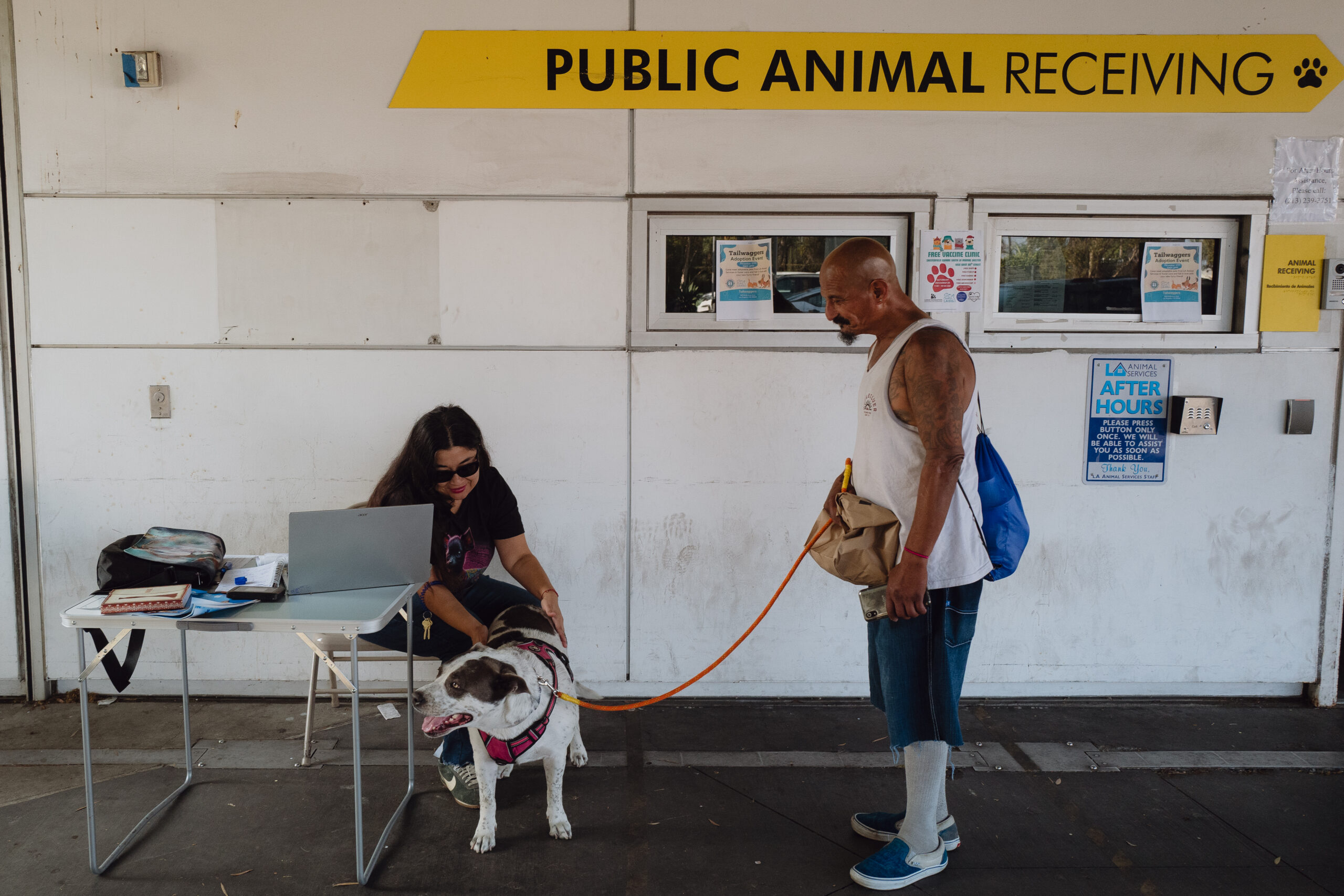
Jackie Parra talks with her client Robert Valenzuela and his dog, Mamas, at the South Los Angeles animal shelter. Photo: Zaydee Sanchez.
Her true superpower is her calm, knowing vibe. Parra is from the neighborhood and understands the lives of her clients. She’s experienced depression, and it’s clear she loves animals. She often wears her brown hair pulled back and large sunglasses and switches easily between English and Spanish with clients. She listens deeply, anticipating their questions. Parra is no-nonsense but compassionate. She doesn’t judge, she says. That makes her approachable. So do the dog paws tattooed on her left forearm.
Parra helps eligible pet owners understand their rights when housing is denied or in jeopardy because of an animal. For those who have a mental health diagnosis, she can issue an emotional support animal letter as outlined under federal housing rules to help smooth the way with a landlord, shelter or motel where short-term housing is available.
It’s the kind of support Romero and many others need.
“Their dog is their everything — that’s all they have,” Parra said. “People fail them and dogs don’t.”
* * *
While homelessness in Los Angeles has declined slightly in recent years, it remains at crisis levels, with more than 72,000 unhoused people across L.A. County as of the most recent count last year.
And for those struggling with housing insecurity, pets are a priority. For people living in cars, tents or temporary shelters, animals provide routine, protection, emotional stability and unconditional companionship.
Public health researchers and psychologists have documented how companion animals can reduce anxiety, depression and social isolation — benefits that can be especially significant for people with few other supports. Among pet owners, 84% said their pets have a mostly positive impact on their mental health and 62% said their pets help decrease stress and anxiety, according to a February 2024 survey released by the American Psychiatric Association.
Animals help alleviate loneliness, and caring for a pet often gives people structure and meaning, said Kogan of Colorado State University.
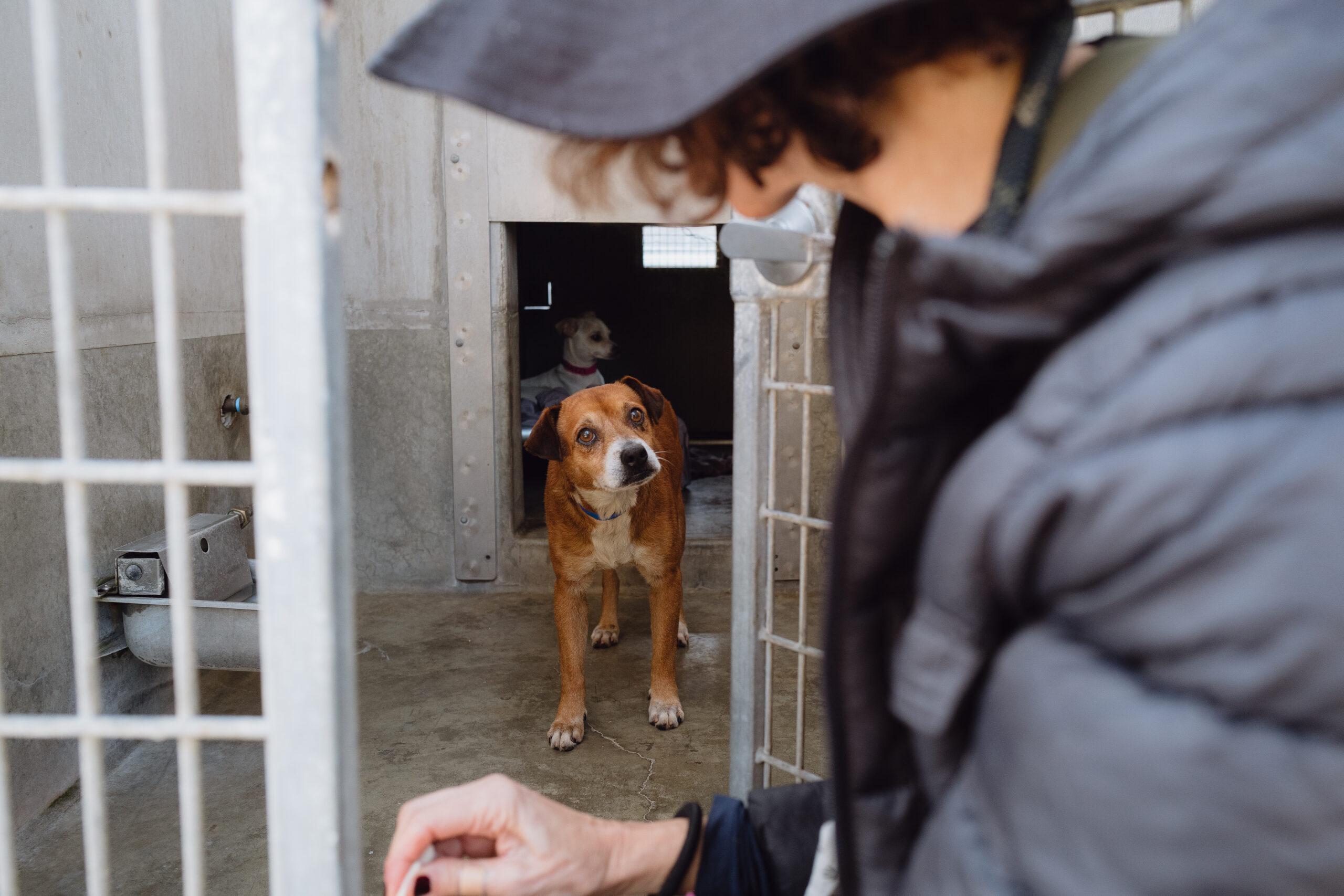
A volunteer visits with a dog at the South L.A. animal shelter. Photo: Zaydee Sanchez.
“When we spend time with animals we trust and feel comfortable around, this can activate the body’s relaxation system, which slows our heart rate, lowers blood pressure and helps us physically relax,” she said. “At the same time, our brains release oxytocin, called the bonding hormone.”
Under federal Fair Housing Act guidance, emotional support animals are not deemed service animals under the Americans with Disabilities Act. However, in housing, the Department of Housing and Urban Development mandates that landlords must make reasonable accommodations for tenants with disabilities who need an emotional support animal.
Critics sometimes frame such accommodations as special treatment. That framing misses the point. Housing policies already privilege people with money, credit and flexibility. Those with the greatest need are often the least able to navigate the process alone.
* * *
Parra’s social worker credentials make her a unicorn in the world of mental health and animal services. Downtown Dog Rescue says it is the only rescue or animal welfare organization in Los Angeles to have a social worker on staff focused on keeping owners and pets together for mental health reasons.
In L.A. County, about one in five pets surrendered in 2024 — roughly 7,290 dogs and cats — were given up because of housing restrictions or costs, according to a report by County Supervisor Hilda Solis.
Parra works out of the South Los Angeles shelter because it takes in the highest number of animals of the city’s six animal shelters. In Los Angeles, when animal shelters are full, the city euthanizes animals to make space, according to LA Animal Services. The city has tried to be a no-kill shelter system, which means achieving a 90% survival rate through adoption or rescue organizations, but has fallen short most years. So far this year, the South L.A. shelter shows one of the lowest survival rates among the city’s shelters, dropping to 73.8% in August, according to city data.
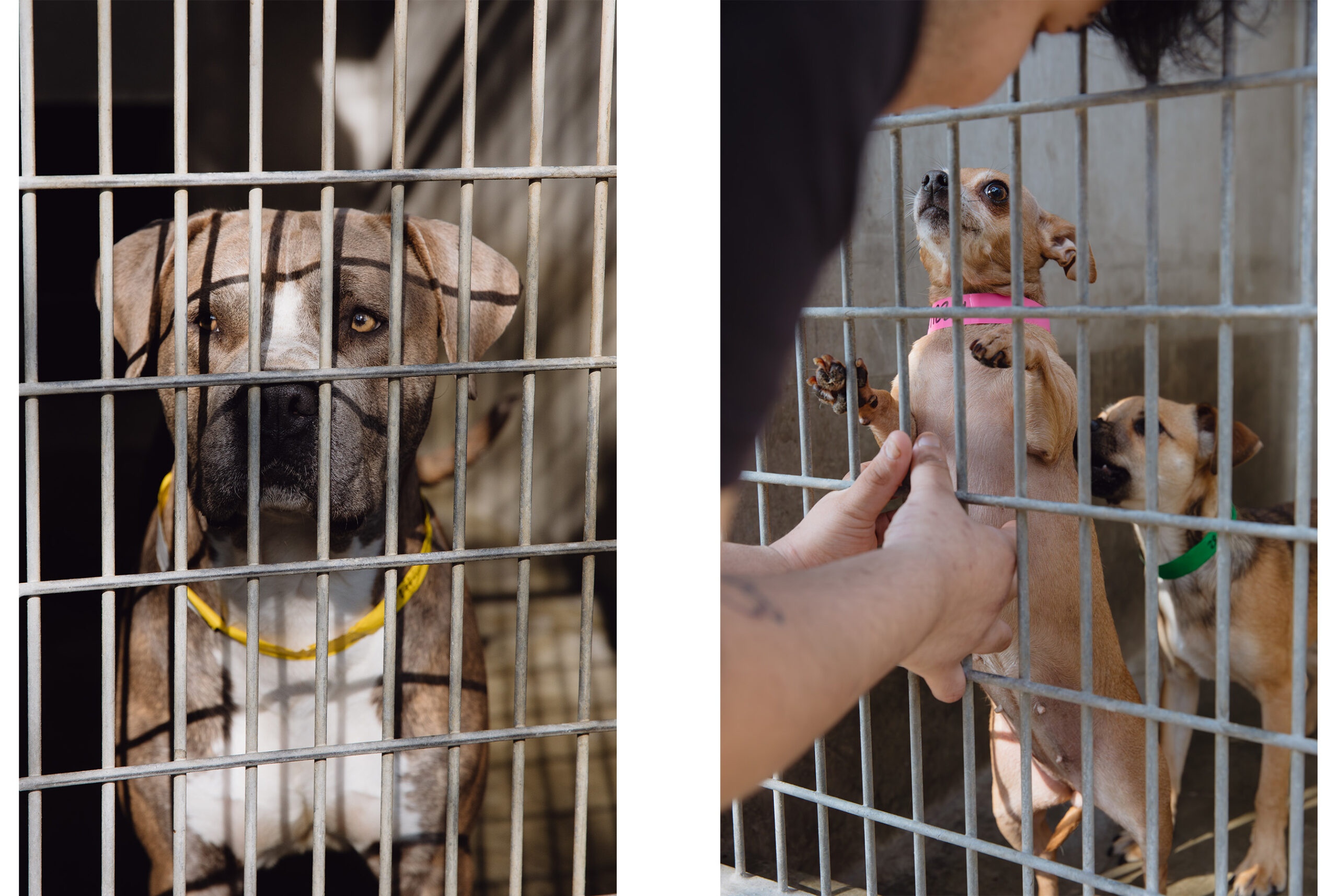
Adoptable dogs in the shelter’s kennels. Photo: Zaydee Sanchez.
Not all of the animals at the shelter are from unhoused families, but if Parra can help she hopes to keep as many animals with their people as possible.
This approach is common sense and L.A. would benefit from more support for pets and their owners who live outside. Pets are often the last thing left to help those without homes feel safe, supported and connected.
For those on the street, there are some efforts to help, such as the county’s Pathway Home, which offers some assistance to those who are moved from encampments into temporary shelter with pets, although it’s not enough with the number of people living outside here. Other cities, such as Denver, have piloted pet-friendly shelter programs and foster partnerships aimed at unhoused pet owners.
Before the rescue, Parra worked as an outreach worker for a homeless services organization. She became familiar with Downtown Dog Rescue because she encountered lots of animals in the homeless encampments downtown that needed help. She began volunteering on her own time for the rescue, transporting needy animals.
“I wanted to do something for my community and myself,” said Parra, who began volunteering after going through a breakup that brought on a deep depression. Parra’s 15-year-old Chihuahua, Chispita, was a comfort to her throughout her depression, her “ride or die,” she said. The job came later.
* * *
The stakes of Parra’s work become clearest in the lives of the people and animals she helps, like Romero and Taro.
Romero said that before she met Parra, she, her husband and their two children, ages 7 and 14, had lived in an RV for a year because they could not afford rent in the city. They had arrived in the U.S. just three years before from Venezuela and living in the RV helped them make ends meet. It was there that Taro the large puppy came to live with the family.
After the vehicle broke down while parked near 55th Street and San Pedro Street, it was cited and towed away with all the family’s belongings inside, Romero said. They did not have the money to pay the fees to retrieve the RV, she said.
When the shelter refused Taro, Romero was distraught. Someone referred her to the city shelter and Downtown Dog Rescue.
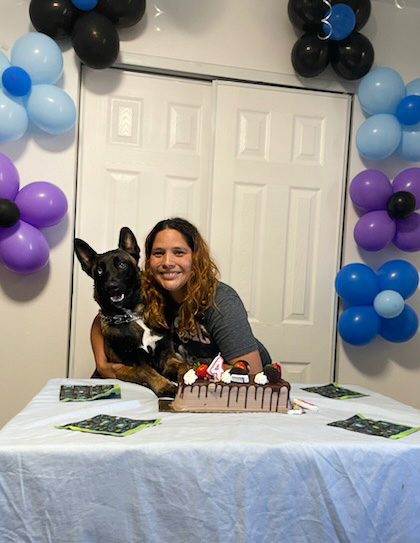
Orianna Romero and her dog, Taro. Photo courtesy Orianna Romero.
“Taro sleeps with me. He accompanies me everywhere,” she said. “I would never let him go. It would be the same as if someone said, ‘Give me your son.’ That is not possible for us.”
Through tears, Romero explained her situation to Parra — her diagnosis, her reliance on Taro and her fear of losing him. Parra wrote a letter qualifying Taro as an emotional support animal that kept the family intact.
“We feel the house is happier with him. For our children, it was super important to keep Taro,” Romero said.
The rescue helps individuals escaping domestic violence, seniors on fixed incomes, families torn apart by deportations and homeless families trying to get into a shelter.
“There are so many people out there that love their animals,” said Lori Weise, founder and executive director of Downtown Dog Rescue. “They go unnoticed and really don’t know that resources are available.”
Weise started the rescue in 1996 to help one unhoused man with his dog. Over the years, the small organization has received funding for a counselor to be at the shelter. Weise said it helped, but she saw the need for someone with more training, a social worker. Several years ago she started asking funders and applying for grants to support her idea. Two special grants gave life to the idea and funded Parra’s position, which began in April of 2024.
But Parra’s position is coming to an end in April when the current grant ends. The first year was funded by a grant from California for All Animals, a $50 million state initiative to support California animal shelters. The ASPCA funded the second year, Weise said.
Weise and Parra hope for additional funding or that the city or county will absorb the position. It’s a worthy aspiration for a program that works to save both people and animals who, as the adage goes, save one another.
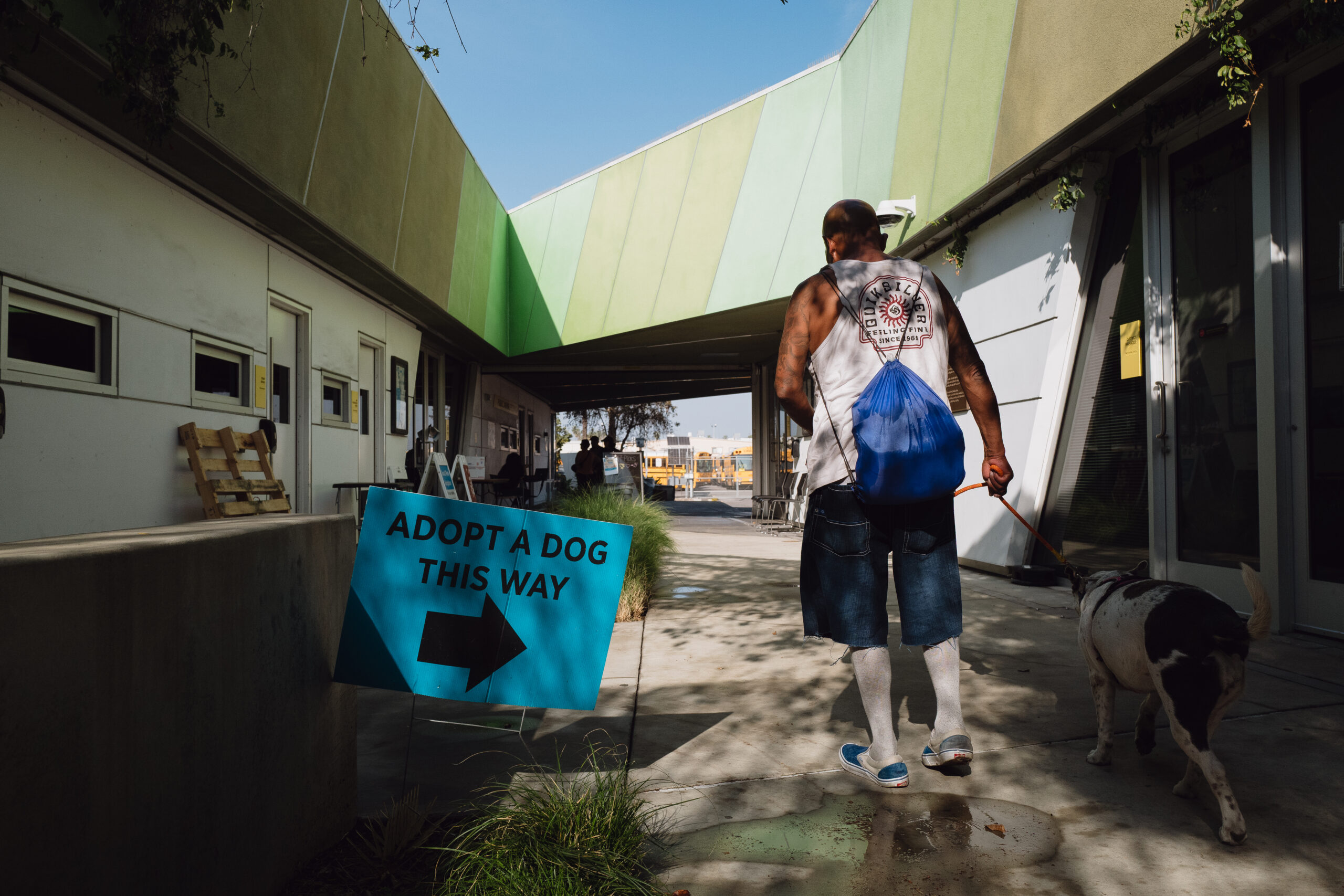
Robert Valenzuela and his dog, Mamas, walk through the shelter gates. Photo: Zaydee Sanchez.
Copyright 2026 Capital & Main.


-

 Column - State of InequalityMay 21, 2026
In California Governor’s Race, Xavier Becerra Walks Away From Single-Payer
-

 Latest NewsMay 22, 2026
Where California’s Gubernatorial Candidates Stand on Climate and Taking Big Oil Money
-

 Latest NewsMay 15, 2026
California Hazardous Waste Rules Criticized as Years Late and ‘Polluter-Friendly’
-

 The SlickMay 20, 2026
70-Foot Wastewater Geyser Reflects New Mexico’s Latest Oilfield Challenge
-

 The SlickMay 29, 2026
Feds to Open Tens of Thousands of Acres of Colorado Wilderness to Oil Drilling
-

 Latest NewsMay 18, 2026
Budget Cuts Threaten Program That Doubles Food Dollars for Californians in Need
-

 Deadly Dust: The Silicosis EpidemicMay 27, 2026
California Moves to Ban Quartz Countertop Fabrication to Combat Silicosis Epidemic
-

 Latest NewsMay 26, 2026
Conditions at California ICE Detention Centers Are Getting Worse, Inspections Find