
The Slick
New Mexico Again Debates Greenhouse Gas Reductions as Snow Melts
Lawmakers table bill to expand use of oilfield wastewater and shoot down another that would restrict drone use around “critical” infrastructure.

A contentious bill to dramatically reduce New Mexico’s greenhouse gas emissions remains in play at this year’s legislative session after two hearings. Meanwhile, a controversial bill to pave the way for treated oilfield wastewater to be used outside the drilling operations was shot down after nearly five hours of debate on Saturday. And another bill that would have sharply restricted the use of drones around “critical infrastructure,” including oil and gas operations and pipelines, was quashed before it could limit a powerful tool for documenting spills.
In its initial form, the Water Quality Commission Produced Water Rules bill would have kicked the state Water Quality Control Commission into gear to create rules to allow treated wastewater water to be used for all sorts of things: cement, hydrogen production, geothermal energy and even watering “industrial” crops and discharge into waterways — the last two being particularly controversial.
Oilfield wastewater — also known as produced water — is highly saline and can contain radioactive elements, toxic organic compounds and other contaminants from the well drilling process. Its toxic nature has kept it highly regulated. But record-breaking oil and gas production in the Permian Basin has also created record-breaking amounts of produced water, leading to problems with its disposal.
Currently, companies reinject the water back underground, but that has led to more frequent earthquakes and failed wells. Producers are desperate for another way to get rid of the water, even as New Mexico faces a growing water crisis. The dream is to clean the water so it can be used outside the oilfield.
Before Saturday’s hearing, the bill’s sponsors stripped out the most controversial possible uses, but public comment still ran 75-18 against the proposed legislation. “The reputation of New Mexico chile is at stake!” an Albuquerque resident testified, loudly, referring to the state’s famed peppers. “Don’t frack with our chile!”
After hours of debate by the House Agriculture, Acequias & Water Resources Committee, the legislation was tabled. Democrats on the committee weren’t convinced of the produced water’s safety or the bill’s need. Rep. Micaela Lara Cadena (D-Doña Ana) led the arguments and spent nearly an hour picking the bill apart.
If the effort sounds familiar, it should. Last year, a push to get the Water Quality Control Commission to reconsider a fresh ruling to postpone broader use of produced water use exploded after reporting showed Gov. Michelle Lujan Grisham had meddled in the process.
Tannis Fox, senior attorney at the Western Environmental Law Center, testified against the bill on Saturday, as she did last year. Before it was heard, she said, “The oil and gas industry is relentless in its efforts to obtain authorization for the reuse … of treated produced water. And industry has the support of the current administration.”
One-month legislative sessions like this year’s are nominally devoted to creating a budget, and legislators need an executive message from the governor to debate nonmonetary matters like this one. Gov. Lujan Grisham provided that on Jan. 30.
“The governor’s message is not an endorsement of the bill as drafted and introduced; rather, a message allows for the bill to advance through the legislative process, including debate and possible amendments,” Michael Coleman, the governor’s director of communications, said before the hearing. “The governor remains committed to advancing responsible and protective produced water reuse rules.”
After it was shot down, Fox said the bill, among other problems, “would have forced a new produced water rule on an extremely rushed timeline. … That would have deprived the commission of the rigor needed to write a rule that would keep New Mexicans and our water resources safe.”
Despite that, she expects proponents to resurrect the petition that died last summer, continuing the fight.
Meanwhile, the Unlawful Use of Unmanned Aircraft bill had its first and only hearing before the Senate Judiciary Committee. It would have restricted flying drones around “critical infrastructure,” including communications and electric networks, water pipelines, jails and prisons, child detainment facilities, military installations, airports, private property — and natural gas and crude oil facilities and pipelines on Monday.
“One of my colleagues said, ‘Hey, this is the Charlie Barrett bill,’” Charlie Barrett said. “I think it’s silly.”
Barrett, an ecologist and thermographer with Oilfield Witness, has made a name for himself in recent years by finding and reporting oilfield spills across New Mexico.
“That visual data can be really useful,” Barrett said. “We’ve documented gathering line spills, and the only way we were able to see it was because we could see a big black stain on the soil” from a drone.
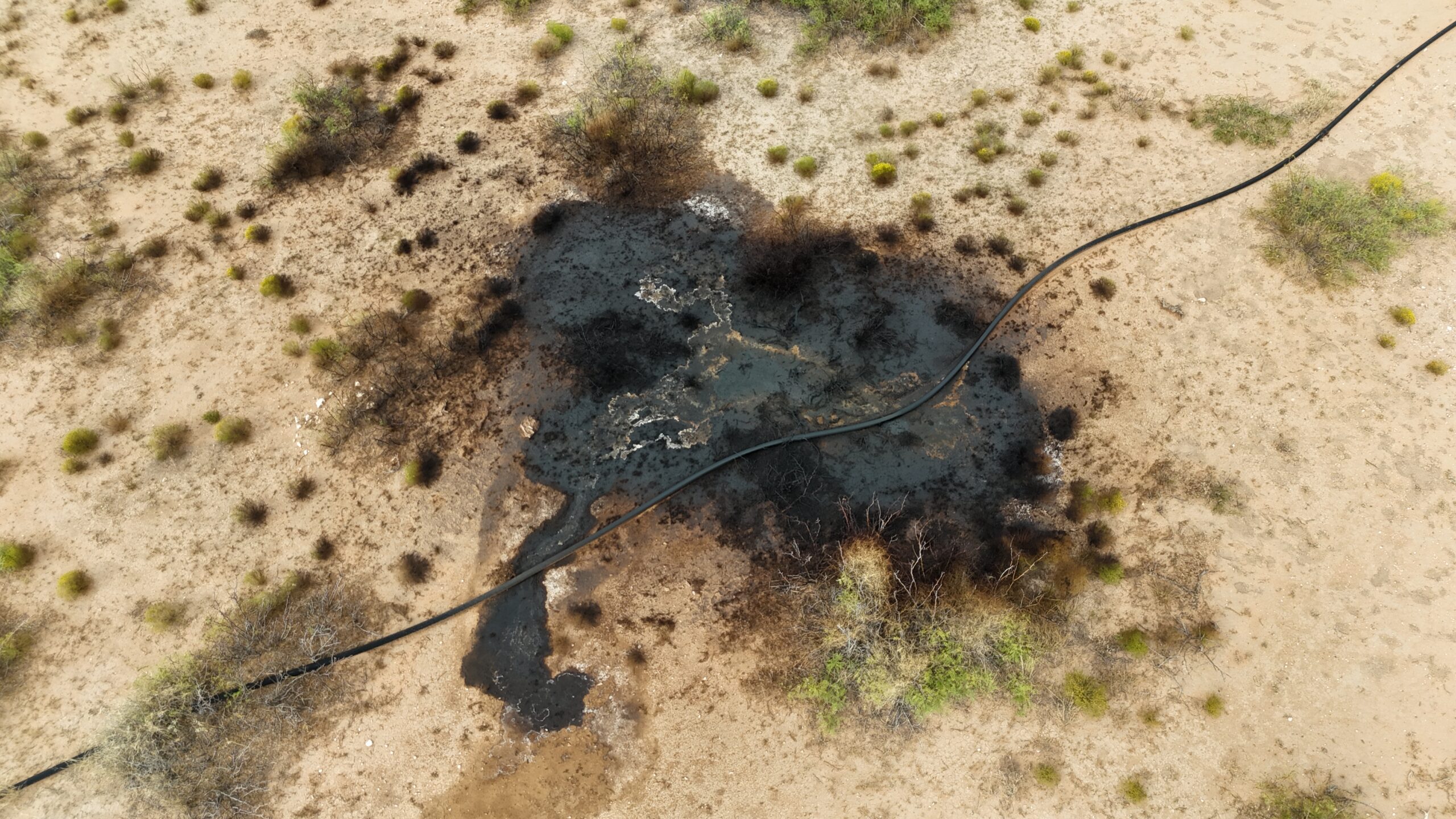
Aerial view of gathering line spill spotted by drone in the Permian Basin. Photo: Charlie Barrett.
During the hearing, bill sponsor George Muñoz (D-Cibola, McKinley & San Juan) didn’t mention no-fly zones for oilfield infrastructure. But Sen. James Townsend (R-Eddy & Otero) said, “It’s a constant battle protecting those facilities from drones because that drone invasion over that can be very serious.”
Sen. Antoinette Sedillo Lopez (D-Bernalillo) told a story of buying her husband a drone for Christmas, which led to them inadvertently finding out that a neighbor swam in their pool in the nude. “Were we guilty of a misdemeanor?” she asked. “I just don’t think that this bill is ready,” she said.
Neither did the committee — they voted it down.
* * *
The Clear Horizons & Emissions Codification Act, sponsored by the president pro tempore of the Senate, Mimi Stewart (D-Bernalillo) would increase oversight of greenhouse gas emissions across the state — particularly from the oil and gas industry.
The push is fueled by recurring climate blows. Across the state, 95% of monitoring stations are in a “snow drought,” made worse after last year’s dismal snow pack. What remains is melting under unusually warm temperatures.
To promote its passage, Desirée Bernard and Clara Sims, both directors with the group Interfaith Power and Light, undertook a three-week walk from Carlsbad, in the middle of the Permian Basin — the country’s most productive oil and gas field — to the Capitol in Santa Fe.
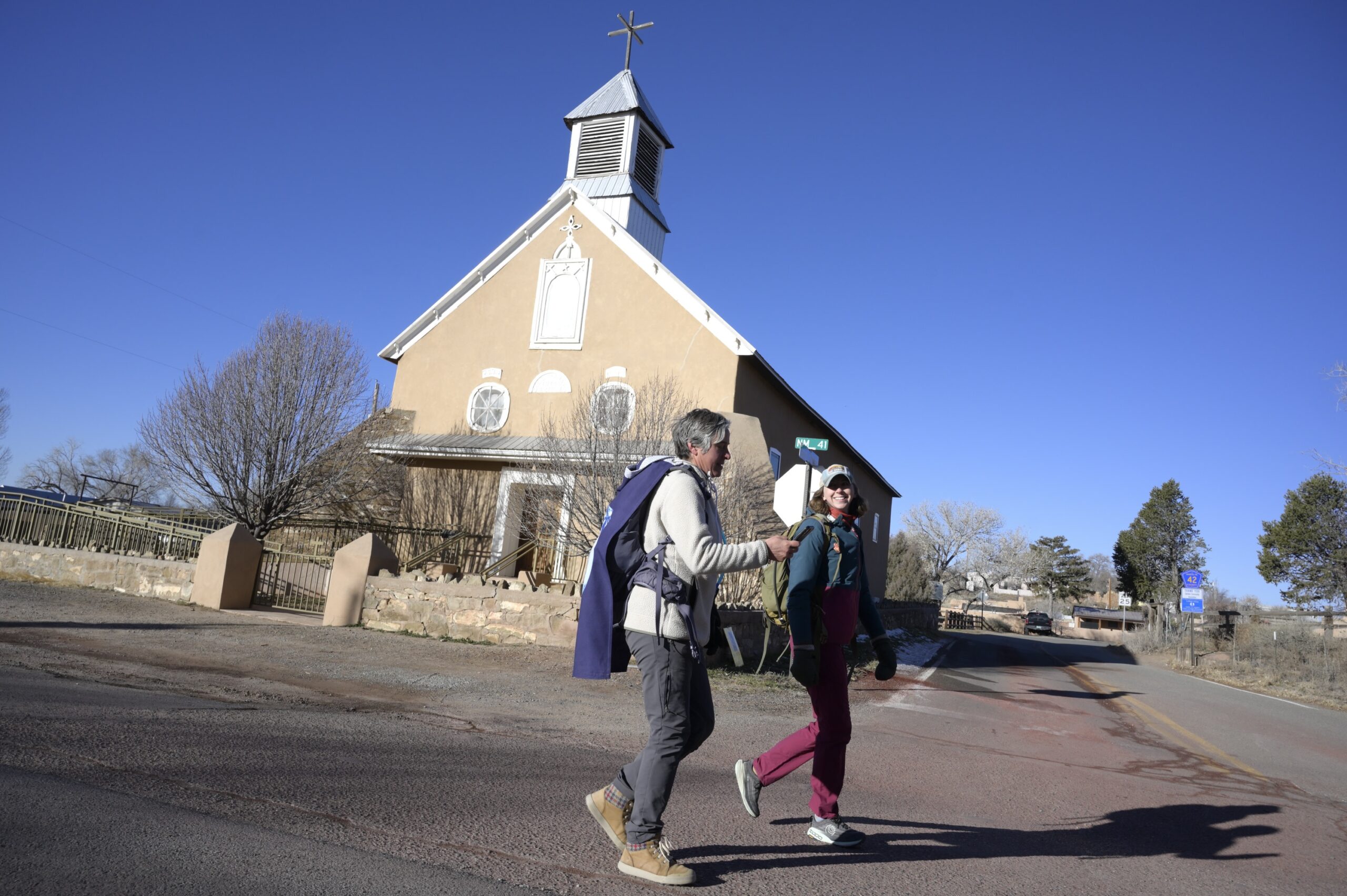
Desirée Bernard and Clara Sims, both directors with the group Interfaith Power and Light, pass the old church in Galisteo, New Mexico, as they begin another leg of their walk to Santa Fe. Photo: Jerry Redfern.
They called their 330-mile, 25-day walk a pilgrimage to connect that most polluted corner of the state with the state’s lawmakers during the legislative session. They want to deliver prayers and a multipart request: to transition away from fossil fuels; to hold industry accountable for pollution; to protect New Mexicans facing climate change impacts; and to encourage the Legislature to pass the Clear Horizons Act.
Last week, the two began that day’s walk just as a Senate committee held the bill’s first hearing. The act would force dramatic greenhouse gas reductions statewide: 45% by 2030, 75% by 2040 and a 100% reduction by 2050, all compared to a 2005 baseline.
The goals and the bill are an attempt to codify and expand Gov. Lujan Grisham’s third executive order after taking office in 2019. The state would get there in two ways: by direct reductions at sources where greenhouse gases are produced; and by offsets through which a company creates regulated gases in one place, but removes an equal amount elsewhere in New Mexico. The latter was an update proposed by oil companies after last year’s failed version of the bill, according to Stewart.
The state’s most recent greenhouse gas inventory in 2024 forecasted that the oil and gas industry would produce about 40% of those emissions in the state in 2025, nearly the same percentage as four years earlier. (A report released last week by the Environmental Defense Fund suggests that inventory may be radically low.) The state inventory also shows that the state is on track to miss the governor’s 2030 greenhouse gas reduction goal, diminishing such emissions by 32% versus the stated target of 45%, without a dramatic policy shift, including larger reductions from the oil and gas industry. Unsurprisingly, the bill is not popular with that group.
The immediate impacts of oil and gas production in the Permian Basin were front and center for Bernard and Sims as they walked between Carlsbad and Artesia in January.
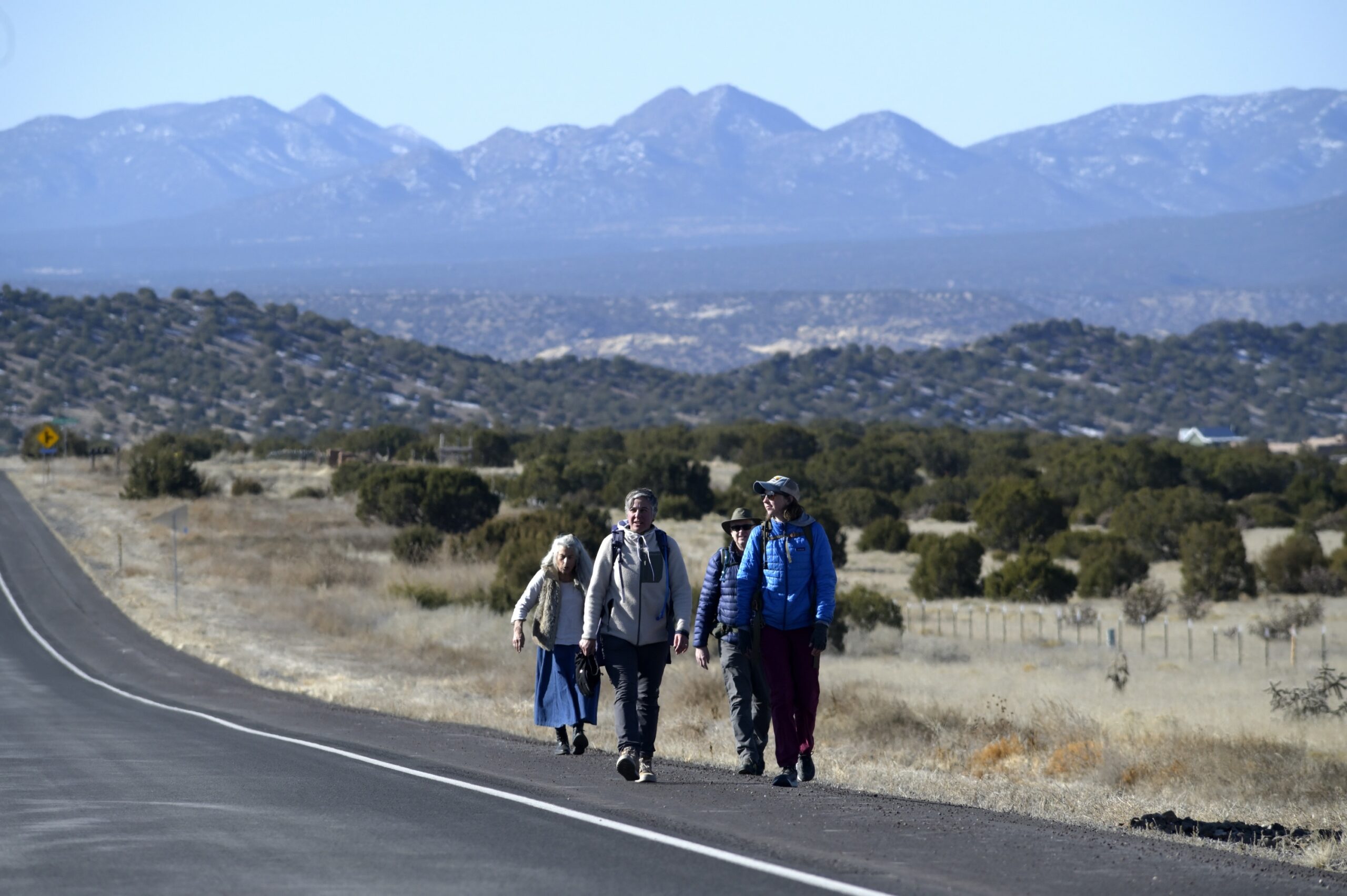
Bernard and Sims, in front, walk along a rural highway on the way to Santa Fe. Photo: Jerry Redfern.
“Walking through those regions and smelling the very, very intense stench in the air and seeing all the warning signs and the poison signs, and just really feeling for the folks who were breathing that air and breathing it ourselves was difficult,” Bernard said.
Sims said that difficulty was driven home for her at a community meal in Artesia where locals told her they felt unrepresented. “They feel like their legislators will not hear them or represent them when it comes to oil and gas,” she said.
The inspiration for their pilgrimage came from an unexpected source: the father of one of the state senators who voted against last year’s version of the bill. In 1989, Ed Muñoz, then the mayor of Gallup, New Mexico, and father to current state Sen. Muñoz, led a march from his home town to Santa Fe to get the Legislature to tighten loose liquor laws that fed the town’s alcohol-fueled problems.
Bernard came across the story while researching those who voted against the Clear Horizons bill in 2025 — like Sen. Muñoz — and shared the idea with Sims. The two of them even talked with Sen. Muñoz about their plan, and they said that he worried about their safety on the road (the senator did not respond to a request for comment). Sims said that the walk happened almost entirely without incident. She said, “We got yelled at by a woman in a car. Once.”
Along the way, the two collected prayers for the planet from people they met, to be shared with legislators when they arrived in Santa Fe. Bernard told of meeting a rancher north of Roswell, who stopped to make sure she was OK walking alone on a road in the middle of nowhere while Sims conducted a sermon at her church. He told Bernard that he had been hauling water for his animals for 10 years because of the ongoing lack of rain — a reflection of the regional megadrought. His prayer was “Moisture.”
“Wow,” she said later. “He just offered up a climate prayer.”
The first legislative debate over the Clear Horizons Act bill ran nearly five hours — long for any legislative hearing. The last person to speak was Sen. Angel Charley (D-Acoma Pueblo).
“The land gifted us the budget that we now use to take care of the people of New Mexico,” she said. “Today I am asking us to take care of the land … in the same way she has always taken care of us.”
Around the time that Bernard and Sims stopped walking on Tuesday, the Clear Horizons Act passed that first hearing. And Saturday evening it passed its second hearing along party lines in the Senate Tax, Business and Transportation Committee, pushed over the line in a comparatively brisk two hours by chair Carrie Hamblen (D-Doña Ana). It awaits a hearing on the Senate floor.
Copyright 2026 Capital & Main.
Correction: Desirée Bernard was identified as Desirée Barnes in an earlier version of this story.



-
 The SlickMay 29, 2026
Feds to Open Tens of Thousands of Acres of Colorado Wilderness to Oil Drilling
-
 Deadly Dust: The Silicosis EpidemicMay 27, 2026
California Moves to Ban Quartz Countertop Fabrication to Combat Silicosis Epidemic
-
 Latest NewsMay 26, 2026
Conditions at California ICE Detention Centers Are Getting Worse, Inspections Find
-
 Imperial DivideJune 3, 2026
California’s Lithium Valley Dreams Meet Reality at the Only Restaurant in Town
-

 Column - State of InequalityMay 28, 2026
Top Democratic Candidates Agree on Housing Urgency, Not the Fix
-

 Latest NewsJune 1, 2026
Deep Cuts to Civilian Support Staff for Families of Deployed Marines Raise Concerns
-

 Column - State of InequalityJune 4, 2026
California’s Economy Runs on Labor Trump Wants to Deport
-
 The SlickJune 5, 2026
At This New Mexico Park, Mountain Bikers Pedal Amid Hundreds of Oil Wells