
Striking Back
Home Care Workers Are Losing Minimum Wage Protections — and Fighting Back
Three million care workers, many of them Black and Latina women, could be classified as “companions” instead of professionals.
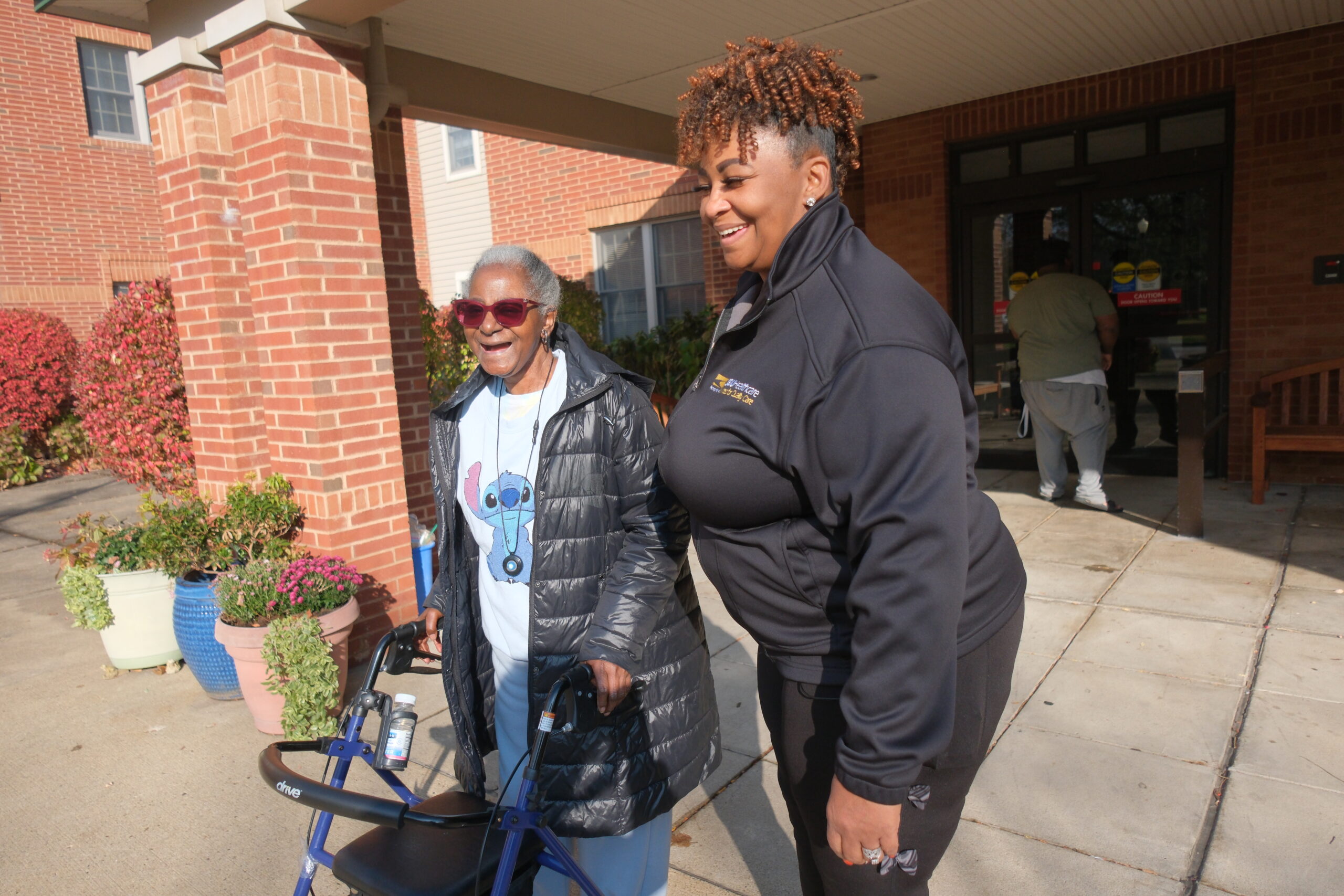

For more than two decades, Denise Lugo has worked as a home care worker in Fayetteville, North Carolina, caring for elderly clients in their homes.
Workers like Lugo provide intimate care for seniors and people with disabilities who cannot care for themselves. For what’s often grueling work, Lugo makes $15 an hour caring for two clients, juggling everything from light housekeeping to household errands to bathing, dressing and exercising.
But Lugo’s livelihood and that of 3 million home care workers across the country is now in peril under a proposal by the Trump administration to end their rights to federal minimum wage and overtime.
“Without my income from caregiving, I would be in the streets,” Lugo, who organizes with the National Domestic Workers Alliance’s We Dream in Black North Carolina chapter, wrote to the Department of Labor in an official comment on the proposed rule. “What would you do if one of your family members needed a home health aid and you can’t get one because you are not paying us enough?” she asked.
Workers like Lugo have been mobilizing against the Trump administration proposal, which reopens a loophole allowing employers to broadly classify care workers as “companions” who can be paid less than minimum wage and are not eligible for overtime pay. The fight has also energized workers’ efforts to push state and federal lawmakers to strengthen their rights even as federal ones are taken away.
* * *
Today, home care work is ubiquitous, with at least 9.8 million older adults and people with disabilities relying on care workers in order to stay out of institutional care. Indeed, home health and personal care work is one of the fastest-growing occupations in the country, projected to add nearly 740,000 workers between 2024 and 2034 — a jump of 17%. But without a federally mandated right to minimum wage and overtime, workers’ wages — and how easily employers can cut them — will vary depending on which state they are in.
“[T]his is going to create a patchwork of [state] laws,” said Anamaria Segura, an attorney at Getman, Sweeney & Dunn, a Kingston, New York-based firm that fights wage theft on behalf of workers nationwide, including home care aides.
At least one-quarter of all home care workers will lose their right to minimum wage and overtime under the Trump administration proposal because they live in states that have no additional wage protections for home care workers. Rights for the rest vary widely. In Pennsylvania, for example, state law guarantees minimum wage and overtime for the 94% of home care workers employed by agencies, but not the 6% directly employed by their client. Meanwhile, home care workers in New York have been entitled to minimum wage since 2010, when the state passed the first state-level Domestic Workers Bill of Rights.
If Lugo’s agency decides to classify her as a companion, it could legally pay her even less than the state minimum wage, which matches the federal rate of $7.25 an hour. She’ll be left with two options: take the lower wage — or quit.
The change, part of a suite of 63 deregulatory actions by the U.S. Department of Labor, is already effectively being implemented, said Mimi Whittaker, a legal fellow at the National Employment Law Project. Rulemaking is still in process, but leadership at the Department of Labor’s Wage and Hour Division instructed staff in July to immediately refrain from investigating home care agencies that had been charged with misclassifying workers as companions, and to drop any cases currently being considered.
The agency is “currently reviewing and considering the more than 5,500 comments received in the department’s proposal,” a Labor Department official said in an email.
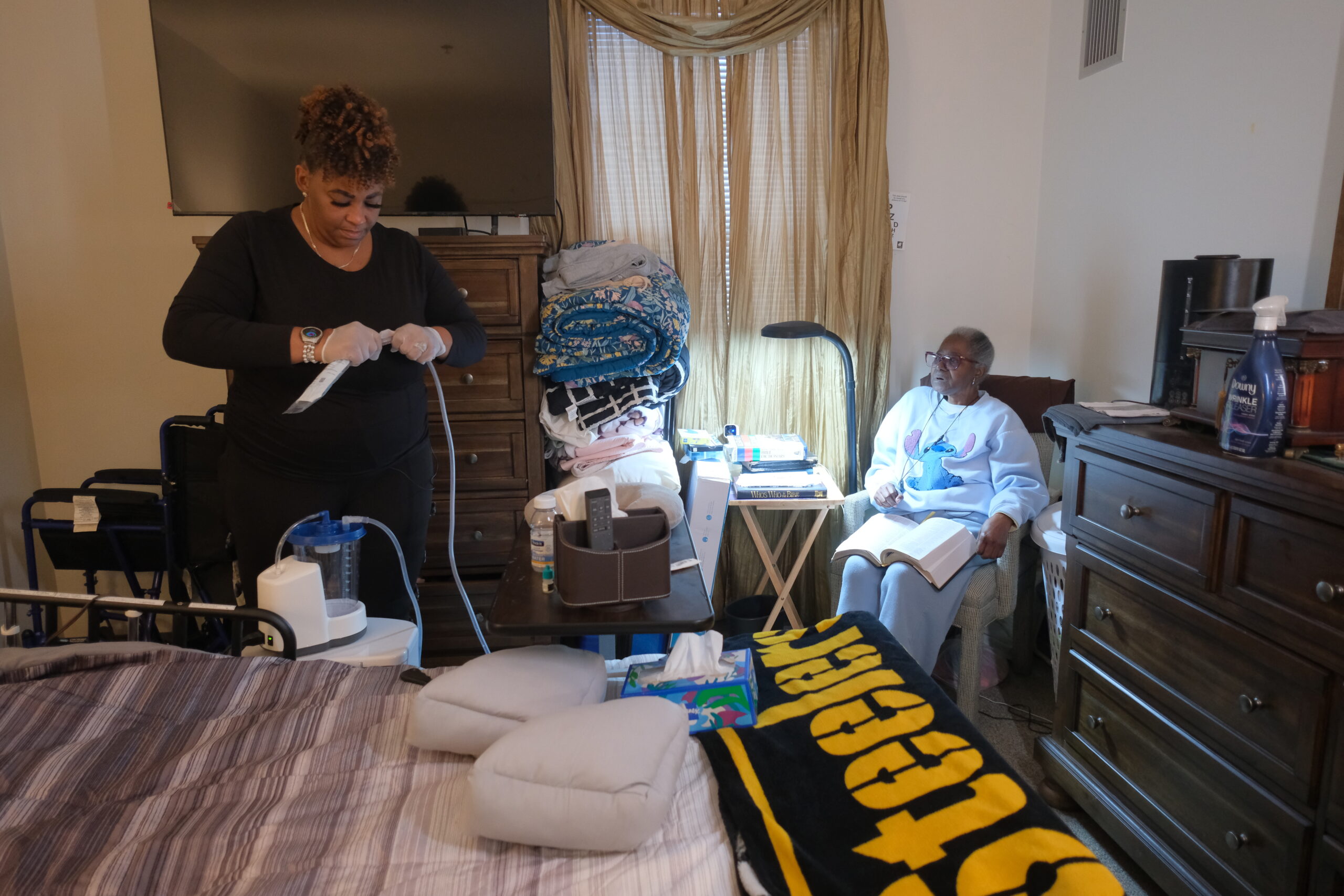
Home care worker Angela Engram tends to her client Linda Stokes’ bedside medical equipment.
Home care employers, particularly for-profit agencies, often exploited a “companionship” loophole that existed from 1974 to 2015, said Eileen Appelbaum, co-director of the Center for Economic and Policy Research. In 1974, the Labor Department extended wage and overtime protections to care workers unless they were “companions.” In 2013, regulators restricted the companionship definition and closed the loophole as of 2015.
Prior to the 1974 change, care workers had no rights to minimum wage or overtime pay, because Congress had excluded jobs primarily held by Black workers from the Fair Labor Standards Act of 1938. Today, the field is 84% female and 67% nonwhite.
The move to reopen the companionship loophole was “a handout to big corporations, the home care agencies, [which are a] powerful industry [with] a lot of private equity investment,” said Whittaker. The majority of home care agencies are for-profit, and an increasing share of them are run by private equity groups.
The Home Care Association of America, an industry group, “lobbied DOL extensively” for the rule change, according to an August newsletter for the roughly 3,500 home care agencies in its membership.
The association also provided members with a comment template that said the 2013 rule extending labor protections to home care workers “limited access to affordable home care by increasing costs and administrative burdens for home care agencies.”
The Home Care Association of America did not respond to requests for comment.
Home care industry experts expect the rule to be finalized soon. In September, before the government shutdown, attorney Angelo Spinola with the Polsinelli Law Firm told home care and hospice agencies that his “best guess” was that the rule would become effective in January.
* * *
Home care workers have pushed back against the proposed rule, the latest battle in a long fight to improve working conditions.
As soon as public comments opened for the July proposal, the National Domestic Workers Alliance, a worker advocacy group, coordinated 2,206 public comments from members and allies. The group also pushed to extend the comment period. On Aug. 25, the agency declined that request. The comment period closed on Sept. 2, with more than 5,500 comments submitted.
In a Sept. 2 letter to the labor secretary, Rep. Pramila Jayapal and more than 100 other Democratic representatives argued that the proposal would “jeopardize our nation’s care economy [and] destabilize an already underpaid workforce.”
Labor officials and attorneys general in Democratic-controlled states have also weighed in with comments, arguing that the proposal would put a greater burden on states to police wage theft.
The proposal has also energized existing fights for stronger federal and state protections.
At the federal level, 114 Democratic representatives have co-sponsored a National Domestic Worker Bill of Rights introduced by Rep. Jayapal in June. The legislation would guarantee care workers’ minimum wage, overtime and anti-discrimination protections through amendments to the Fair Labor Standards Act, which governs wages and overtime, and the Civil Rights Act. Every House Republican and 98 Democrats have so far declined to co-sponsor.
Even if the bill doesn’t advance, said Whittaker, the effort can help build momentum in campaigns to expand state labor protections. That effort is further along in some states than others. Currently, about half of U.S. states have protections that at least partially close the loophole, although details vary widely.
In September, after a lobbying push by California’s United Domestic Workers and other caregivers, California passed a bill codifying home care workers’ overtime protections into state law. (Disclosure: UDW is a financial supporter of Capital & Main.)
Meanwhile, existing home care workers’ fights have taken on new urgency, whether with unions or worker centers.
In Washington State, home care workers with Service Employees International Union 775 advocated for a successful ballot resolution this election that backers say will increase funding for long-term care and, therefore, job security for care workers. (Disclosure: SEIU is a financial supporter of Capital & Main.) In Illinois, home care workers with SEIU Healthcare Illinois have demanded progressive taxation to fund senior home care threatened by Medicaid cuts in the Republican-backed federal tax law. In Michigan, 32,000 home care workers unionized with SEIU Healthcare Michigan this past October. And in Pennsylvania, home care workers with SEIU helped push the state legislature to pass a 2026 budget in November that includes $21 million to raise wages for care workers hired directly by their clients — the same workers left without protections thanks to the federal loophole.
And in Georgia, workers with that state’s We Dream in Black chapter have advocated for a bill requiring Medicaid-funded home care agencies to share data on wages, benefits, vacancies, and workforce demographics.
* * *
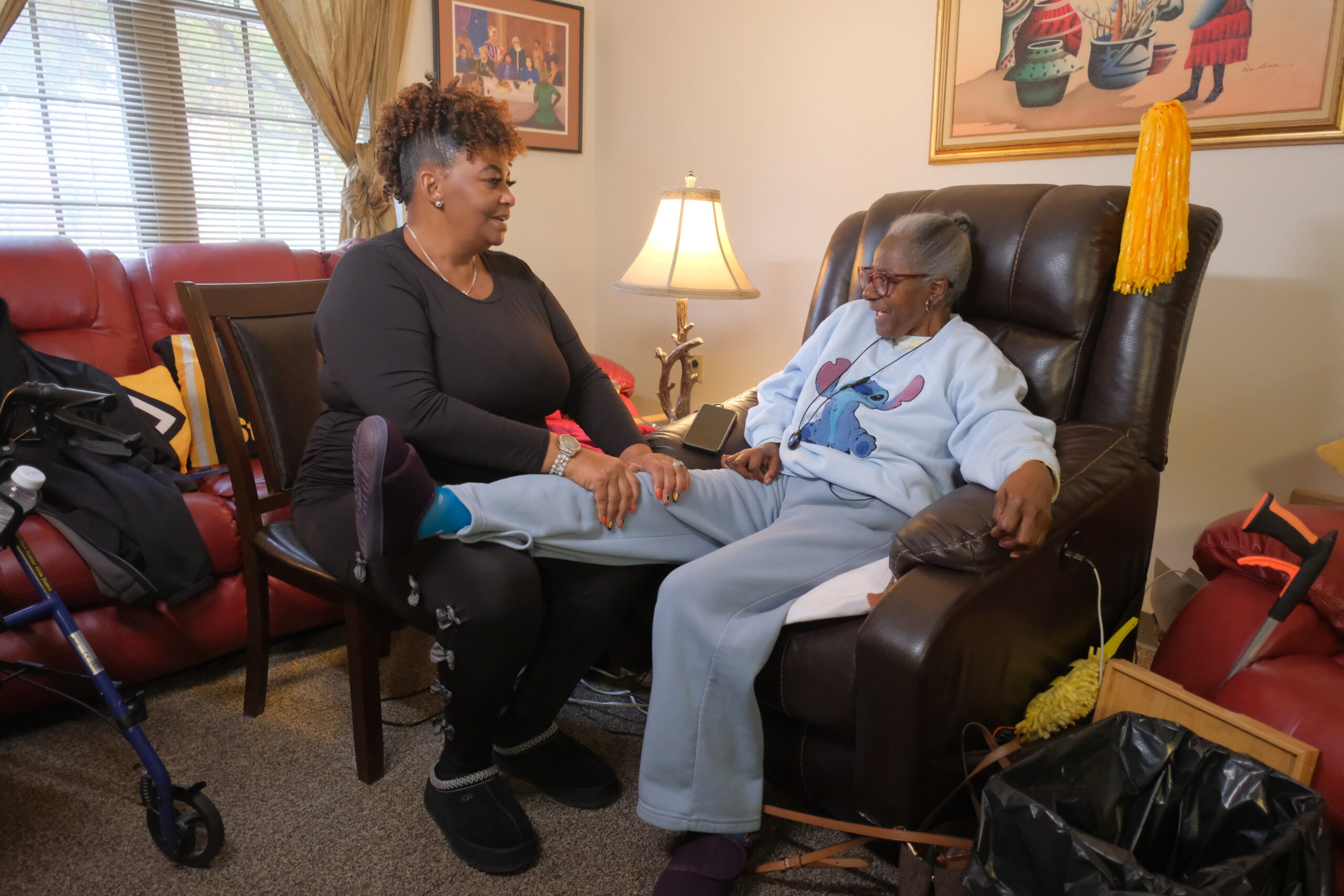
Engram massages Stokes’ leg to increase blood circulation before their daily walk.
Angela Engram, a home care worker in Pittsburgh, worries the change could put an end to overtime pay she needs.
Engram works more than 60 hours per week caring for an elderly client who hires her directly. For doing “everything” for the woman she cares for, Engram said — grocery shopping, housekeeping, helping her get dressed, coordinating doctor visits and showing up at night if something is wrong — she makes $13.53 per hour. Thanks to overtime protections, she usually earns around $20.30 for every hour above 40 each week.
“I basically live off my overtime pay,” she said. But if she’s classified as a companion rather than a worker, she could lose it.
“I wouldn’t be able to eat without it, pay my bills without it,” Engram said. Her husband is disabled and unable to work. She gets health insurance through a subsidized plan on the Affordable Care Act marketplace. In October, she started requesting 90-day prescriptions, expecting that they will become unaffordable if Congress allows the subsidies to expire.
“Without the overtime, my goodness, there’s no way I can live off of $13.53 an hour,” Engram said. “I’m barely doing it now.
Copyright 2025 Capital & Main.
Photos by Jeff Ricker.


-

 Column - State of InequalityMay 21, 2026
In California Governor’s Race, Xavier Becerra Walks Away From Single-Payer
-

 Latest NewsMay 11, 2026
Inside the Texas Water Crisis Pitting Residents Against Industry
-

 Latest NewsMay 22, 2026
Where California’s Gubernatorial Candidates Stand on Climate and Taking Big Oil Money
-

 Latest NewsMay 15, 2026
California Hazardous Waste Rules Criticized as Years Late and ‘Polluter-Friendly’
-

 Latest NewsMay 12, 2026
Government Fails to Provide Adequate Interpreter for Deaf Ukrainian Asylum Seeker
-

 The SlickMay 20, 2026
70-Foot Wastewater Geyser Reflects New Mexico’s Latest Oilfield Challenge
-

 Latest NewsMay 13, 2026
While Pentagon Spends Billions on War, Military Families Say They’re Getting Short-Changed
-

 Column - State of InequalityMay 14, 2026
The Real Stakes Behind California’s Billionaire Tax Fight: Health Care Access