
Culture & Media
Zuccotti Park Blues: Occupy Wall Street Reconsidered

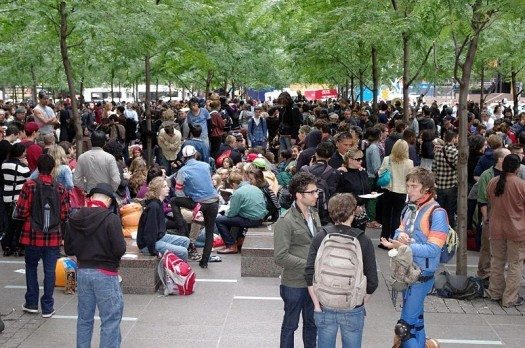
Was Occupy Wall Street just a dream? The fall of 2011 was one of the most exciting and optimistic times of my life as a progressive. Seeing thousands of young people all over the country flock to their local occupations was truly amazing and historic. I felt that we were in the middle of a cultural awakening and that a huge radical change was just on the brink.
The other weekend I went to New York City to see where it all began up close and in person. I walked to Wall Street to find Zuccotti Park and literally walked right past it. Quite naively I expected a huge space with progressive activists still meeting and planning the revolution, but found no one. In fact, Zuccotti Park is a tiny little plaza where tourists rest after visiting Ground Zero and taking pictures of the Wall Street bull sculpture. On the subway back to my friend’s house, I found an old edition of the Occupied Wall Street Journal telling inspiring stories about the encampment. A part of me felt that I had missed the moment when lightning struck and that whatever happened in that short time needed to be forgotten.
What’s missing here? Why does it feel as though the occupation movement lost even before it really got started? Even Robert Reich’s recent article, “April Is the Cruelest Month As the Economy Crawls Along,” seems to only confirm what we already know: Our economy is far from the total revolution and optimism that the occupiers had in mind.
I wonder, however: Is total revolution necessary or possible? I won’t pretend to answer that in 500 words or less, but in the midst of the “Marx was right” discussions I’ve had with fellow activists over the past few years, we seem to neglect the value of Michel Foucault’s ideas on revolution. Foucault, a wonderfully complicated postmodern thinker, grabbed the philosophical bull by its horns in stating, “Power is everywhere.” It’s not limited to the One Percent or the banks or the politicians. It’s dispersed, in constant flux and negotiation. Resistance occurs in the personal every day experience, in the words we use, in our choice of seemingly insignificant actions all the time.
If this is the case, and I hope it is, then we need not confine ourselves to a depressive state. OWS, in its grandest notions of self, is only one of millions of daily acts of resistance to corporate dominance and disparate inequality. These actions, such as an organizer speaking to a worker about her job conditions for the first time, need to be recognized and celebrated. If not, the vision of OWS becomes just a sad commentary of yet another failed attempt for average people to do something extraordinary.
(Rachel Torres is a research analyst for Unite Here Local 11.)



-

 Featured VideoJune 5, 2026
At This New Mexico Park, Mountain Bikers Pedal Amid Hundreds of Oil Wells
-

 Latest NewsJune 9, 2026
Ousted by the Trump Administration, U.S. Immigrants Remain Locked up in African Kingdom
-
 The SlickJune 10, 2026
Data Centers Are on the Ballot — This Pennsylvania Candidate Won Her Primary Keeping Them Top of Mind
-

 Latest NewsJune 8, 2026
The Glacier May Be Gone, but the Love Isn’t
-
 Latest NewsJune 12, 2026
California Town Lets Private ICE Detention Centers Police Themselves
-
 Column - State of InequalityJune 11, 2026
County Tax Measures Show Limits of Local Responses to Medicaid Cuts
-

 The SlickJune 16, 2026
Why Coal Will Lead to More Deaths in Colorado
-

 Latest NewsJune 17, 2026
California Rideshare Drivers Move Toward Unionizing, Following Massachusetts