

These pages are filled with stories of bad corporate actors — companies that attempt to boost profits by cutting labor costs at the expense of safe and ethical work environments. It’s a pleasure, then, to report on a multinational company’s CEO who is trying to make a difference.
Karl-Johan Persson, the CEO of H&M, recently traveled to Bangladesh, a country from which the fashion giant sources tons of textiles, to meet with Prime Minister Sheik Hasina and ask that textile workers be paid a fair wage.
The visit was pure activism as H&M does not actually own any Bangladeshi factories, it simply sources from the country. The argument Persson used with the PM is strikingly similar to that used by U.S. living wage advocates: A higher wage will be good for the country, not just workers.
Corporate Social Responsibility Newswire reports on the strategy behind the visit:
In addition to working with suppliers to increase wages,
» Read more about: A Responsible Persson: H&M's Boss Argues for Wage Hikes »


Big Food companies and their lobbying groups have lied to us many times. They convinced Congress to include tomato paste on pizzas as a vegetable. They say we need industrial, chemical-laden agriculture to feed the world. (Check out Anna Lappé’s new video Food MythBusters to learn that we don’t.) And Big Food has also spread the mythology that if the minimum wage is raised, food will become so expensive that none of us will be able to afford to eat out – or eat at all – again.
Yes, that’s a lie! On this Food Day 2012, our organizations are releasing a new report, A Dime a Day: The Impact of the Miller/Harkin Minimum Wage Proposal on the Price of Food. The proposed Fair Minimum Wage Act, introduced this year by Representative George Miller (D-CA) in the House and Senator Tom Harkin (D-IA) in the Senate would raise the federal minimum wage from $7.25 to $9.80 per hour over the next three years and the tipped minimum wage from $2.13 to 70 percent of the regular minimum wage.
» Read more about: What Can You Get for a Dime a Day? A Lot, Actually »
As pundits constantly remind us, when it comes to the national elections, it’s the economy, stupid.
But the parameters of the debate about our dire economic straits has been disappointingly narrow, leaving out some of the most pressing issues facing tens of millions of Americans.
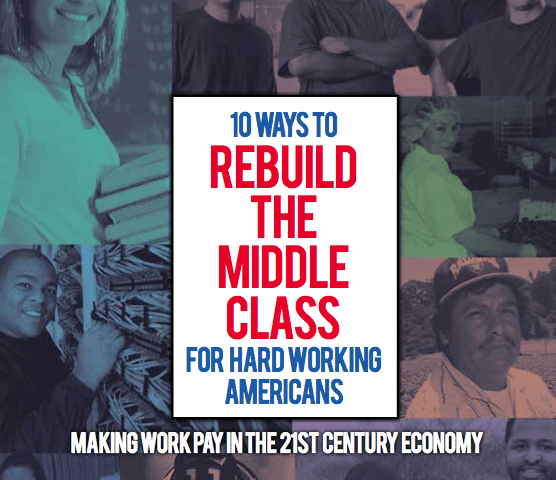
If national leaders are serious about reviving the economic fortunes of our struggling middle class, the unemployed and the growing ranks of the working poor, they would do well to take a long, hard look at the new report, “10 Ways to Rebuild the Middle Class for Hard-Working Americans: Making Work Pay in the 21st Century.” Released today by a consortium of two dozen organizations across the country, the report is a clarion call for a set of policies that are largely off the radar screen of both major parties. This deafening silence notwithstanding, the prospect of a true economic recovery that restores the promise of broadly shared prosperity is nearly inconceivable without the adoption of most of these proposals.
» Read more about: A Prescription for Middle Class Recovery »

There is little disagreement that consumer spending is a critical driver of American economic growth. The recession that began in 2007, while precipitated by the meltdown in the financial sector, is at root a crisis of aggregate demand. The halting recovery has been punctuated by disappointing monthly job reports and—just as important—by gloomy predictions from the Conference Board’s monthly survey of consumer confidence. Even business surveys admit (here and here) that anemic consumer demand (not “job-killing regulations”) is holding back new job creation and economic recovery.
Yet, despite worries about sagging consumer confidence and shrinking paychecks, business leaders seem unconcerned about the declining standard of living of middle-class America, or about the growing number of American families slipping into poverty. Over the last generation, wages for middle-class workers haven’t budged, while compensation for corporate executives and owners is reaching stratospheric levels.

My grandchildren live on pizza. Oh, they eat other things that young children like, but whenever mom or dad work late or events intervene, the call goes out for pizza man to deliver.
I was thinking about this when I read a piece in The Week a while back about franchisers who will soon need to cover the cost of health insurance for their low-wage workers or pay a fine. The case study focused on a guy who owns a string of chicken and Mexican fast food stops and who employs 425 workers. Some of these people run the front counter. Some do the deep frying. Some sweep up. None, apparently, have any health insurance.
The owner complains that providing these workers health insurance will cost him $546,000 a year – a cost that he says his business plan simply cannot support. Really? I thought.
» Read more about: Pizza, Health Care and the Minimum Wage »
Few American institutions have been subjected to such a consistent stream of vitriol and assault as the minimum wage, which celebrates its 74th birthday this week. The first federal minimum wage was established when FDR signed the Fair Labor Standards Act (FLSA) on June 25, 1938. The FLSA also established the eight-hour day, paid overtime and child labor protections into federal law. Since then, it has been amended nine times to expand coverage and to raise the wage to keep it in line with the nation’s economic growth.
Business leaders, industry associations, politicians and more recently think tanks have opposed the FLSA and every legislative amendment since. They said it would destroy American civilization, kill jobs and hurt black people. Business owners predicted they would be forced into bankruptcy.
One business opponent of the 1938 legislation even warned that the minimum wage would lead to the decline of the American empire.
» Read more about: Minimum Wage Doomsayers Still Wrong After 74 Years »