
Latest News
Fire Recovery Could Wipe Out Altadena’s Affordable Rentals
Without funding and policy interventions, rebuilt homes will rent at market rates, pricing out long-term residents.


In the weeks after the Eaton fire devastated the foothill community of Altadena, local officials followed a familiar script used after other disasters: promising to rebuild, to bring back displaced residents, and to preserve what made the community unique.
“This isn’t just about rebuilding structures — it’s about restoring whole communities so that families have a place to call home and businesses can reopen and thrive,” said Los Angeles County Supervisor Kathryn Barger, who represents Altadena, at an event a month after the fire.
Join our email list to get the stories that mainstream news is overlooking.
Sign up for Capital & Main’s newsletter.
In Altadena, that “whole community” included renters, who made up over one-fifth of the community’s households. Altadena is already known for its diverse homeowner population, but the heads of tenant households were even more likely to be people of color than the community’s homeowners. Many had lived in the area for over a decade in units that were often rent stabilized and relatively affordable compared to those in other parts of the county.
But early indications suggest that the rental housing lost in the fire is unlikely to be rebuilt at the same level of affordability as what came before. County planning records reviewed by Capital & Main in mid-February showed just one affordable unit across two dozen multifamily rebuild projects that had received initial approval. And, if past experience is any guide, renters will be less likely to return to their communities than their homeowner neighbors, a disparity that can make rebuilt communities less economically and racially diverse.
Experts and advocates say that bucking this trend in Altadena will require making advances on a range of policy interventions that so far remain absent. And time may be running out.
There’s a limited “window of opportunity after a disaster to rebuild differently,” said Nicole Lambrou, an assistant professor in urban and regional planning at California Polytechnic State University, Pomona, who has studied efforts to rebuild after previous California wildfires. In recent years, many communities have changed their zoning or community plans to allow higher density, she said. Rebuilding to this density could help “mitigate a lot of the displacement that happens right after the fire,” said Lambrou. In Altadena, for example, the county’s long-range plan, completed in 2024 and informed by community input, envisions denser, walkable, mixed-use corridors along two of the community’s major streets.
But local and state leaders appear to be deferring to the desires of Altadena residents who want to retain the community’s previous low-density character — and most policies that encourage or require affordable housing rely on higher density development.
Meanwhile, leaders of nonprofits and community land trusts, who say they’re ready to buy land and build affordable housing, lack the funding to do so at scale. A key federal program that funds affordable housing after disasters is in legislative limbo. And the county’s rent stabilization ordinance, which kept Altadena’s rents affordable for many residents before the fire, won’t apply to rebuilt properties.
For Gabriella Carmona, a senior research analyst at the UCLA Latino Policy & Politics Institute, all of this raises a question: “Are we prioritizing our recovery on returning Altadena to what it once looked like based on housing” density — or “based on people” who lived in the community prior to the fires? “Without directed policy, I fear that it might primarily be the housing piece, rather than the people,” she said.
What Altadena Lost
Before the fire, rental properties dotted Altadena, most added incrementally over the decades: a single-family home split into a duplex here, a quadplex added behind a home there. Renters were long-term residents who had “substantially lower incomes” and were more racially and ethnically diverse than homeowners, according to a recent policy brief from the UCLA Latino Policy & Politics Institute.
In one day, the Eaton fire wiped out hundreds of relatively affordable rental units that had accumulated over decades. More than seven in 10 of Altadena’s recorded rental units were located in the fire’s footprint, according to the policy brief. The county’s planning department estimates that at least 618 multifamily units were lost, likely an undercount, since the figure includes only buildings with three or more such units.
Recovery has been slow. As of January, nearly three-fourths of all rental units in the Eaton fire perimeter were on properties “with no publicly observable recovery action,” from listing property to for sale to filing for a reconstruction permit, according to the UCLA policy brief. Meanwhile, as of the end of last year, 44% of single-family homes had seen no observable signs of recovery.
And the rental units that are coming back are destined to be more expensive.
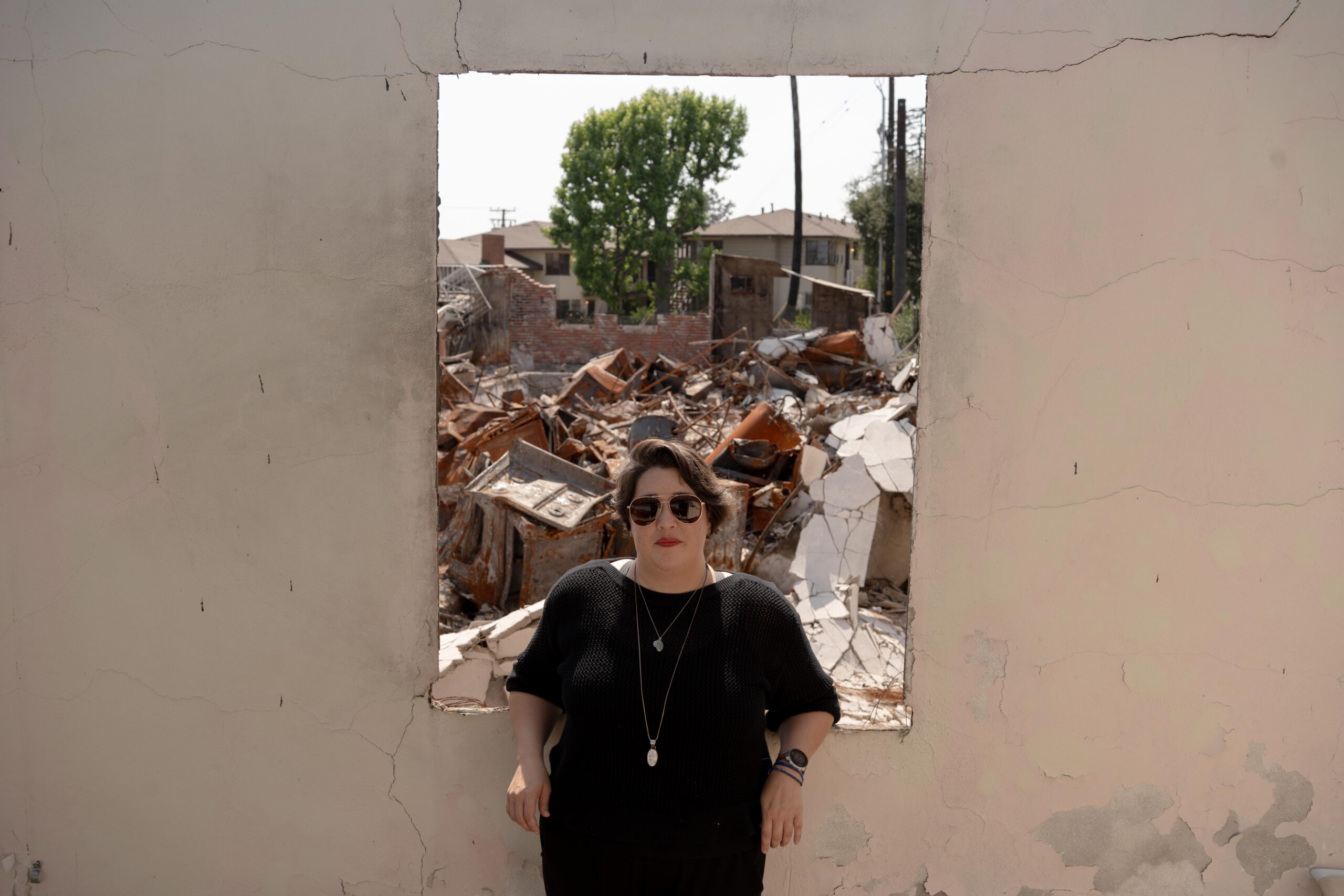
Tenant activist Katie Clark stands in the ruins of her Altadena home after the Eaton fire. Photo: Jeremy Lindenfeld.
The ‘Disaster Loophole’
For 16 years, rent stabilization kept Katie Clark’s 900-square-foot, one-bedroom apartment affordable at $1,446 a month — until the Eaton fire destroyed her building. The co-founder of Altadena Tenants Union now pays around double that amount for an apartment 28 miles away in Pomona, the “best option” she could find in the frantic months after the fire.
The deal on rent she had before the fires “doesn’t exist anywhere in Los Angeles County, and has not for a long time, and will never exist in Altadena absent an intentional effort to make it exist,” said Clark.
Clark owed her affordable rent to the county’s rent stabilization ordinance, which limits annual increases to less than 2% for multifamily units built before 1995.
But newly rebuilt multifamily properties in the Eaton fire zone won’t be subject to the ordinance, even if they were rent stabilized before the fire. The law accounts for situations in which a property owner voluntarily demolishes a rent-stabilized unit but not for disasters like wildfires — an omission the policy brief calls the “disaster loophole.”
The UCLA policy brief estimates that over two-thirds of the Altadena’s rent-stabilized homes were located within the fire’s footprint. The fire also “disproportionately eliminated” the community’s “naturally occurring affordable housing,” units that rents for below market-rate without the intervention of government programs often due to their age, size or quality.
Renters “weren’t paying today’s market rent before the fire, so the expectation that they pay it now is an impossible feat,” said Lisa Odigie, chair of the Eaton Fire Collaborative’s emergency housing and stabilization committee.
A survey of renters by the collaborative found an average pre-fire rent in Altadena of $1,792 per month, and many paid less. Now the average asking price for a one-bedroom apartment in the area is $2,350, out of reach for displaced renters who report an average monthly income of $2,966.
Affordable Housing Requirements Don’t Apply to Many Rebuild Projects
The county and state do have tools for spurring the construction of affordable housing, but they do not apply to many of the projects currently under development.
For example, the county’s inclusionary housing ordinance requires the owners of new properties with five or more units to set aside a small percentage of affordable units.
But the ordinance does not apply to “like for like” rebuilds that simply replace the units that existed on a property before the fire. And such projects appeal to property owners because they tend to move more quickly through the approvals process than those that replace, say, a single-family home with an apartment building or a duplex with a fourplex.
Ararat Megerdichian, who bought his E. Sacramento Street property a few years before the fire, initially considered rebuilding plans that would have doubled the number of units on his lot from four to eight, triggering the county’s requirement that the building include affordable units. “But unfortunately, they told me it would be faster if I go like-for-like,” said Megerdichian, who opted to rebuild his four rentals at market rate.
So far, it appears that most other property owners are making similar decisions. Of the roughly two dozen multifamily projects that received initial planning clearance, only one includes an affordable unit, according to the list the county’s planning department provided to Capital & Main in mid-February. A 1923 duplex, which had been rent stabilized, will be replaced with a three-story building with eight apartments and a ground-floor cafe. A single unit on the Lake Avenue property, just across the street from Eliot Arts Magnet Middle School, will be set aside for a household making 80% or less than the area median income.
The projects on the county’s list account for more than 100 residential units in Altadena. But not every one will become rental housing. Many are single-family homes with extra units or additional homes on the property that could be used for other purposes.
Carmona worries that, without policy intervention, “The math won’t pencil to be able to provide the same level of affordability” as existed in Altadena previously.
Adding to this concern, Gov. Gavin Newsom suspended a law that requires local governments to grant incentives — such as a higher density than typically allowed — to developers who include below-market units, including for projects with up to 100% affordable housing.
The suspension of the density bonus law, issued in March at the request of the Los Angeles County Board of Supervisors, removed “some of the strongest mechanisms” for affordable housing production, said Carmona.
Anish Saraiya, director of Altadena recovery at Supervisor Kathryn Barger’s office, said the law’s suspension was intended to prevent commercial corridors from being used solely for housing, and pointed to the long-range plan for Altadena as an example of the county’s support for density.
“I think a lot of people conflate (the suspension) as not wanting to see density, but really the emphasis is on making sure that we don’t see a complete erosion of commercial spaces,” said Saraiya.
The initial motion, jointly authored by Barger and Supervisor Lindsay Horvath, listed another reason for the suspension: “retention of community character.”
Without incentives or requirements that could spur more private developers to include affordable housing in their rebuilds, nonprofits and community land trusts are left to fill the gap — if they can rustle up enough funding.
More Funding Is Needed for Affordable Housing
After the bungalow court on East Pine Street in Altadena burned down, Tiprin Mandalay Follett searched for a way to both rebuild and keep units relatively affordable. Before the Eaton fire, the one-bedroom bungalows rented for an average of $1,500 a month. Long-term residents paid less due to years of protection from large rent increases under the county’s rent stabilization ordinance.
But there was “no way” for her to rebuild the property and preserve affordable rents, said Follett. Her insurance payout was in the hundreds of thousands of dollars; the rebuild was expected to cost millions.
So she sold the property to the nonprofit Beacon Housing, which plans to rebuild 14 homes on the site for very low-income renters displaced by the fire, using a $5.83 million grant from the Altadena Builds Back Foundation and ABBF partner Molly Munger. (Because the development has not yet completed the planning process, it was not on the list of projects the county provided to Capital & Main). The project will replace rent-stabilized housing with deed-restricted affordable housing, a rare feat in Altadena’s recovery process. (Disclosure: Molly Munger is co-trustee of the Achieving America Family Foundation, a funder of Capital & Main.)
The grant “only just barely scratches the surface” in terms of addressing displaced Altadena renters’ need for housing, said Candice Kim, project director for the Altadena Builds Back Foundation, part of the Pasadena Community Foundation.
“I don’t know how many of these we can afford to fund,” said Kim.

Palin Ngaotheppitak, executive director of Beacon Housing, stands on an empty lot on East Pine Street in Altadena’s burn area holding plans for an affordable rental housing project. Photo courtesy Molly O’Keeffe.
Efforts to make it easier for community land trusts and nonprofits to buy housing have so far stalled in the state Legislature. A bill proposed by state Sen. Sasha Renée Pérez that would have given nonprofits and public agencies first right of refusal to purchase property impacted by the Eaton or Palisades fires died last year. And a separate push by Pérez and community groups to secure $200 million from the state budget for nonprofits to purchase fire-damaged properties for affordable housing has also seen little progress.
The federal government could also help, at least in theory. The federal Community Development Block Grant Disaster Recovery program, which funds affordable housing construction, has been shown to slow rent growth and increase multifamily permits in communities affected by disasters. But it remains unclear if or when Congress will approve these long-term recovery funds for Los Angeles, in spite of repeated requests from Gov. Gavin Newsom and state legislators.
“The reality is, philanthropy can move money in the millions. It’s the federal government that brings aid in the billions,” said Kim.
‘Renters and Tenants are Left Behind’
The county and state have made some efforts to help displaced renters find affordable housing. In March, the county received nearly $5 million in state funding to provide down payment assistance of up to $200,000 to fire-impacted renters who are ready to buy a home.
On the one-year anniversary of the fire, Newsom’s office announced plans to fund 673 units of new affordable housing that would prioritize survivors of the 2025 fire and “keep survivors in their communities,” although the projects are scattered across Los Angeles County. None are in Altadena, and only two of the nine are in neighboring Pasadena.
Experts and advocates say state and local support for affordable housing in Altadena has so far been inadequate.
If the county fails to restore affordable rental housing after the Eaton fire, it would join a long list of communities that have struggled to bring back renters after disasters. Two years after the Marshall Fire in Colorado, a survey found that compared to homeowners, renters moved out of the county affected by the fire at twice the rate of homeowners.
“In almost every single instance, renters and tenants are left behind [after disasters], and they do not come home, and they are not prioritized,” said Clark. “We are trying as hard as we can to change the narrative on that in this recovery.”
Copyright 2026 Capital & Main


-

 Column - State of InequalityMay 21, 2026
In California Governor’s Race, Xavier Becerra Walks Away From Single-Payer
-

 Latest NewsMay 22, 2026
Where California’s Gubernatorial Candidates Stand on Climate and Taking Big Oil Money
-
 The SlickMay 20, 2026
70-Foot Wastewater Geyser Reflects New Mexico’s Latest Oilfield Challenge
-

 The SlickMay 29, 2026
Feds to Open Tens of Thousands of Acres of Colorado Wilderness to Oil Drilling
-

 Latest NewsMay 18, 2026
Budget Cuts Threaten Program That Doubles Food Dollars for Californians in Need
-
 Deadly Dust: The Silicosis EpidemicMay 27, 2026
California Moves to Ban Quartz Countertop Fabrication to Combat Silicosis Epidemic
-
 Latest NewsMay 26, 2026
Conditions at California ICE Detention Centers Are Getting Worse, Inspections Find
-
 Imperial DivideJune 3, 2026
California’s Lithium Valley Dreams Meet Reality at the Only Restaurant in Town