Labor & Economy
Chuck Reed: No Comment on Weak Ballot Polling Numbers


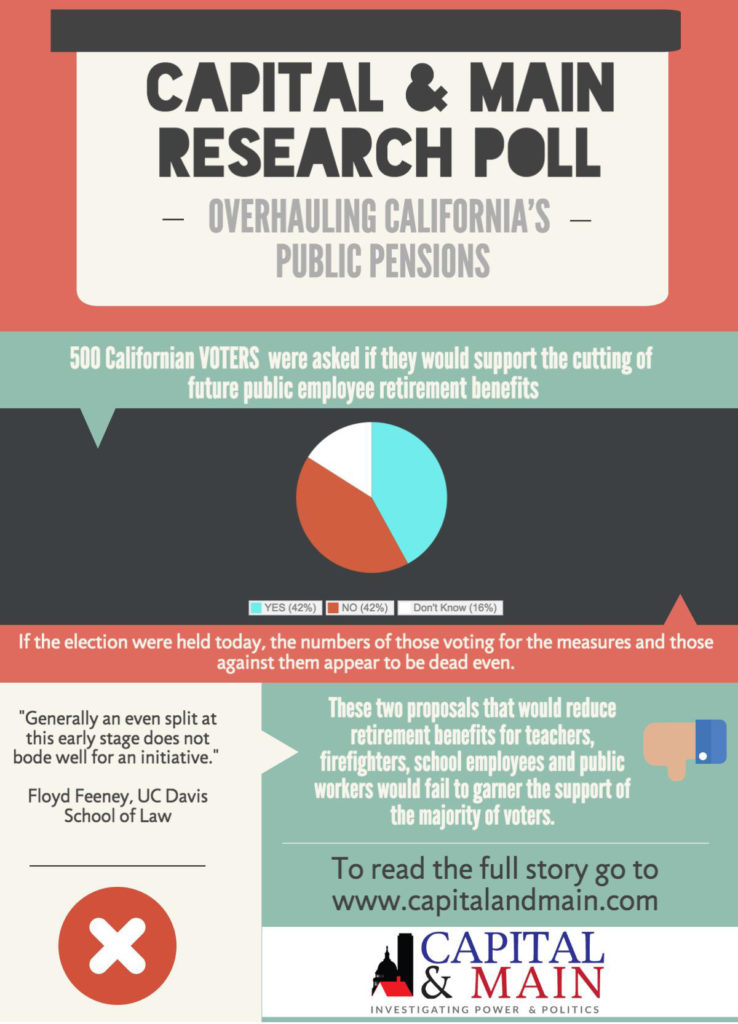
Chuck Reed today declined to address the findings of a Capital & Main poll that showed weak support for two Reed-created ballot initiatives aimed at reducing pension benefits for California’s public employees. If either measure receives the necessary number of petition signatures to be placed on the 2016 ballot, it will face fierce opposition from organized labor.
The poll, conducted by David Binder Research, was released yesterday and showed that if an election were held today, the two measures would win between 40 and 42 percent of the vote. The survey sampled 500 likely voters and has an error margin of plus or minus 4.4 percent.
“I never make statements based on other people’s polling,” Reed told Capital & Main. “Especially in a political environment. We’ll make our decisions based on our own polling.”
Drafted by Reed, a former Democratic San Jose Mayor, and former Republican San Diego City Councilman Carl DeMaio, the Voter Empowerment Initiative and the Government Pension Cap Act received their official summary language (though not their official titles) from the state attorney general December 9.
Sherry Bebitch Jeffe, a senior fellow at the University of Southern California’s Price School of Public Policy, and a longtime analyst of state politics, was also asked about the measures.
“It is the group whose rights are threatened that mobilizes, and that is the unions in California,” Bebitch Jeffe said. “The unions can organize, the unions can raise money to oppose the initiative, so the proponents have to get money, have to have a message.”
Reed conceded that his campaign to gather the necessary signatures to put at least one of the measures on the 2016 ballot and then win voter approval will require great financial resources.
Click on infographic
“This is California,” he said. “If you want to run a statewide campaign you need a lot of money. We’ve always operated under the premise that we need to raise and spend a lot of money in order to win.”
Bebitch Jeffe also noted that the measures’ backers will confront further adversity because the initiatives would appear on the November ballot, instead of the June primary’s, which traditionally sees lower turnouts among the kind of voters who are expected to oppose public pension cuts.
“The general electorate in November is usually far more Democratic than Republican,” Bebitch Jeffe said. “In November, that’s when Democrats turn out in force.”



-
 Column - State of InequalityMay 21, 2026
In California Governor’s Race, Xavier Becerra Walks Away From Single-Payer
-

 Latest NewsMay 22, 2026
Where California’s Gubernatorial Candidates Stand on Climate and Taking Big Oil Money
-

 The SlickMay 20, 2026
70-Foot Wastewater Geyser Reflects New Mexico’s Latest Oilfield Challenge
-

 The SlickMay 29, 2026
Feds to Open Tens of Thousands of Acres of Colorado Wilderness to Oil Drilling
-
 Deadly Dust: The Silicosis EpidemicMay 27, 2026
California Moves to Ban Quartz Countertop Fabrication to Combat Silicosis Epidemic
-

 Latest NewsMay 26, 2026
Conditions at California ICE Detention Centers Are Getting Worse, Inspections Find
-

 Imperial DivideJune 3, 2026
California’s Lithium Valley Dreams Meet Reality at the Only Restaurant in Town
-

 Column - State of InequalityMay 28, 2026
Top Democratic Candidates Agree on Housing Urgency, Not the Fix