Labor & Economy
Walmart’s War Against Unions — and the U.S. Laws That Make It Possible

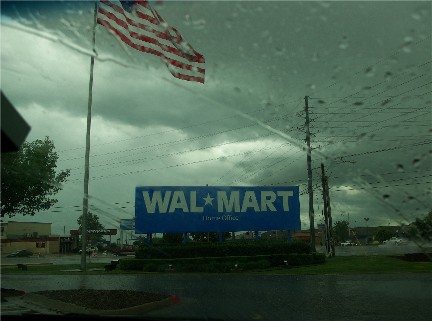
For several years, Walmart’s annual shareholders meeting has been the staging ground for high-profile protests against the retail giant’s treatment of its employees. As Walmart workers from across the country — many of whom are on strike — once again converge this week on the corporation’s headquarters in Bentonville, Arkansas, one startling fact stands out: none of them, or any of the retail giant’s 1.4 million workers, are represented by a union.
Walmart’s success in keeping its American workforce entirely nonunion is, of course, well documented — so much so that observers of the company’s chronic labor strife almost take it for granted. But even in the context of a long national decline in union membership among American workers, it is staggering that the country’s largest employer, and one of its stingiest, has remained union free.
While Walmart contends that its employees have no use for union representation, it stretches credulity beyond the breaking point to think that no group of workers at any of the company’s more than 4,000 U.S. stores would choose to organize themselves into a bargaining unit. After all, Walmart has become almost as famous for its low wages and paltry health benefits as it is for its low prices. And despite the weakened position of unions in the U.S. economy, unionized workers still enjoy wages that are 13.6 percent higher on average than those of their nonunion counterparts. Likewise, unionized workers are 28.2 percent more likely to be covered by employer-provided health insurance and 53.9 percent more likely to have employer-provided pensions.
So what’s the secret to Walmart’s “success” in remaining 100 percent nonunion? In short, it’s the corporation’s thorough exploitation of our nation’s anemic labor laws.
In a blistering 2007 report that sadly still holds true, Human Rights Watch meticulously analyzed how Walmart has taken advantage of the gaping holes in U.S. labor law to turn back every effort at unionization. For example, because American employers are allowed to actively oppose union organizing campaigns, Walmart “bombards workers with the message that disastrous results will ensue if they organize, while largely denying them access to contrary views.”
Similarly, since national labor law allows employers to permanently replace workers who strike for economic reasons, “Wal-Mart uses this threat of permanent replacement as part of its strategy to scare workers into rejecting union formation at its U.S. stores.” This message is drummed home not only during organizing efforts, but also in trainings for new workers, which are part of Walmart’s coordinated, pro-active approach to stopping organizing campaigns in their tracks.
Perhaps Walmart’s most powerful tool in resisting unionization efforts is the incredibly weak penalties for employers that violate labor law. There are no punitive awards for labor law infractions, which means that employers — particularly those with the enormous resources that Walmart enjoys — have little economic incentive to obey the law.
Even on the rare occasions when efforts to organize Walmart workers have overcome all these obstacles, the company has still managed to prevail. In 2000, for instance, when butchers at a Texas Walmart voted to join the United Food and Commerical Workers Union, Walmart announced two weeks later that it was closing all 180 of its meat counters. In 2004, the company went so far as to close an entire store after its employees voted to unionize.
It’s not surprising that, given Walmart’s determination to remain nonunion and the complicity of U.S. labor law in supporting this goal, Walmart workers and their supporters have turned to non-traditional alternatives. The caravans transporting striking Walmart employees to Bentonville this week are part of this growing movement, which has succeeded in keeping the company on the defensive about its labor practices. These workers will need every ounce of creative strength they can muster to prevail against a system that is stacked against them, and a corporation that has mastered that system.
Julie Gutman Dickinson is partner in the union-side law firm Bush, Gottlieb, Singer, Lopez, Kohanski, Adelstein & Dickinson. She also serves on the Advisory Board of the Los Angeles Alliance for a New Economy.


-

 Column - State of InequalityMay 21, 2026
In California Governor’s Race, Xavier Becerra Walks Away From Single-Payer
-

 Latest NewsMay 11, 2026
Inside the Texas Water Crisis Pitting Residents Against Industry
-

 Latest NewsMay 8, 2026
Salvadoran Man Says He Suffered Stroke While Awaiting Deportation to Torture Prison
-
 Latest NewsMay 22, 2026
Where California’s Gubernatorial Candidates Stand on Climate and Taking Big Oil Money
-

 Latest NewsMay 15, 2026
California Hazardous Waste Rules Criticized as Years Late and ‘Polluter-Friendly’
-

 Latest NewsMay 12, 2026
Government Fails to Provide Adequate Interpreter for Deaf Ukrainian Asylum Seeker
-

 The SlickMay 20, 2026
70-Foot Wastewater Geyser Reflects New Mexico’s Latest Oilfield Challenge
-

 Latest NewsMay 13, 2026
While Pentagon Spends Billions on War, Military Families Say They’re Getting Short-Changed