
The Slick
Feds to Open Hundreds of Acres of Colorado Wilderness to Oil Drilling
Wildlife habitat, endangered animals and recreation could all be at risk in state’s biggest public land sale in modern history.
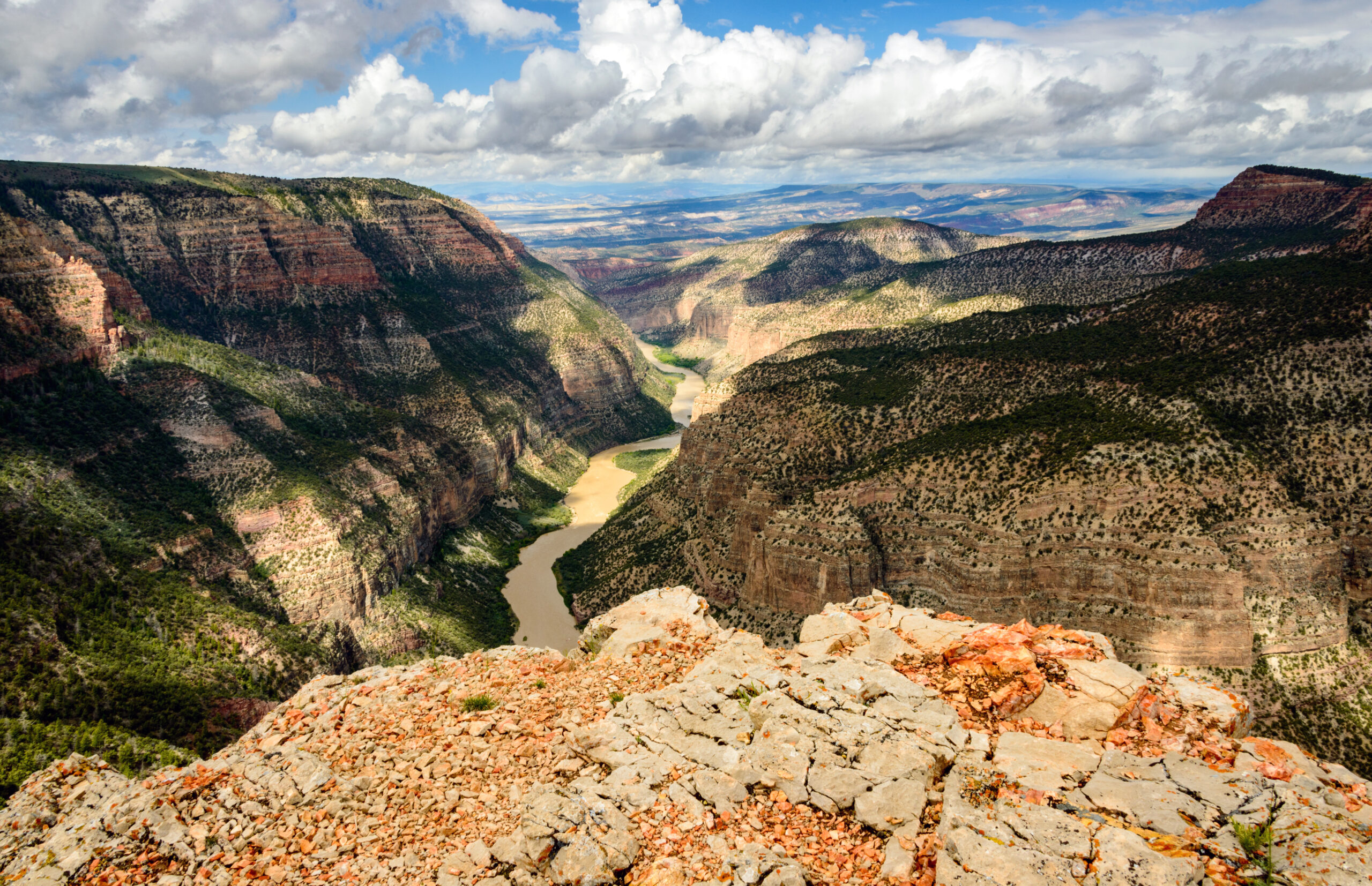

A federal agency will offer hundreds of acres in northwestern Colorado that the nation’s largest elk herd relies upon for migration, foraging and winter habitat to oil and gas companies for lease in the state’s biggest such sale in modern history.
More than 100 parcels included in a June 16 lease sale by the Bureau of Land Management encompass elk, pronghorn and mule deer migration corridors that extend into southern Wyoming. Many sit in Moffat County, which bills itself as the “Elk Hunting Capital of the World,” and relies on the pastime in part for its economic stability.
About two-thirds of the acreage in the 156,000-acre lease sale is just south of Dinosaur National Monument, a remote park that’s among the country’s over 40 certified International Dark Sky Places — areas with exceptionally dark night skies. Tourism officials in Moffat, who saw inquiries drop by more than half this spring, voiced concern that bright lights and truck traffic that accompany fossil fuel extraction could imperil this hard-won designation.
“Things like that could put that status in jeopardy,” said Tom Kleinschnitz, the county’s director of tourism. “In the long run, I think it’s important to keep these areas as pristine as possible.”
The record June lease sale contradicts the Bureau of Land Management’s stated strategy for the national monument, as well as a 2024 amendments to area plans for northwestern Colorado that strengthened habitat protections for ungulates like elk and deer and at-risk birds such as the Gunnison sage-grouse.
Risks to big game and Dinosaur National Park are just a few examples of what’s at stake for the environment, the economy and public health. A 2,360-line spreadsheet compiled by Denver-based nonprofit Rocky Mountain Wild enumerates 17 rare plants and endangered species whose habitat could be imperiled by fossil fuel exploration and extraction.
These include the black-footed ferret, wolverine, boreal toad and Colorado pikeminnow and threatened plants such as the Colorado hookless cactus and Parachute penstemon. The lease sale includes acreage relied upon by other species such as the Columbian sharp-tailed grouse, greater sage-grouse, ferruginous hawk and swift fox — all identified by state wildlife officers as being of special concern.
The June event is one of four large lease sales in Colorado since Congress passed and President Donald Trump signed a bill in 2025 that included provisions to encourage drilling on the nation’s public lands. This agenda lies in stark contrast to the pattern of leasing activity during President Joe Biden’s term — with just six sales in Colorado during his four years in office. Just several hundred acres were offered during that period.
The 2025 H.R. 1 legislation prioritized fossil fuel extraction over other uses such as recreation and conservation; mandated that federal officials hold a minimum of four lease sales each fiscal year in Alaska, Colorado, Montana, New Mexico, Nevada, North Dakota, Oklahoma, Utah and Wyoming; shortened public comment times; and reduced the discretion land managers hold over whether to offer acreage for lease or not.
The law also decreased oil and gas royalty rates, making it cheaper to extract fossil fuels on public lands and reducing the share of profits from such natural resources to taxpayers. Colorado alone could lose $148 million in revenue from future production from about 81,000 acres that sold in 2026, according to an analysis by Taxpayers for Common Sense, a nonpartisan watchdog organization.
The push to lease tens of thousands of acres to oil and gas companies comes as bipartisan polling conducted as part of Colorado College’s State of the Rockies Project found a majority of voters in eight Western states want their congressional representatives to prioritize conservation over energy development on public lands.
About 21 million acres of public lands overseen by the Bureau of Land Management are leased for oil and gas development already, according to fiscal 2025 statistics on the agency’s website. Only 12 million of those acres are actually producing fossil fuels.
This discrepancy underscores a concern of conservation groups that during the decade that energy companies hold federal oil and gas leases, the parcels by law cannot be managed for other uses such as sensitive habitat, wilderness character or recreation.
“Folks need to understand the long-term impacts of a rush to lease so much public land,” said Peter Hart, legal director of the Wilderness Workshop, which works to conserve wildlife and the wilderness.
“Once those leases are issued they are very hard to get rid of — they stay on the land for a long time, even if they aren’t developed.”
In response to issues raised in a 106-page comment letter filed March 13 by the Wilderness Workshop and 17 other organizations, the Bureau of Land Management wrote in an environmental assessment that it would conduct additional site-specific analysis of each parcel in the Colorado sale if a company files for a drilling permit.
The agency also pointed out repeatedly in its 646-page report that “risks are reduced through the careful review of drilling and completion plans for proposed wells by both the BLM” and Colorado’s Energy and Carbon Management Commission.
Federal officials removed four parcels and reduced a fifth, for a total of about 4,800 acres, from the initial sale offering, citing a recent decision by the Interior Board of Land Appeals. These parcels included habitat for the greater sage-grouse and Columbian sharp-tailed grouse as well as high priority habitat for big game. Numerous other parcels with similar characteristics remain in the sale.
The environmental assessment also noted that agency officials would apply stipulations to leases issued for sensitive parcels aimed at protecting animals, plants, cultural resources and fish.
Even so, conservation groups who closely monitor what’s at stake in oil and gas lease sales said that federal land managers have significantly less leeway at the permitting stage to move oil and gas operations, add conditions of approval or to cancel a lease altogether. Together with these limitations is an inability for these officials to remove parcels that were deferred from past sales because they included habitat for sensitive species.
“During the first Trump administration, there was a sale that was initially proposed to be much larger than this and the state Bureau of Land Management was able to use its discretion to defer parcels that were inappropriate because of greater sage grouse conflicts,” said Alison Gallensky, a conservation geographer at Rocky Mountain Wild.
“Now, they are being forced to offer a much larger sale than that one turned out to be,” she added.
Greater sage grouse are very sensitive to oil and gas infrastructure — even if it’s moved farther away from their habitat — and intuitively sense a winged predator could land on such equipment. They won’t breed if they feel that they are in danger, Gallensky said.
In addition, provisions developed to protect the birds listed in the environmental analysis for the June lease sale, such as requiring an oil and gas company to build a pad farther away from nesting locations, relies on operators to follow through — something that the federal government isn’t always staffed to monitor, she said.
Acreage included in the June sale also marks the continuation of a trend that began with last year’s federal oil and gas lease sales in Colorado. Typically, such sales offer public lands to energy companies in more remote parts of the state.
Yet in September, the agency leased a parcel near the Aurora Reservoir, which is bordered by a densely populated Denver suburb, for about $5.6 million. The acreage is part of the Lowry Ranch Comprehensive Area Plan – a more than 150-well project approved by state regulators and strongly opposed by nearby residents.
Many of the more than 340 individual comments the agency received for the June sale urged the agency not to lease similar parcels near the reservoir. Residents and conservation groups wrote that emissions from oil and gas development on this acreage would worsen pollution in an area that’s already out of compliance with federal air quality rules.
In addition, the agency estimated in its analysis for the June sale that several parcels listed in Weld County, home to the state’s largest and most productive oil field, could result in up to 150 wells. Emissions from these wells would worsen smog in a region that already fails to meet national standards, conservation groups wrote.
“BLM’s implication that this lease sale ‘would result in no emission increase’ or that emissions are not reasonably foreseeable enough to perform a conformity determination are thus entirely baseless,” said numerous organizations in the March 13 comment letter to the agency.
Federal officials responded in the environmental analysis that the agency would conduct a “project-specific emissions inventory” if companies file for drilling permits on the parcels after leasing them. Permit requests would include details such as how many wells are proposed, a drilling and completion schedule, and a list of the equipment to be used, allowing the agency to conduct a more thorough analysis, officials wrote.
In Moffat County, on the western slope of the Rocky Mountains where much of the acreage in the June oil and gas lease sale is concentrated, community representatives noted a need to balance pollution and environmental concerns with the economic reality that rising grocery and gas prices are hitting rural areas hard. Some residents in this sparsely populated region, where 80% of voters cast ballots for Trump in 2024, rely in part on royalties from drilling to make ends meet, said Kleinschnitz, the county’s director of tourism.
“Many people in outfitting have agricultural businesses, and hunting is incredibly important to keeping people on those landscapes,” he said. “And some of them make royalties from oil and gas and have benefited greatly from having those.”
Copyright Capital & Main 2026


-

 Column - State of InequalityMay 21, 2026
In California Governor’s Race, Xavier Becerra Walks Away From Single-Payer
-
 Deadly Dust: The Silicosis EpidemicMay 6, 2026
California Could Be the First State to Ban Quartz Countertops
-

 Latest NewsMay 1, 2026
In One of L.A.’s Food Deserts, ‘Hands That Harmed Are Now Hands That Heal’
-

 Column - State of InequalityApril 30, 2026
Don’t Call It Upward Mobility If People Still Can’t Afford to Live
-
 Latest NewsMay 5, 2026
Fire Recovery Could Wipe Out Altadena’s Affordable Rentals
-
 Latest NewsMay 11, 2026
Inside the Texas Water Crisis Pitting Residents Against Industry
-

 Column - State of InequalityMay 7, 2026
California Lawmaker Proposes Fix to Blunt Loss of Food and Health Aid
-

 Latest NewsMay 8, 2026
Salvadoran Man Says He Suffered Stroke While Awaiting Deportation to Torture Prison