
The Slick
As States Spend Millions to Woo Data Centers, Colorado Is Having a Reckoning
Legislators debate a possible moratorium while residents take their demands and health fears directly to a data center developer.
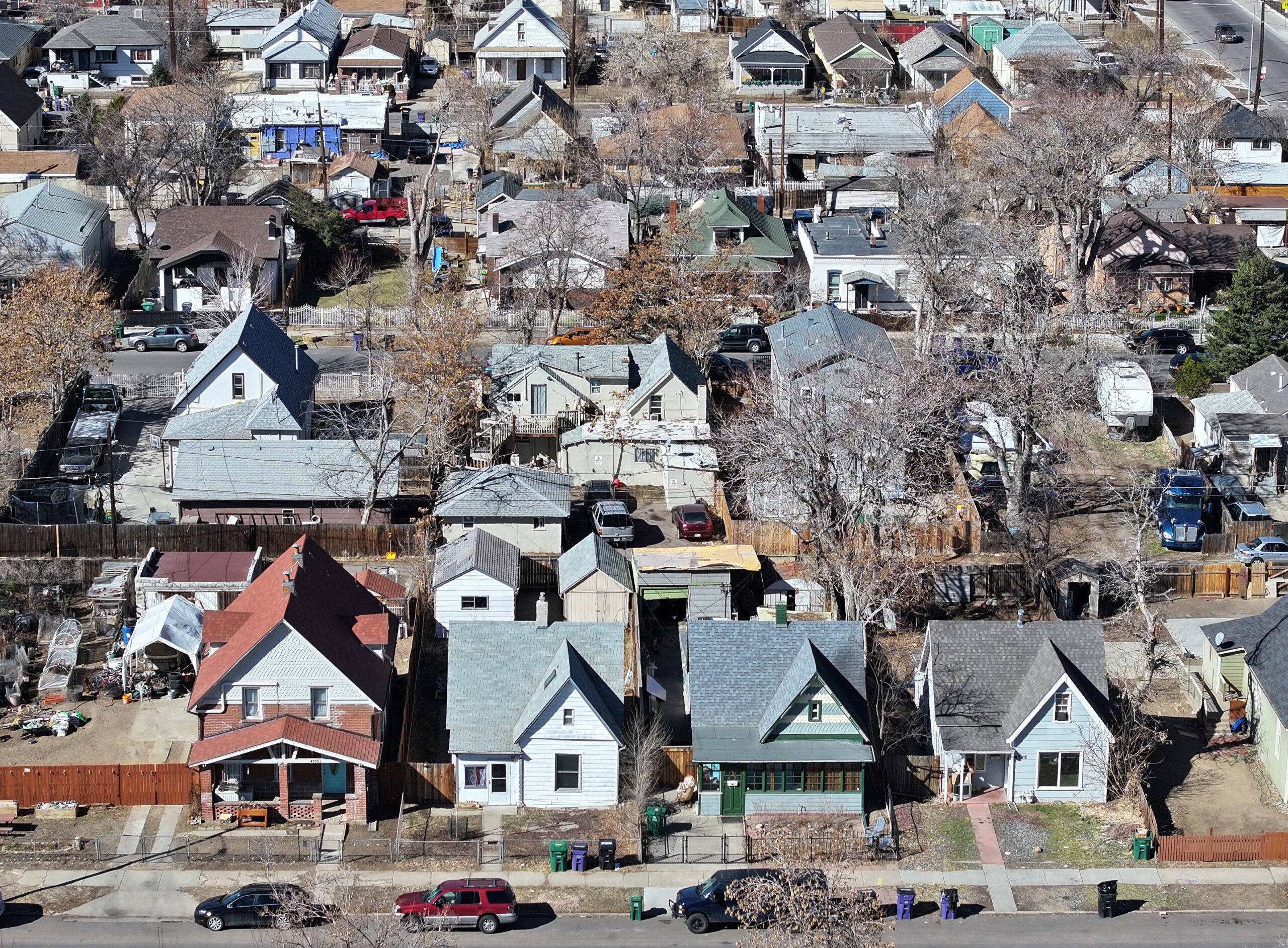

Community organizer Alfonso Espino stood near the newest industrial building rising in his north Denver neighborhood, which ranks among the nation’s most polluted zip codes. Now it’s the epicenter of a tense debate over data center expansion in Colorado.
Espino raised his voice over construction noise and a train horn and pointed to 14 shipping-container-sized diesel generators that line the building, just yards from a half-built senior living center. Exhaust from such engines, designed to provide backup power during an outage, is categorized by the International Agency for Research on Cancer as “carcinogenic to humans.” Xcel Energy, which will provide power to the site, projected “large load” customers like data centers will comprise two-thirds of its new electricity demand.
The bank of generators also sits across the street from an affordable housing facility, a community park and a health clinic with a weeks-long waiting list.
Join our email list to get the stories that mainstream news is overlooking.
Sign up for Capital & Main’s newsletter.
Espino is concerned that particulate matter and poisonous gases emitted by these generators during electrical outages could increase hospitalizations for respiratory illnesses that residents in the neighborhoods of Globeville and Elyria-Swansea already experience at higher rates than the rest of the Denver metropolitan area.
“I have asthma, my little brother has asthma,” said the community organizer, who also sits on the board at the Tepeyac Community Health Center. “We want to do everything we can to protect the health of our neighborhood.”
Higher rates of such diseases are the legacy of this community’s location. The region’s two busiest highways bifurcate the area and a petroleum refinery with a history of air pollution violations sits nearby. More than two-thirds of the land here is occupied by industrial or commercial businesses, compared to one-third in Denver overall.
Given that its residents are disproportionately impacted by exhaust from vehicles and air toxics from the refinery, Espino said his community deserved a more transparent approval process when it came to the data center complex.
The city of Denver greenlit the facility administratively because the property was already zoned for an industrial use, bypassing the need for a public hearing before the planning board and the City Council and raising questions among residents.
“A lot of things are concerning about the way the city handled this,” Espino said.
By 2028, U.S. data centers’ annual electricity consumption is expected to exceed that of 28 million households.
Mounting tension around the CoreSite development led Denver Mayor Mike Johnston to call for a citywide moratorium on data center construction on Feb. 23. There are 46 data centers currently in the city. The Denver City Council’s Community Planning and Housing Committee approved a measure on March 31 that would seat a working group to define rules around land, energy and water use, as well as zoning and ratepayer protections. The City Council is expected to take up the one-year moratorium bill later this spring.
“We think we need to build more data centers,” Johnston said on Feb. 26 on the “City Cast Denver” podcast. “The key is we need a framework to figure out how and when and where to build them.”
The controversy around how the CoreSite facility was approved mirrors debates nationwide around how to ensure the approval of such developments is considered in the open and that such complexes don’t negatively impact resource-strained regions and ratepayers and undermine greenhouse gas emissions reduction goals.
Lawmakers from Wisconsin to Georgia, Oklahoma, New York and Maine are considering similar moratoriums to provide municipalities more time to design regulations governing data center construction.
The push comes on the heels of a building boom driven by the need to power artificial intelligence that caught public officials off guard and left communities reeling. The industry is projected to double in size globally by 2030 in an “infrastructure investment supercycle,” according to a January Jones Lang LaSalle IP Inc. report.
By 2028, U.S. data centers’ annual electricity consumption will exceed that of 28 million households, according to nonprofit Food & Water Watch. Such facilities’ water needs to cool computer servers could equate to the consumption of 18.5 million households by that year, the report found.
The data center gold rush is also taxing state budgets. About 37 states offered tax incentives for companies to locate their servers there. Some are reconsidering these offerings as such policies add up to millions of dollars in lost tax revenue.
In Colorado, dueling bills in the state Legislature reflect the nation’s fraught relationship with the industry. One would offer sales and use tax exemptions to attract data centers, and a second “guardrails” bill would require developers to use renewable energy, hold public hearings and forge community benefit agreements with disproportionately impacted communities such as Globeville and Elyria-Swansea. It would also set standards for backup systems.
At a March 18 hearing on the guardrails bill, which offers no government incentives, state legislators expressed frustration with the process the city of Denver used to approve the CoreSite campus.
“Even local councilmembers had no idea what was taking place, what plans were or were not being proposed,” said state Sen. Julie Gonzales, a Democrat who represents Globeville and Elyria-Swansea, during six hours of testimony before the Senate Transportation & Energy Committee.
Nationwide, air pollutants associated with data center operations could contribute to about 600,000 asthma cases each year.
Denver City Council members who represent the area, including Councilman Darrell Watson, and two at-large members, Serena Gonzales-Gutierrez and Sarah Parady, did not return phone and email requests for information about the CoreSite approval process.
Another councilmember, Paul Kashmann, addressed the controversy at the council’s March 31 Community Planning and Housing Committee meeting.
“While you can point fingers at data centers, you can also point fingers at Denver city government,” he said. “We did not do enough advance regulation — I think we need to do better in the future.”
An environmental justice summary that CoreSite filed with the Colorado Department of Public Health & Environment on Feb. 24 contains a page-long list of statistics that illustrate how the Elyria-Swansea neighborhood bears more environmental and socioeconomic risks than other census tracts.
About half of those who call Globeville and Elyria-Swansea home are low income and a majority are of color. The residents here are exposed to more air toxics than 93% of the state’s census tracts, more particulate pollution than 100% of such geographic regions, and more traffic.
Espino, the community organizer, said to protect residents’ health, his coalition presented CoreSite with a binding Good Neighbor Proposal signed by 215 people living near the complex. The company plans to build three buildings to house servers. The first is under construction. It must apply for permits with the city for the other two.
Community organizers asked the firm to disclose its energy and water requirements, measure pollution emitted by its facility and conduct an independent health equity analysis that quantifies the center’s emissions, noise, traffic, water use and emergency plans.
Residents also asked that CoreSite use diesel generators designed to reduce particulate matter and poisonous gases that contribute to the formation of ozone — a haze that leads Colorado to violate federal air pollution standards each year and forces health officials to issue dozens of air alerts warning people to stay inside.
Public health researchers found that air pollutants associated with data center operations nationwide could contribute to about 600,000 asthma cases each year and lead to public health costs of more than $20 billion by 2028.
Once constructed, the new CoreSite facility will use 230,000 gallons of water per day at its peak capacity.
CoreSite said it began engaging with the community in June 2024 and hosted in-person meetings with GES Coalition members.
“We’re committed to continuing engagement,” CoreSite Vice President of Marketing and Sales Development Megan Ruszkowski wrote in an email. “We’ve begun a city-sponsored mediation process in the hope of fostering a constructive conversation with the community that could lead to an agreement all parties accept.”
Residents were upset, however, when representatives of the firm failed to show up at a community meeting in February. Among the chief concerns are diesel generators. A state-issued construction permit for the company’s 14 diesel generators limits emissions, allows only two engines to operate simultaneously, and caps the number of nonemergency hours each engine may run per year to 25.
The 17-page permit says the engines “must only be operated to provide back-up power to the facility when electric power is interrupted, or for periodic maintenance and testing purposes.”
The generators are “expected to run for less than 50 hours per year, though generators at our other Denver locations run on average as few as 10 hours per year,” Ruszkowski said.
CoreSite operates two other data centers in Denver. The building under construction in north Denver, designed for an 18-megawatt capacity, is its third. The new facility will use 230,000 gallons of water per day at its peak capacity. Both water and electrical use will likely be lower than this, Ruszkowski said, and will not impact consumers because the company ensured adequate supply with area utilities.
Eighteen megawatts can power up to 12,000 homes per day, depending on location and climate, and 230,000 gallons of water is equivalent to water used daily by 4,600 residential consumers. (Denver Water estimates its single family residential customers use 50 gallons per person per day.)
The facility will cater to customers who pay to use servers that CoreSite says will “provide common applications we all use in our daily lives, including e-commerce, online banking, telehealth, 911 and emergency services, remote work, video streaming and social media.”
The 14 generators approved in the construction permit issued by the state health department are not the cleaner options residents requested.
Similarly, most diesel backup generators installed at data centers nationwide are Tier 2, which allow higher levels of air pollutants than newer Tier 4 designs, according to a March report compiled by the nonprofit Better Data Center Project in collaboration with former employees of the U.S. Environmental Protection Agency.
Ruszkowski said that generators on the site are “positioned toward the center of the facility to minimize exposure to fence line neighbors.” She said additional generators “would only be needed if we developed the two additional buildings — if customer demand makes that necessary.” This probably wouldn’t occur until the 2030s, she wrote. The first building is scheduled to begin operation this summer.
Until then, Espino said coalition members are focused on working with CoreSite and state and city officials to devise protections “that will actually make a difference in protecting the health and integrity of our communities.”
Copyright 2026 Capital & Main


-

 Column - State of InequalityMay 21, 2026
In California Governor’s Race, Xavier Becerra Walks Away From Single-Payer
-
 Latest NewsApril 28, 2026
A May Day Push to ‘Shut It Down’ Takes Shape Across the Country
-
 The SlickApril 29, 2026
With Promises of Money, Controversial Gas Pipeline on Navajo Nation Passes First Hurdle
-
 Deadly Dust: The Silicosis EpidemicMay 6, 2026
California Could Be the First State to Ban Quartz Countertops
-

 Latest NewsApril 27, 2026
As the U.S. Spends Billions Fighting Iran, War-Driven Inflation Hits Working Families Hard
-
 Latest NewsMay 1, 2026
In One of L.A.’s Food Deserts, ‘Hands That Harmed Are Now Hands That Heal’
-

 Column - State of InequalityApril 30, 2026
Don’t Call It Upward Mobility If People Still Can’t Afford to Live
-
 Latest NewsMay 5, 2026
Fire Recovery Could Wipe Out Altadena’s Affordable Rentals