The Slick
Pennsylvania Spent Big on a ‘Petrochemical Renaissance.’ It Never Arrived.
Visions of a booming hub that would bring jobs and prosperity to Appalachia faded, but the plastic “nurdles” remain.

When Captain Evan Clark steers his boat along the rivers that cut through and around Pittsburgh, he does so because he loves it, but also because he’s on a mission.
A self-proclaimed “river rat,” Clark lives on a houseboat on the Allegheny and works with the environmental nonprofit Three Rivers Waterkeeper. His main duty: prowling southwestern Pennsylvania’s waterways to monitor pollution from both new and legacy industrial facilities that the region has lived with for more than a century.
A silver manta trawl — named for the ray it resembles in shape — hangs off the side of his boat, its net gliding across the river’s glassy surface, catching leaves, twigs and weeds in its wake. On a September trip in 2022 by Raccoon Creek in Monaca, a borough some 30 miles north of Pittsburgh, it also caught a smattering of small, hard white pellets known as “nurdles.”
“It took us a little,” he recalled. “What are all these tiny little flecks and baby beads that we’re getting in our wash water?”
A building block of plastics, nurdles are small enough to miss at first glance. Microplastics a few millimeters in size, they resemble larvae, lentils or in Clark’s discovery, specks of dust. Clark and his team, who routinely embark on so-called nurdle patrols, spotted the tiny particles in Raccoon Creek 12 more times in the months that followed.
Eventually, they identified the source: a nearby chemical manufacturing facility owned since 2020 by a company named Styropek, which manufactured the polystyrene beads, derived from petroleum and natural gas and used to make styrofoam. The nurdles were released from water discharge points — known as outfalls — at the manufacturing plant, directly into the creek, which feeds into the Ohio River, a source of drinking water for more than 5 million people. The Ohio River watershed is also home to dozens of species of fish, which can mistake the nurdles for food and suffer cell and tissue damage, among other health effects, as a result of ingesting them.
“Fish generally congregate at outfalls,” Clark said. “They’re a place where different things are happening. It’s a mixing zone.” And where fish congregate, Clark said, so do recreational fishermen, whose catches may end up on the dinner table.
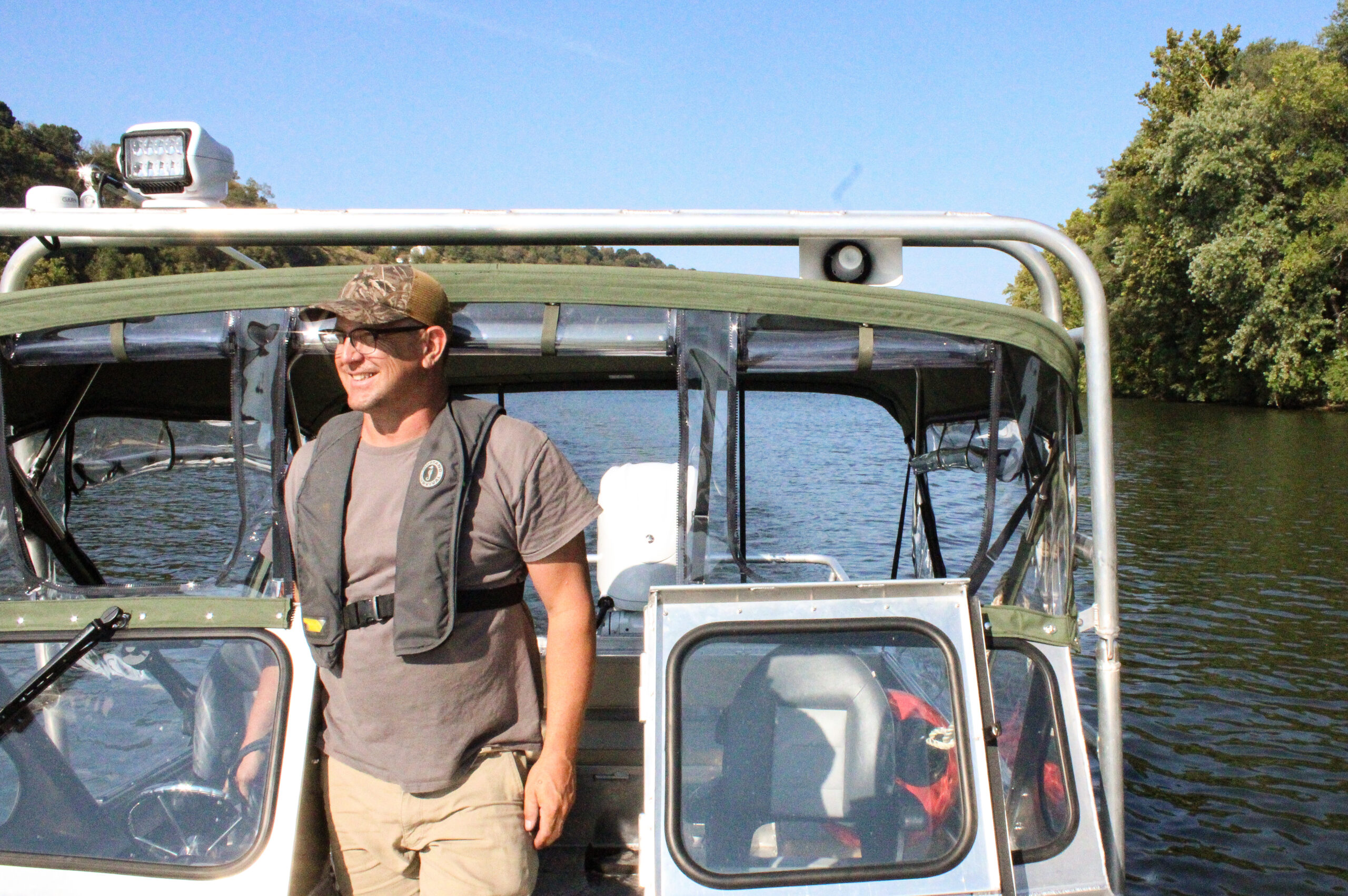
Captain Evan Clark pilots the Three Rivers Waterkeeper boat along the Allegheny River.
Clark’s organization, alongside nonprofit PennEnvironment and the Pennsylvania Department of Environmental Protection, used the data collected on these “nurdle patrols” as the basis for a lawsuit that concluded last September. The result was a settlement in which Styropek paid $2.6 million in fines and agreed to make technology upgrades that would monitor for and prevent nurdle releases. The company also agreed to a daily penalty for plastic beads found to have been released after installation of the technology.
“It’s not easy taking on big polluters,” said David Masur, PennEnvironment’s executive director, who called the settlement a “concrete” victory for the environment.
The agreement has the potential to set national precedent, its authors say. “State regulators … could basically just do a rule right now, going, ‘We’re going to basically require all facilities to amend their permits to include this now,’” Masur said. (Nurdles are not explicitly regulated in Pennsylvania; the lawsuit argued that Styropek violated the federal Clean Water Act, and while a key federal permit allowed for certain releases into public waterways, it did not allow for the release of nurdles.)
And, per terms worked out in the settlement, all reforms the company made must be grandfathered into the operation by any future owner, Masur said.
That point is key, because Styropek had, for months, been warning that the plant would close in early 2025. The company began the process of selling the facility in 2024. It halted production the following year and 140 people were laid off.
Styropek did not respond to Capital & Main’s request for comment.
The settlement and potential sale come as the petrochemical industry — makers of chemicals such as plastic and styrofoam that are derived from fossil fuels — is undergoing a reckoning. Throughout the 2010s, plastics were pitched as an answer for the glut of natural gas in Appalachia. Today, the industry is showing signs that such predictions were overblown. Many fossil fuel companies are now selling off or restructuring their plastic and chemical assets altogether — oil giants Occidental Petroleum and BP among them.
As Clark and his colleagues were negotiating the settlement, leaders at oil titan Shell began reconsidering their role in a $14 billion, 384-acre plastic materials production plant not far from Styropek. As an enticement, Shell was offered $1.65 billion in tax credits over 25 years, the largest subsidy in state history. Known as an ethane cracker, the facility “cracks” wet molecules of ethane, a fracking byproduct, into dry polyethylene nurdles. Those nurdles are then used to make food packaging, toys, waste bags, and even chewing gum. It came online in 2022.
The facility was once envisioned as being part of a large plastics hub in Appalachia that would help usher in a “petrochemical renaissance” that would bring prosperity and jobs to the area.
“The Appalachian region could become a second center of U.S. petrochemical and plastic resin manufacturing,” the American Chemistry Council, a trade group for petrochemical companies, wrote in 2017, referring to the Gulf Coast as the first.
State politicians leaned into a similar narrative. “The Shell project would be the largest economic development project in southwestern Pennsylvania in more than a decade,” reads a 2013 document shared by Pennsylvania state Senate Republicans. The origin and author of the document is unclear.
The argument was used to justify historic levels of spending on tax incentives used by Shell. At the time, critics pointed out that a key subsidy written for Shell did not come with any requirements that the company create long-term jobs or provide economic development in order to claim the credits.
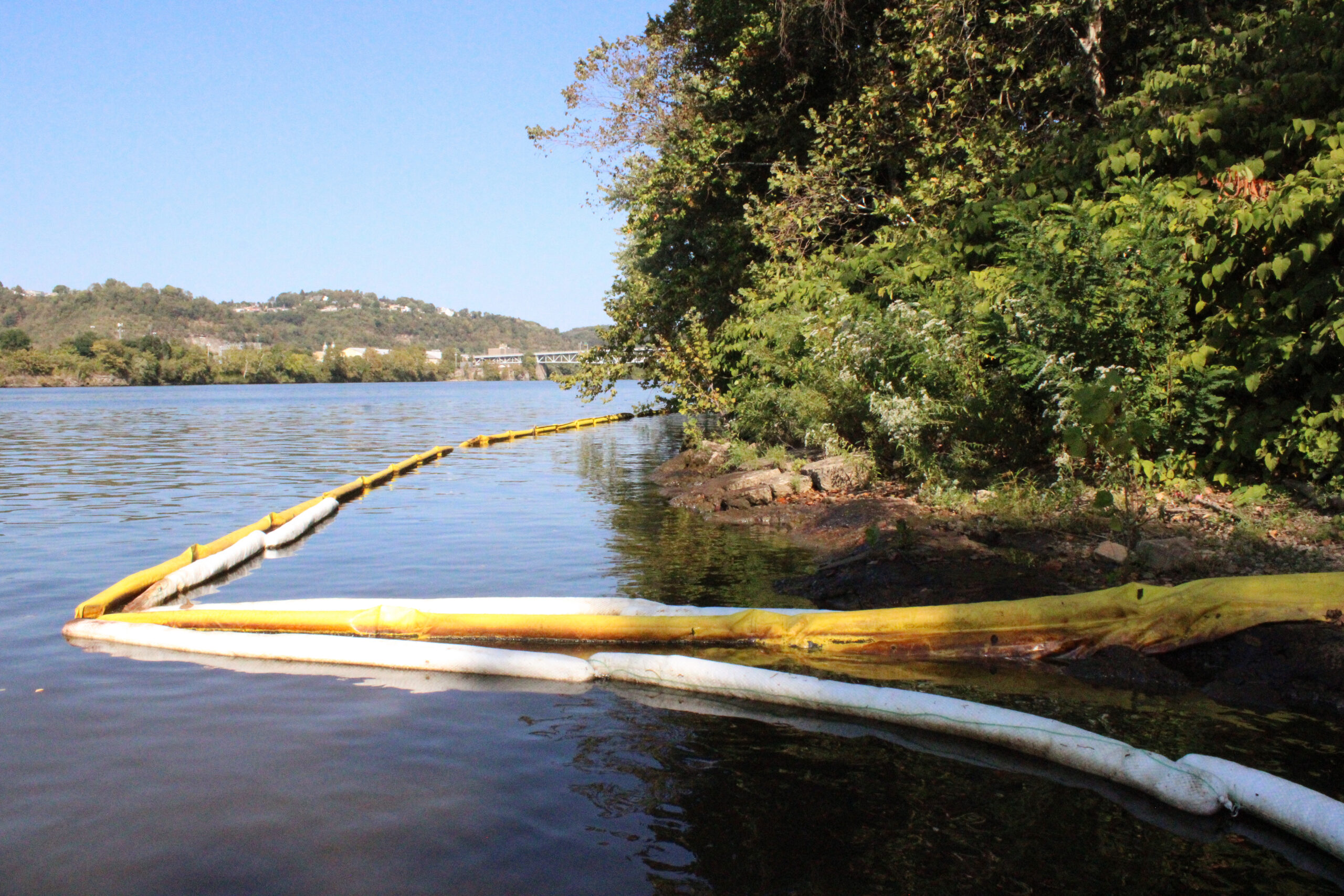
Containment booms on the Allegheny river. Booms can help absorb contaminants and limit the spread of pollution.
Early visions of a booming plastics hub never came to fruition and Shell’s is the lone facility left standing. After just over three years in operation, Shell is now looking to sell its plant, the Wall Street Journal reported in March.
While the Shell facility has come at a cost for the state, plastics production has also come at the expense of the local environment. Nurdles still coat the area around the Styropek facility.
“You don’t need much to have it go everywhere,” Masur said, likening them to grains of sand one might inadvertently carry away from a day at the beach.
Downstream, plastic faces a more worrisome fate, with a recycling rate worse than that of any other recyclable material. Globally, just 9% of plastic ends up being reused; most of it ends up in landfills. That is in part because recycling plastic is more expensive than making new plastic, said Sean O’Leary, senior researcher in energy and petrochemicals at the Ohio River Valley Institute, a nonprofit thinktank. “No one has yet figured out a solution to that problem.”
Plastic production also comes with other harms to those who live near production plants. Communities around Shell’s facility have complained of foul smells from the facility, and feared the health risks that come from exposure to its emissions, like particulate matter and volatile organic compounds. Exposure to these pollutants has been linked to cancers and respiratory, cardiovascular, liver and nervous system damage.
In June, a fire at the Shell plant sent a plume of smoke into the atmosphere, the latest in a series of incidents at the facility. In the three years since the plant started production, Shell has been issued 45 notices of violation from state regulators for air and water contamination. In 2023, it paid the state $10 million and admitted that it had routinely exceeded its emissions allowances. Within a year of going live, Shell had submitted 39 reports of malfunctions at the site to state regulators, the environmental nonprofit Clean Air Council wrote in 2023 after joining a federal lawsuit alleging Shell repeatedly violated air pollution limits.
The emissions numbers for the plant do not include what’s released from the infrastructure built around southwestern Pennsylvania to keep the Shell facility running, such as pipelines that bring in ethane, or fracking wells that feed them.
“The Shell plant is indeed more than just a plant,” Jennifer Baka, associate professor of geography at Penn State, wrote in a 2025 peer-reviewed paper. Rather, it is “supported by a network of more than 20,000 infrastructures.”
Shell is not just reevaluating its investment in the Beaver County plant, but in chemical production altogether. It plans to “pull back” from its chemical assets in full by 2030, Chemical & Engineering News reported in March. What the company once thought was one of the Appalachian facility’s assets — its location, far from the hurricane-prone petrochemical corridor along the Gulf Coast and within 700 miles of what the company said was “the majority of North American polyethylene buyers” — is now its Achilles’ heel.
“They were hoping that other facilities would open up in the region and join them,” Baka told Capital & Main. But that never happened in full.
Kathy Hipple, research fellow at the Ohio River Valley Institute, wrote in a November report that the Shell facility is now at a “significant disadvantage compared to facilities located near developed supply chains,” as proximity to other plants can “provide a buffer when operational upsets occur.”
Shell CEO Wael Sawan said on a July 2025 earnings call that the company wants to return to “what we call the brilliant basics.”
A Shell spokesperson told Capital & Main that the company plans to “unlock more value from our strong portfolio of chemicals assets by exploring strategic and partnership opportunities in the U.S., and this includes our Monaca facility in Pennsylvania and both high-grading and selective closures in Europe, enabling the business to prosper whilst improving returns and reducing capital employed by 2030.” On its fourth-quarter 2025 earnings call, Sawan said there was a “downturn in Monaca” as it posted weak profits.
Shell’s and Styropek’s changes of heart after less than five years underscore the realities of the plastics and petrochemicals bubble, while the nurdles that still drift in Raccoon Creek offer a glimpse at what’s left behind.
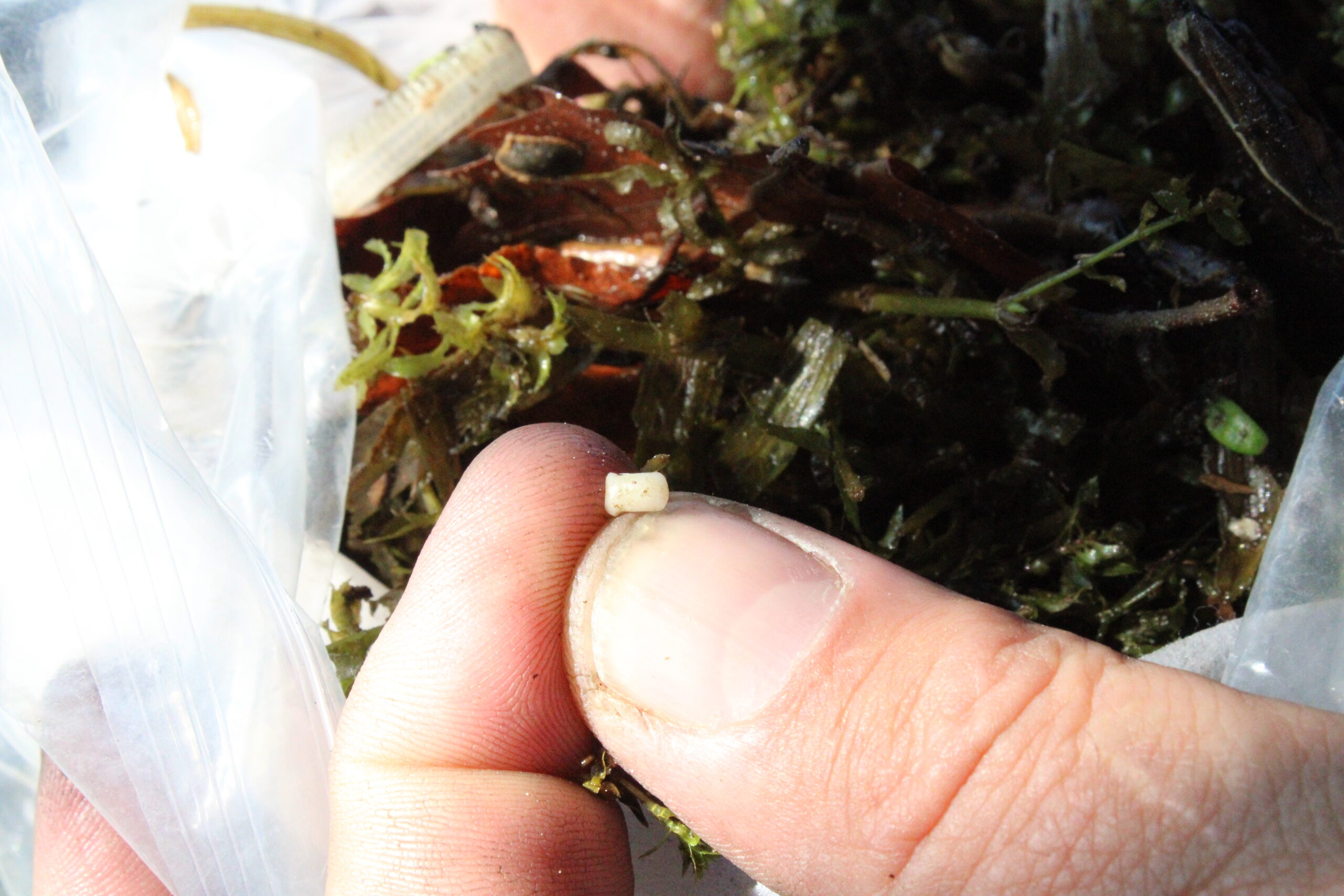
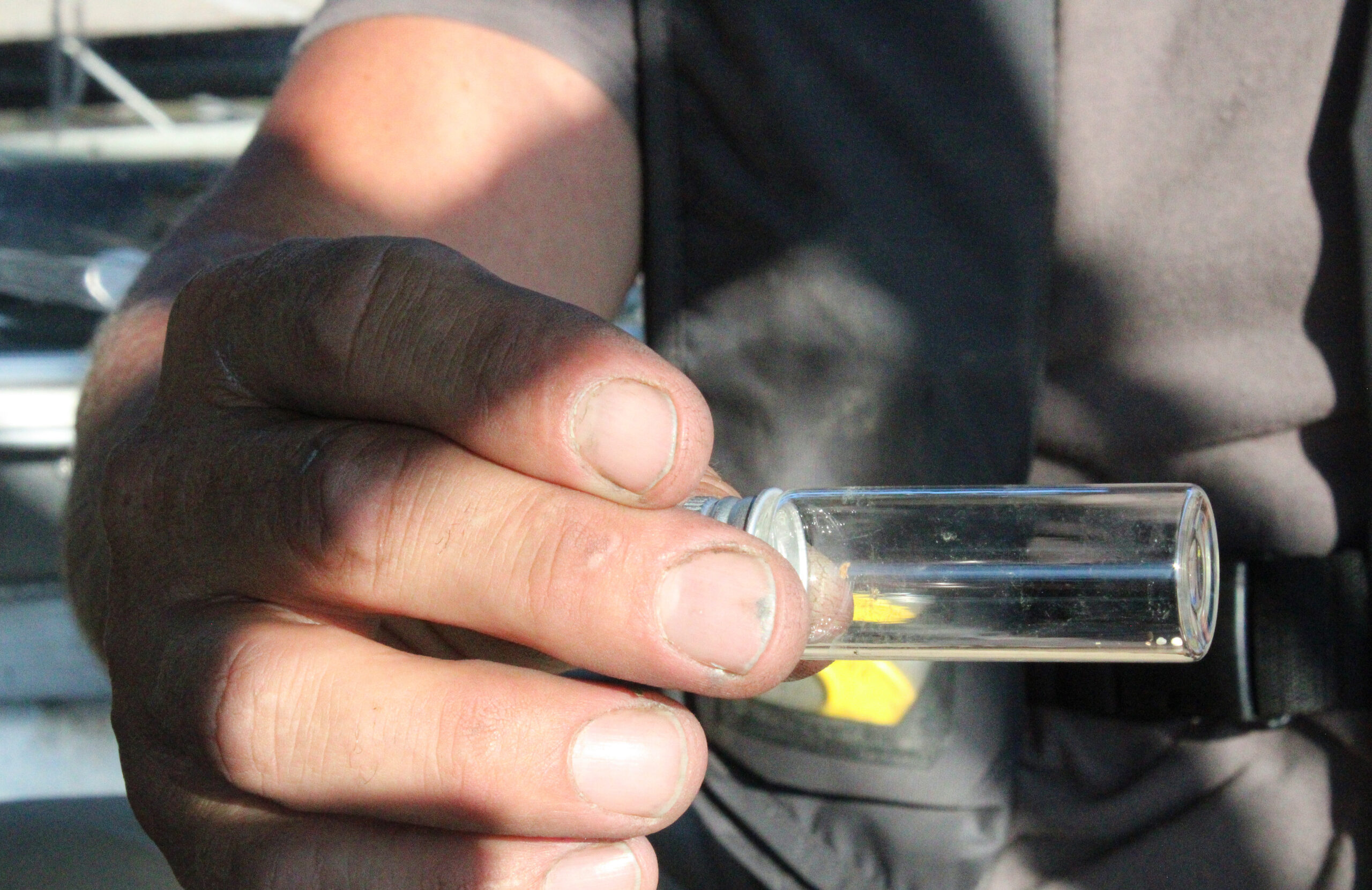
Clark holds a plastic nurdle.
“I remember a lot of people saying, ‘I applied, I’m excited to work down there,’” said Hilary O’Toole, executive director of the environmental group Beaver County Marcellus Awareness Community, of the days when the Shell plant was in development. “And now, when they talk about selling, there’s a lot of confusion.”
O’Toole grew up in Beaver County, near both facilities. She remembers when the zinc plant that once occupied the space where Shell now operates shut down in 2014.
“When that mill closed, a lot of people were unhappy,” she recalled. “All the other mills where they could have worked have closed down too … the lifestyle was gone.”
O’Toole said her community, long used to boom-and-bust cycles, is reckoning with the end of one — plastic — and the emergence of what could be another — data centers.
“I definitely think they’re a cautionary tale,” she said of the petrochemical facilities, noting that county leaders recently softened the news of job losses from Styropek’s closure by announcing new jobs emerging at a local data center.
O’Leary warns against jumping aboard the hype wagon. “These are all seen as extensions of the natural gas industry downstream,” he said. “Whether you’re talking about the hydrogen hub, whether you’re talking about the crackers, whether you’re talking about data centers.”
The subsidies that state legislators enacted to woo Shell to Appalachia likely helped the company avert paying a laundry list of state and local taxes, including corporate net income taxes, property taxes and sale and use taxes. Over the last three years Shell received $90 million in state tax credits for the ethane it purchased for its cracker. It has sold about a third of these to insurance companies, some out of state, the Ohio River Valley Institute detailed in the November report.
When Shell arrived there was hope the facility would generate financial prosperity in the greater Pittsburgh area. But Hipple, the Ohio River Valley Institute research fellow, asserted in the report that the local economy has declined rather than improved in the years since the facility was first proposed.
“For 400 permanent jobs,” she lamented, “the state paid a lot of money to get 400 permanent jobs.”
Clark, from the captain’s seat on his boat, reflects on what the state gave up chasing jobs and prosperity.
“Plastic is incredibly cheap to manufacture if you push all of those true cost ingredients … out on the public,” he said. In his eyes, the costs can be seen in the environment scarred by manufacturing.
“Generations of people’s lands who got fracked out for a short-term gain, and whose water quality got lost, and all of the other things that kind of go along with an exploitative, extractive system.”
He carries the evidence in glass jars and plastic bags stored trunks on his boat — leaves and water samples dotted with polystyrene and polyethylene beads that will take hundreds of years to break down.
Copyright 2026 Capital & Main.
Photos by Audrey Carleton.


-
 The SlickMay 29, 2026
Feds to Open Tens of Thousands of Acres of Colorado Wilderness to Oil Drilling
-
 Deadly Dust: The Silicosis EpidemicMay 27, 2026
California Moves to Ban Quartz Countertop Fabrication to Combat Silicosis Epidemic
-
 Latest NewsMay 26, 2026
Conditions at California ICE Detention Centers Are Getting Worse, Inspections Find
-
 Imperial DivideJune 3, 2026
California’s Lithium Valley Dreams Meet Reality at the Only Restaurant in Town
-

 Column - State of InequalityMay 28, 2026
Top Democratic Candidates Agree on Housing Urgency, Not the Fix
-

 Latest NewsJune 1, 2026
Deep Cuts to Civilian Support Staff for Families of Deployed Marines Raise Concerns
-
 Column - State of InequalityJune 4, 2026
California’s Economy Runs on Labor Trump Wants to Deport
-
 The SlickJune 5, 2026
At This New Mexico Park, Mountain Bikers Pedal Amid Hundreds of Oil Wells