
Column - State of Inequality
On Eve of Strike, Kaiser Nurses Sound Alarm on Patient Care
More than 31,000 nurses and health care workers plan to walk out next week following months-long stalemate with Kaiser.
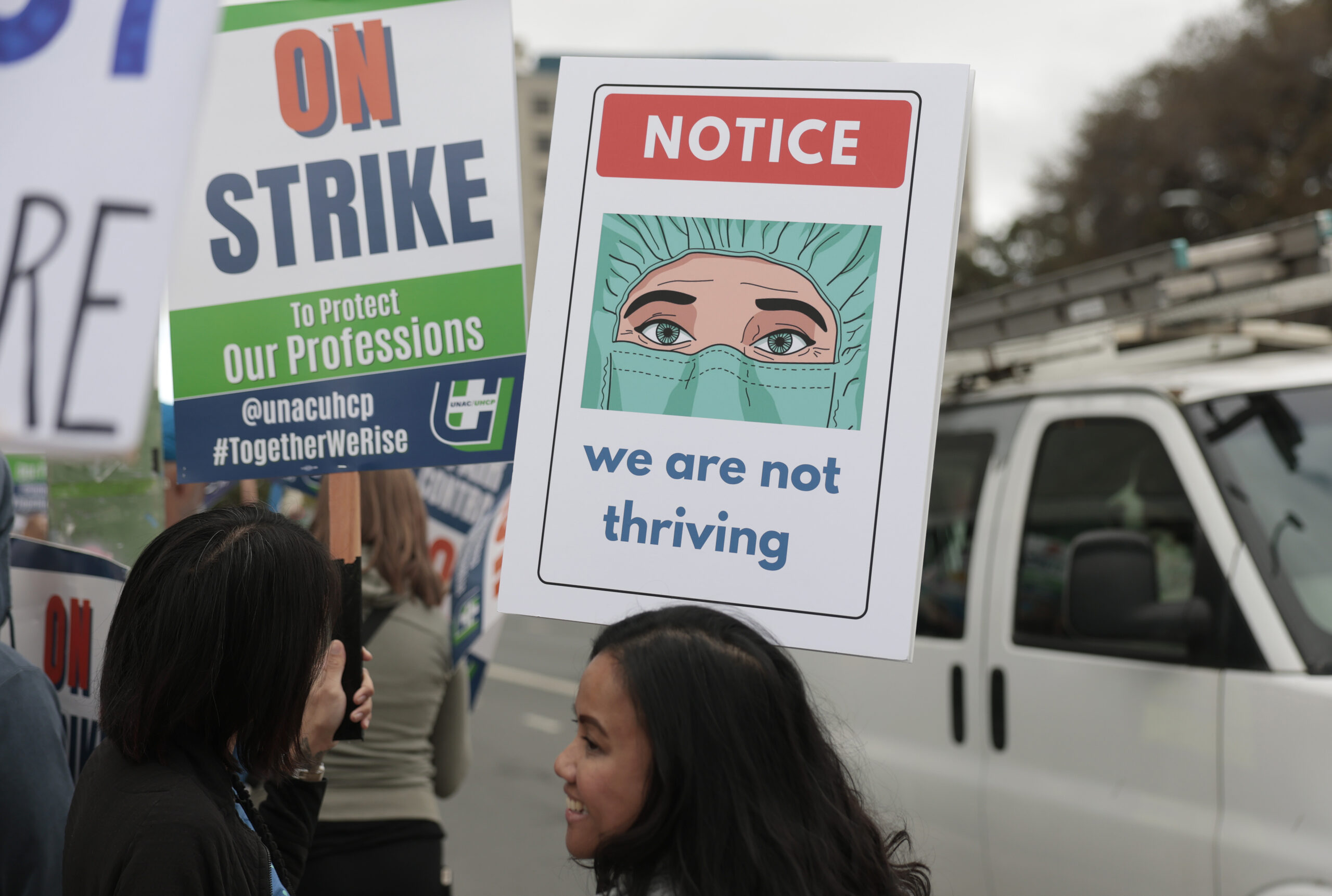

A stinging new report from a union stuck in going-nowhere labor negotiations with health giant Kaiser Permanente makes clear the union’s position: Kaiser, sitting on $67 billion in reserves, can well afford to address glaring staffing shortages and close pay gaps that the union says were years in the making.
Will the report move the needle in negotiations? Not likely. And that almost certainly means that a massive employee walkout against Kaiser, the second such job strike in four months, will go off as planned on Jan. 26.
With more than 31,000 registered nurses, pharmacists, physical therapists and other health professionals involved, the strike has the potential to significantly disrupt Kaiser patients’ experiences, including the likely cancellation or rescheduling of some appointments and elective surgeries. A five-day strike last October prompted Kaiser to bring in 6,000 contract nurses and clinicians.
This strike is open-ended, meaning its impacts could be felt for weeks or months. Nurses say they hate that idea for their patients — but it may be the only way to focus Kaiser’s attention on the chronic staffing issues that they say negatively affect those patients on a regular basis.
“I see the end result of the poor staffing every single day,” said Zach Pritchett, an emergency room nurse at Kaiser Permanente Medical Center in Los Angeles. “What I’m seeing in the ER are Kaiser members who can’t get appointments for months at a time with their own primary care physicians — so they wind up here.”
Kaiser officials, meanwhile, have mostly waved off those concerns, saying in a prepared statement that union leaders “continue to talk about improving care, when this strike, and their actions over the past several months, are really all about higher wages.”
It adds up to a toxic stalemate, nearly 10 months after the union delivered its first proposal for a new contract and almost four months after its previous contract expired. Patient care for some of California’s 9.5 million Kaiser members will almost certainly suffer as a result.
* * *
The Jan. 26 strike date, set by the United Nurses Association of California/Union of Health Care Professionals, follows a tumultuous month in which Kaiser officials at one point cut off negotiations entirely, claiming a UNAC/UHCP representative had threatened to release damaging information about the company unless a settlement was reached. (Disclosure: UNAC/UHCP is a financial supporter of Capital & Main.)
“I certainly didn’t threaten Kaiser, and I made it clear in that meeting that I was not threatening them,” said union representative Joe Guzynski, referring to a December conference at which an independent mediator was also present. Instead, Guzynski said, he informed Kaiser that the union would be releasing much of the information publicly and offered to let company officials read it. They declined, he said.
The union has now made the information public, in an 84-page document that notes Kaiser’s astounding profitability despite the organization’s claim to nonprofit status in several areas of its operation. In 2024, the report notes, Kaiser generated $12.9 billion in what the report calls profits, which Kaiser generally refers to as net revenue or net income. The profit or surplus for the first three quarters of 2025 was $7.9 billion, with fourth-quarter totals not yet known.
On its website, Kaiser Permanente describes itself as “one of the nation’s largest not-for-profit health plans.” That designation applies strictly to its health insurance arm and the foundation that owns Kaiser’s hospitals. The company’s Permanente Medical Groups, the vast physician organizations that actually provide the care to patients, are for-profit ventures. Some union members work in Kaiser Foundation Hospitals and others in the individual clinics that comprise the for-profit medical groups, but their contract is negotiated with Kaiser as a whole.
Kaiser’s reserves, estimated at $67 billion (they fluctuate with market investments, among other things), are unrestricted. That means they can be used for any purpose.
Nurses and other Kaiser employees say they’ve been pleading with Kaiser for years to use some of that money to beef up staffing, to little avail. In its report, UNAC/UHCP says its members filed nearly 14,000 complaints related to unsafe staffing levels in Southern California Kaiser facilities alone from November 2023 to November 2025. That includes instances in which the staffing is out of compliance with the union’s contractual agreed-upon levels.
Kim Mullen, a union negotiator and a nurse who works primarily with stroke victims at Kaiser’s South Bay Medical Center near Long Beach, described what such staffing shortages look like. In her telemetry unit, she said, charge nurses often have to leave their posts in order to provide direct care for patients, meaning they are not doing their main job: running the overall shift, coordinating care and managing assignments.
On a short-staffing day, Mullen said, she doesn’t have enough nurses and other professionals to cover the need, plain and simple. “There’s no extra set of hands,” she said. “You give it your all, put your whole heart and soul in it, and then at the end of the day you’re exhausted, beat up, and you know that you didn’t give the patients all the care that they needed. And that’s what sucks.”
* * *
Kaiser officials have acknowledged staffing issues during these negotiations, union reps say. But in their public communications, the organization has repeatedly hammered the union as being interested only in raises that Kaiser says are “out of step” with economic realities.
“Our focus remains on reaching agreements that recognize the vital contributions of our employees while ensuring excellent, affordable care,” the company said in an emailed statement that it attributed to Senior Vice President Camille Applin-Jones.
Kaiser did not respond to a series of specific questions about the negotiations from Capital & Main. With regard to the union’s report, Kaiser’s statement said it “appears to be a collection of misrepresentations of facts across a broad range of issues, already published news stories, and information we have publicly reported.”
The wage negotiation has been stuck for months, with Kaiser offering a 21.5% raise over four years and the union proposing 25%. Neither side has budged. Union officials say their members agreed to much smaller increases during their last contract, negotiated during and just after the COVID-19 pandemic, and are trying to recoup some of the buying power they lost.
In October of 2025, UNAC/UHCP staged a five-day strike, and that did appear to prompt Kaiser to renew bargaining. For the most part, though, the medical behemoth has only erratically agreed to sit down. Union officials say that Kaiser showed up for negotiating sessions only seven days in November and five in December.
Such stalling is a longstanding corporate negotiating tactic, meant to frustrate and wear down union members whose contracts have expired and who want new deals in order to get on with their lives. In this case, the union’s Guzynski says, Kaiser may have picked the wrong opponent.
“I don’t think they know our members,” Guzynski said. “Our members understand and really feel these issues of staffing, when the employer has billions of dollars in reserves and says they can’t do anything to help them provide the patient care they want to provide.”
Copyright 2026 Capital & Main


-
 Latest NewsApril 14, 2026
ICE Has Arrested Dozens of Delivery Drivers at the Gates of a San Diego Military Base
-

 Deadly Dust: The Silicosis EpidemicApril 13, 2026
As Worker Silicosis Deaths Mount, GOP Moves to Shield Companies From Liability
-

 The SlickApril 20, 2026
As Prices Climb, California Imports More Gasoline Made From Russian Oil
-

 Latest NewsApril 21, 2026
Federal Job Cuts Hit Black Women Hard — A Year Later, Unemployment Is Up
-

 Latest NewsApril 17, 2026
What Could a Republican Governor Get Done in Deep-Blue California?
-

 Featured VideoApril 15, 2026
Teaching LGBTQ+ History in Trump’s America
-

 The SlickApril 22, 2026
Texas’ Gulf Coast Has a Health Problem: Benzene Emissions Are Among the Highest in the Nation
-

 Column - State of InequalityApril 16, 2026
Hot Union Spring at LAUSD