
Striking Back
‘There’s Power in Numbers’
In October, Michigan home care workers formed a statewide union of 32,000. Experts say it’s a template for protecting rights in 2026.


When Ravina Turner, 53, started working for Michigan’s Home Help Program around 2015, she was just grateful to get paid. For years, she’d missed work to care for her daughter, Davina, who has Crohn’s disease and colitis.
At first, the Home Help Program, run by the state’s Department of Health and Human Services, paid her about $300 a month for her work, allowing her to scale back her hours as a nursing assistant. By last year, she had become a full-time caregiver for Davina, and her wages had risen to $15.88 an hour. That is still well below the $35.59 per hour living wage for a single parent in Dearborn Heights, outside Detroit, according to the MIT Living Wage Calculator.
“This is a job and we deserve benefits,” said Turner, who’s picked up a gig as a personal care assistant at a nearby assisted living facility. “We deserve health insurance as well as life insurance. We deserve vacation … because if I was punching a clock, I would get all those perks.”
Turner thought she just had to endure low wages, no benefits and no paid time off, she said, until a canvasser knocked on her door and talked to her about how much less Michigan home health aides made compared to aides in states such as Washington, where in 2023 starting rates were set at $21 per hour. She suggested Turner join the Michigan Home Care Workers United campaign, an effort from the Service Employees International Union to get union recognition for home care workers paid through Medicaid. Turner decided to join. (Disclosure: SEIU is a financial supporter of Capital & Main.)
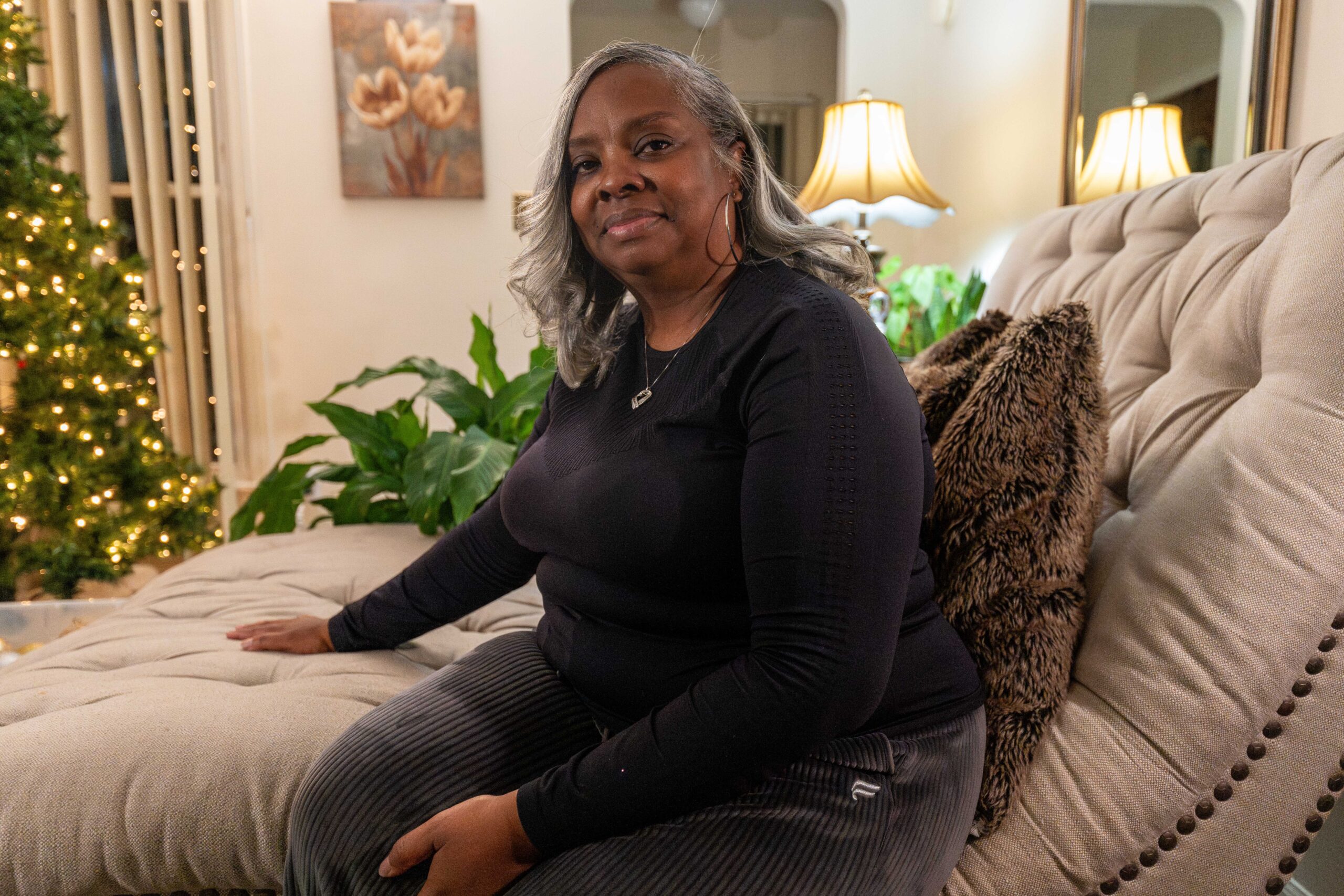
Ravina Turner at her home in Dearborn Heights. Photo: Alejandro Ugalde Sandoval.
This October, Turner was among 32,000 Michigan home care aides who became union members after 73% of voting home care workers voted to join the union. They are currently working towards negotiating a contract with the state. And their victory, say observers, achieved something politicians increasingly need to pull off: building coalitions across political divides by speaking to material concerns.
* * *
Michigan Home Care Workers United launched in March 2024, around the time that the canvasser came to Turner’s door. Their efforts were aimed, initially, at getting care workers the right to form a union — which was successful, with Democratic Gov. Gretchen Whitmer signing a bill granting Home Help workers state employee status for the purposes of collective bargaining last October.
Then they turned to the difficult work of organizing a union vote across the state. Currently, at least 11 other states, most of them Democratic strongholds like California and New York, have laws that recognize home care workers as public employees for the purposes of forming a union. The Michigan home care worker election was the first under President Donald Trump’s second administration. It was also only the second success in a state that went twice for Trump.
Kevin Reuning, a political science professor at Miami University of Ohio who tracks nationwide union elections, said the Michigan home care worker win was a “rare” victory given the feat of workers at that scale.
“It is statewide … that poses such an incredible difficulty because you don’t have all your workers in a single location. It just makes the actual organizing hard,” said Reuning, who is also the creator of UnionElections.org.
As activists began to talk with care workers across the state, demands emerged: higher wages and benefits, access to training, and a registry to connect workers with clients in need of care.
“Hundreds of home care workers have had boots on the ground for a very long time,” said Gabriella Jones-Casey, executive vice president of home care and staff development for SEIU Healthcare Michigan.
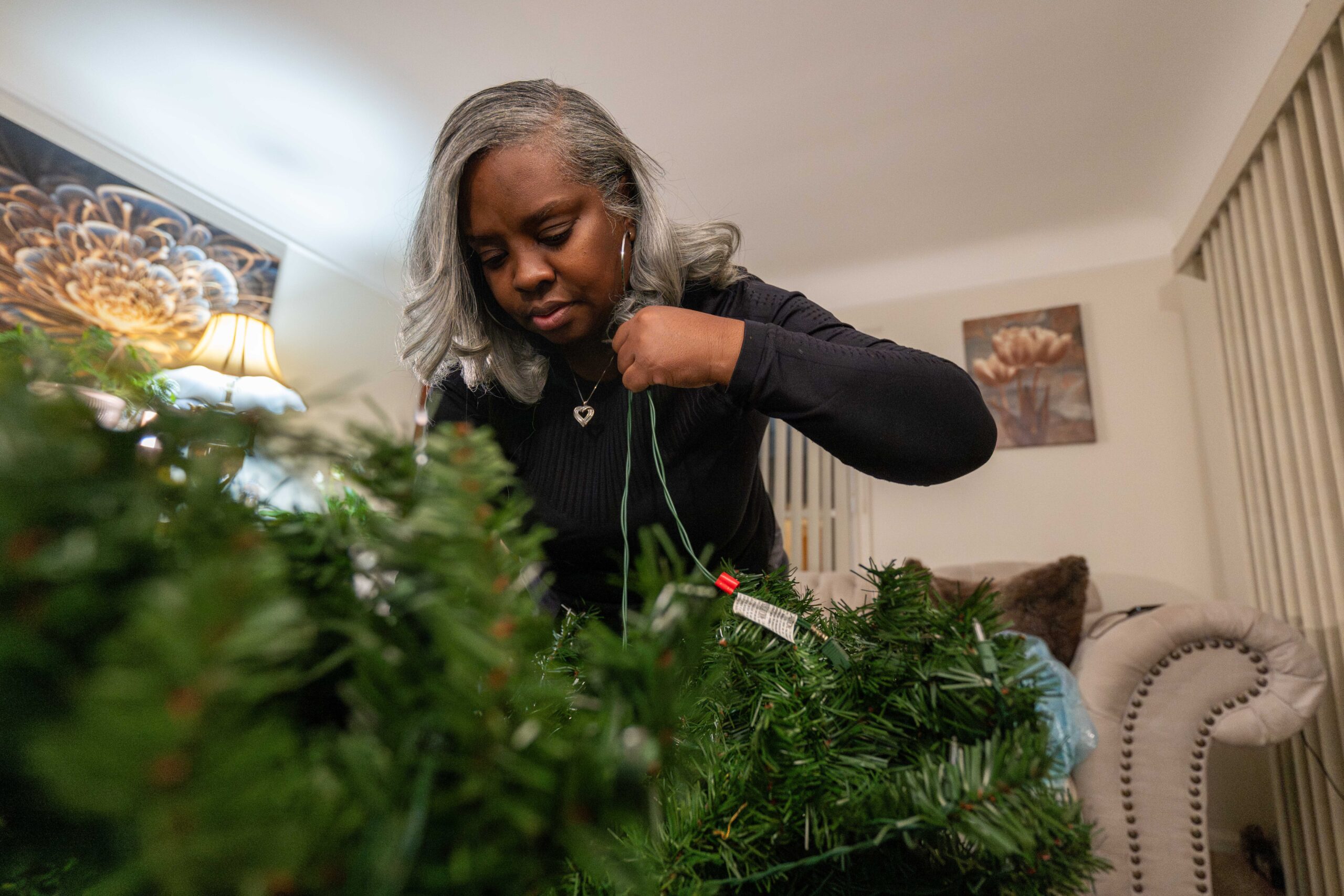
Turner decorates her home for Christmas in anticipation of her daughter’s return from the hospital. “I’m preparing for her to come home. It’ll be a cheerful holiday setting.” Photo: Alejandro Ugalde Sandoval.
Home care workers are predominantly female, older and racially diverse, and they have long experienced stagnant wages, no benefits and limited access to training. At the federal level, workers are embattled; in July, the Trump administration issued a proposal rolling back federal minimum wage and overtime protections for home care workers.
“This is a serious rollback, and it’s going to exacerbate shortages,” said Catherine Ruckelshaus, legal director at the National Employment Law Project. “It’s pretty much a disaster.” Locally, home care workers are facing cuts to Medicaid, which funds Michigan’s Home Help Program.
The rapidly growing profession already battles significant issues with retention. Although long-term home health care is expected to grow by 17% over the next decade, rates of turnover were nearly 75% nationally in 2024.
When the election results came in, those were the issues on workers’ minds — wherever they were. That included Michigan’s cities and suburbs, where most of the state’s Black and brown workers live and where voters lean Democratic, as well as its rural areas, which are generally white and voters are heavily Republican.
The organizers’ success came from the unit’s ability to speak to broad concerns about wages, working conditions, and respect, said Jones-Casey.
“We represent workers all across the state from the UP [Upper Peninsula] down,” said Jones-Casey. “The challenges that arise might be different across the urban areas versus the rural versus suburban, but that’s kind of the beauty of this unit. They are representative of the entirety of Michigan.”
* * *

Home care worker Erika LaFountain helps Ricky Johnson into his wheelchair during a visit to the local shopping mall. Photo: Alejandro Ugalde Sandoval.
Workers say there is power in finding common ground between disparate places and political landscapes.
Erika LaFountain, a home care worker involved with the union, lives in Jackson County, a conservative stronghold about an hour west of Detroit. It is 82% white, and Trump won it by more than a 20-point margin in 2024. It is just the sort of place SEIU needed to win over.
LaFountain said she’d never thought of herself as an activist. When a canvasser came to her door, she said, “I’m like, I don’t think that’s me,” said LaFountain. “I think you’re talking about nurses and, like, people with degrees.”
LaFountain started in home health care after she helped a wheelchair-bound neighbor, Ricky Johnson, get into his home without a ramp. At first, LaFountain cared for Johnson in her free time, unpaid. When his family said they needed more help, LaFountain joined the Home Help Program. As had been true for Turner, the little bit of state money helped LaFountain — but it wasn’t enough to live on.
It’s been powerful, said LaFountain, to share her story.
“I started just telling Ricky’s struggles,” LaFountain said, as well as “our story and our struggles, and how if there was health insurance, that I wouldn’t have to be on Medicaid.”

LaFountain poses for a portrait taken by Ricky Johnson, with some support holding the camera.
Turner, who lives in deep-blue Wayne County, which Kamala Harris won by almost 30 points in 2024, agreed completely. “I learned that there’s power in numbers … strength in numbers,” she said.
Overall, Turner said, she felt lucky. “I take care of my daughter, and she does have good moments when I’m able to leave for a couple of hours.” But she knows not every caregiver has that freedom. “The ones that can’t leave … those are the ones that I was really fighting for,” she said.
Copyright 2025 Capital & Main


-

 Column - State of InequalityMay 21, 2026
In California Governor’s Race, Xavier Becerra Walks Away From Single-Payer
-

 Latest NewsMay 22, 2026
Where California’s Gubernatorial Candidates Stand on Climate and Taking Big Oil Money
-

 The SlickMay 20, 2026
70-Foot Wastewater Geyser Reflects New Mexico’s Latest Oilfield Challenge
-

 The SlickMay 29, 2026
Feds to Open Tens of Thousands of Acres of Colorado Wilderness to Oil Drilling
-

 Latest NewsMay 18, 2026
Budget Cuts Threaten Program That Doubles Food Dollars for Californians in Need
-
 Deadly Dust: The Silicosis EpidemicMay 27, 2026
California Moves to Ban Quartz Countertop Fabrication to Combat Silicosis Epidemic
-

 Latest NewsMay 26, 2026
Conditions at California ICE Detention Centers Are Getting Worse, Inspections Find
-
 Imperial DivideJune 3, 2026
California’s Lithium Valley Dreams Meet Reality at the Only Restaurant in Town