
The Slick
Utility Asks New Mexico for ‘Zero Emission’ Status for Gas-Fired Power Plant
Plan puts costs of new solar farms on New Mexicans and extends lives of coal-fired plants. Critics call it “profound greenwashing.”
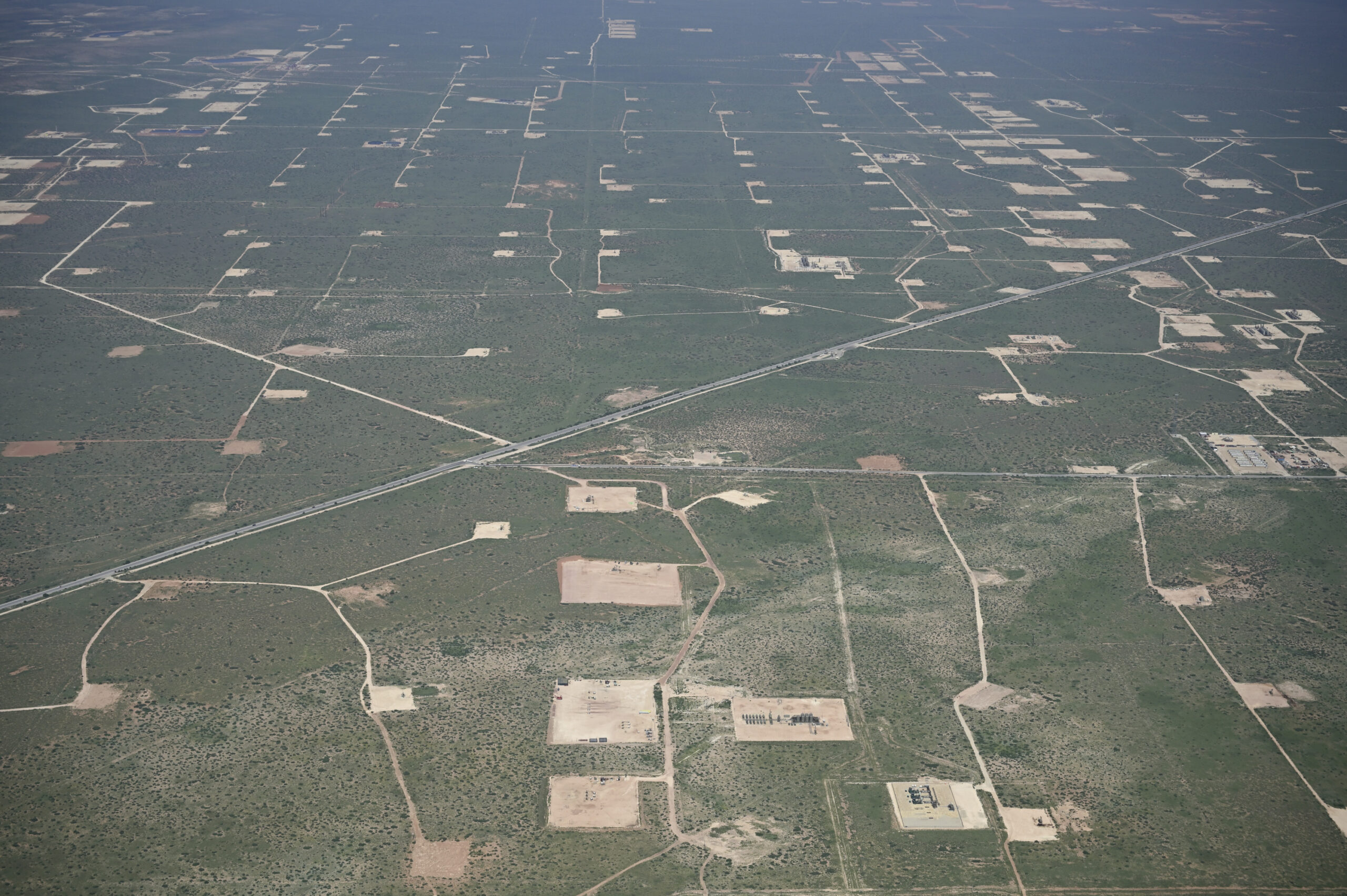

The Southwestern Public Service Company has asked the state of New Mexico to grant exceptions to the state’s Energy Transition Act for two proposed gas-fired power plants, including one exception that would see approximately one-third of the energy produced at one plant qualify as a “zero-carbon resource” like solar panels or wind turbines.
A second exception would exempt both plants from the act’s zero-carbon requirement, “to preserve system reliability and protect customers from unreasonable bill impacts.”
The two proposed plants would be in Texas, with the larger of the two — called Gaines County Power Plant — to be built just across the border from Hobbs, New Mexico. Even though the two wouldn’t be in the state, New Mexico’s Energy Transition Act requires that all energy sold in the state by investor-owned utilities be from zero-carbon-emission sources by 2045, no matter where it is generated. The act was an early environmental win for Gov. Michelle Lujan Grisham.
The request is part of a wide-ranging application the Southwestern Public Service Company, a subsidiary of Xcel Energy, has before the Public Regulation Commission of New Mexico for new transmission lines, extended closure dates for existing coal-fired power plants and eight new power facilities — two each of natural gas, solar, wind and battery systems. The $10 billion plan covers the company’s service area in the southeast corner of the state and parts of West Texas.
While most of the proposed plants would generate renewable energy, the two gas plants would generate 51% of the total energy in the application.
“To pretend that natural gas in some way or another is a zero carbon resource is just a bald-faced lie,” said Camilla Feibelman, director of the Sierra Club Rio Grande Chapter, and an energy watchdog. “It’s profound greenwashing.”
Southwestern Public Service Company has requested that all costs associated with two new solar projects be borne by New Mexico ratepayers.
The majority of Southwestern Public Service Company’s coverage area and energy sales are in Texas, but, according to Xcel, much of the projected increase in energy would be used in New Mexico, particularly in the state’s portion of the Permian Basin, the nation’s largest oil field. More than 50% of the company’s energy sales in New Mexico already go to oil and gas companies to power their wells and other infrastructure with grid-based electricity. Oil and gas revenues are also the state’s biggest single source of income.
According to the application, replacing the two proposed gas plants with renewable energy sources would cost New Mexico customers an additional $5.5 billion and raise residential electricity rates by more than 40%.
And the gas plants may be on the way. “We have already signed and executed contracts for the turbines,” Kaley Green, a senior media relations representative for Xcel Energy, said. “We anticipate a 40-year service life for each of the plants.”
In the application the company requests that all costs associated with the two solar projects be borne by New Mexico ratepayers because they will be built to meet New Mexico Energy Transition Act requirements, “not because they were needed for the overall system.” In addition, it asks for a speedy approval of the solar plants to secure renewable energy tax credits that were enhanced under President Joe Biden but had their timeframes dramatically curtailed under President Donald Trump.
These and other moving parts create an unusually large, wide-ranging and controversial application that landed before the New Mexico Public Regulatory Commission on Sept. 25. The commission plans to reach a decision on the Gaines Plant zero-carbon request by Dec. 10 and a decision on the full application by May 7. Green said that Southwestern Public Service Company began work on the proposal in 2022.
“It is a lot for one filing, but it’s not absurd,” said AnnaLinden Weller, senior policy adviser with Western Resource Advocates, a nonprofit that fights climate change and its impacts across the western U.S. Previously she spent four years as a policy director at the New Mexico Energy, Minerals and Natural Resources Department. “It’s certainly the biggest one that I’ve seen, but not by a huge amount.”
Southwestern Public Service Company cites several factors for the size and complexity of the application: It wants to close two aging coal-fired plants in Texas; it sees increased demand from oil and gas producers in the Permian Basin, data centers and other industries; and there are new requirements from the power-sharing system in which the new plants would operate, the Southwest Power Pool. Despite its name, the pool runs from southeast New Mexico north to the Canadian border, balancing production loads from utility companies in 14 states along the way.
In August 2024, the pool raised the production reserve requirements of member utilities like Xcel from an annual 15% to 16% in summer and 36% in winter. (A production reserve requirement is extra power production capacity available for unexpected peak loads.) The new winter load requirement was in part a response to the winter storms of 2021 and 2022 that created sudden, massive electrical demands from damaged energy systems across the Southwest Power Pool.
The next 20 years are critical for mitigating catastrophic future warming — but that goal may already be out of reach due to increasing oil and gas use.
The request to keep the new gas-fired plants beyond 2045, when New Mexico pledged to reach zero carbon emissions, aims for a possible loophole in the law.
“So there’s a weird thing about the Renewable Energy Act. It doesn’t prohibit fossil fuels per se,” Weller said, so long as the utility can convince the Public Regulation Commission that it will be producing zero carbon electricity for New Mexico customers by 2045 while hitting ever smaller targets along the way.
Xcel’s Green said, “We will continue to work towards compliance with the 2045 goals and adjust our grid planning as we proceed, based on technology and other factors.”
If that’s not possible, Weller said the commission has the discretion to give utilities “wiggle room” for the 2045 zero carbon requirement if the utility faces reliability or affordability issues — both of which Southwestern Public Service Company explicitly claimed in its application. No utility has tried for such an exemption before, Weller said.
In 2020, the commission shot down a gas-fired power plant proposed by El Paso Electric, which provides electricity in parts of southern New Mexico and far West Texas. That plant would have produced about 11% of the electricity that the proposed Gaines County and Tolk plants would generate together. But, “They didn’t have a plan for how it would be possible for them to comply with the Renewable Energy Act,” Weller said — such as asking for exemptions from the act.
Another loophole in the act allows a utility to claim a fossil fuel plant is a “zero carbon resource” if that plant’s use reduces methane emissions “as a result of electricity production” by a 10-to-1 ratio or better of carbon dioxide to methane emissions. Southwestern Public Service Company hired an outside economist to show how electrifying oil and gas operations in the Permian Basin could offset enough methane emitted by wells and associated facilities to qualify roughly one-third of the electricity from the Gaines County plant as “zero carbon.”
“We’re still thinking about that as a legal question,” Weller said. “A plain reading of the Renewable Energy Act [the underlying law for the Energy Transition Act] says that the generation resource has to be zero carbon, not the effects of the generation resource.”
She added, “Are there climate impacts? Yeah. The question is are they big enough or worthwhile enough given what you’re building.”
Both carbon dioxide and methane are greenhouse gasses that contribute to climate warming, but methane is far more potent, producing more than 80 times the warming potential as carbon dioxide in its first 20 years in the atmosphere. The next 20 years are critical for mitigating catastrophic future warming — but that goal may already be out of reach due to increasing oil and gas use.
“There’s this fantasy that we’ll be able to make oil and gas extraction something that’s sustainable in the short or long term, and that’s just not a fact.”
~ Camilla Feibelman, director, Sierra Club Rio Grande Chapter
On Nov. 12, the International Energy Agency released its 2025 World Energy Outlook, which concluded that oil and gas demand will not peak before 2050, as previously hoped for — and needed — if the planet is to avoid increasingly frequent climate change catastrophes. The report goes on to say that with the increase in fossil fuel use, “exceeding 1.5°C is now inevitable.” Holding global warming to 1.5°C above preindustrial levels was the stated goal of the landmark 2015 Paris Agreement.
“There is some low-hanging fruit that we can get from electrifying the oil field, and ideally the infrastructure would be communicable to some future replacement industries that might help the state head in some different direction,” said Feibelman, the Sierra Club director.
“But you can’t deny the fact that it basically builds a more permanent infrastructure around oil and gas extraction,” she continued. “There’s this fantasy that we’ll be able to make oil and gas extraction something that’s sustainable in the short or long term, and that’s just not a fact.”
In 2023, Chevron touted a 20-megawatt solar field it built in southern New Mexico to power a nearby gas facility and reduce the company’s greenhouse gas emissions. For a while, the facility was a prominent focus of the company’s social media advertising in New Mexico.
But on the same day that the International Energy Agency released its World Energy Report, Chevron announced plans to build a natural gas power plant in Texas to power data centers. The plant is expected to produce 2.5 gigawatts of electricity, 125 times the amount of the solar field.
When asked about the fossil fuel power plants in the Southwestern Public Service Company application and how they mesh with the Energy Transition Act her administration championed, Gov. Lujan Grisham’s office punted.
Jodi McGinnis Porter, the governor’s deputy communications director, wrote, “Nearly half of this proposal is renewable energy. The same law that sets those aggressive renewables targets provides an exception process for utilities to protect system reliability. We’re confident the [Public Regulation Commission] can make the technical determination about whether it’s truly necessary. We’ll let that process move forward.”
If approved, Southwestern Public Service Company will build the Gaines County plant about five miles south-southeast of Hobbs, a town of about 40,000. The prevailing wind patterns would carry much of the exhaust from the new plant right over town.
“It’s not like there’s some bright-line border separating New Mexico and Texas’ pollution,” Feibelman said, and the region already suffers from bad air pollution. The American Lung Association has given both Lea and Eddy counties — the center of New Mexico’s portion of the Permian — failing grades for their ozone levels. The American Lung Association does not have ozone figures for the Texas side of the basin.
“The Permian Basin is basically out of compliance with federal ozone standards,” Feibelman said. “It’s kids, it’s communities, it’s elderly people that are going to pay the price of this poor air quality no matter where they live.”
Copyright 2025 Capital & Main


-

 Column - State of InequalityMay 21, 2026
In California Governor’s Race, Xavier Becerra Walks Away From Single-Payer
-

 Latest NewsApril 28, 2026
A May Day Push to ‘Shut It Down’ Takes Shape Across the Country
-
 Deadly Dust: The Silicosis EpidemicMay 6, 2026
California Could Be the First State to Ban Quartz Countertops
-
 The SlickApril 29, 2026
With Promises of Money, Controversial Gas Pipeline on Navajo Nation Passes First Hurdle
-

 Latest NewsMay 1, 2026
In One of L.A.’s Food Deserts, ‘Hands That Harmed Are Now Hands That Heal’
-

 Column - State of InequalityApril 30, 2026
Don’t Call It Upward Mobility If People Still Can’t Afford to Live
-
 Latest NewsMay 5, 2026
Fire Recovery Could Wipe Out Altadena’s Affordable Rentals
-

 Latest NewsMay 11, 2026
Inside the Texas Water Crisis Pitting Residents Against Industry