Latest News
What Could a Republican Governor Get Done in Deep-Blue California?
Experts say he would likely face a recall, but could still wield power through appointments, vetoes and regulatory boards.
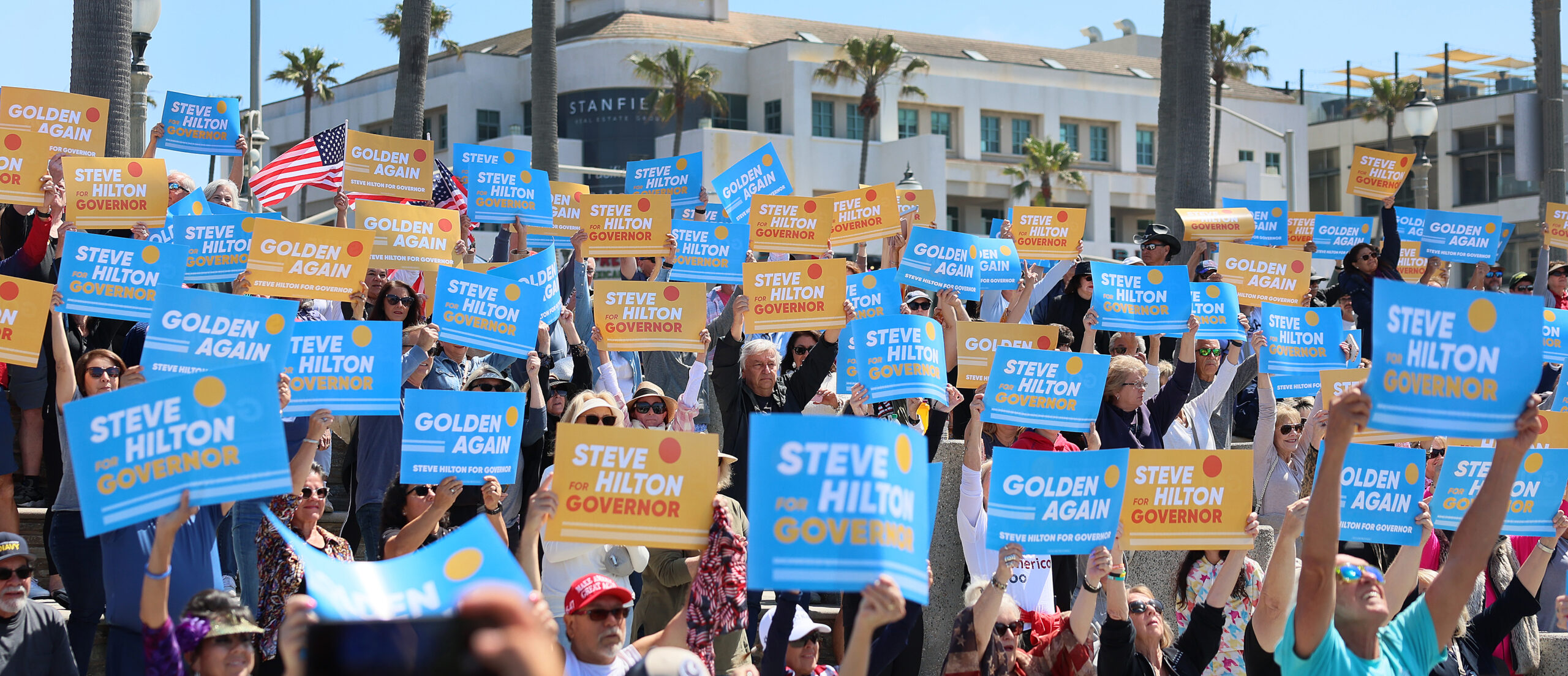

With the presumptive Democratic favorite, U.S. Rep. Eric Swalwell, exiting the race, the possibility of a Republican being elected governor of deep-blue California has once again swung into view. But what would that look like in practice?
The answer, according to multiple political consultants and campaign-runners contacted by Capital & Main, is more nuanced than it might appear. Most obvious, perhaps, is that a GOP governor would not only face an almost immediate recall petition, but also be surrounded by Democratic supermajorities in the state Legislature that could override the governor’s vetoes of key pieces of legislation.
Join our email list to get the stories that mainstream news is overlooking.
Sign up for Capital & Main’s newsletter.
“We don’t have a king,” said Matt Rexroad, a veteran consultant who has run local and state campaigns for candidates from both major parties. “We have a governor who has executive authority, who also has some constraints on that authority — and one of those constraints is the Legislature.”
Still, the authority the governor does have extends to thousands of state job appointments, the ability to stall legislation and budget processes via veto, and the shaping of state regulatory boards that oversee such areas as oil and gas, water resources and the like.
It may be work conducted in the margins, the experts say, but it’s not nothing.
“Everything that comes out of the regulatory levers, a governor has pretty solid control over,” said Rob Stutzman, a GOP consultant and former deputy chief of staff for communications under Gov. Arnold Schwarzenegger. “They could use that fairly effectively even in a blue state.”
Of course, that would hinge on the governor understanding how Sacramento works and how to engage those levers. In the case of the two leading Republican candidates, former FOX News host Steve Hilton and Riverside County Sheriff Chad Bianco, such is not the case, the consultants say — and it sets up the potential for legislative gridlock and not much else in the way of governance.
* * *
California hasn’t had a Republican governor in 15 years, going back to the final days of Schwarzenegger’s tenure. The intervening period has been marked by two significant developments: the coalescence of a two-thirds majority of Democrats in both the State Senate and Assembly, and the GOP’s hard-right tilt under the influence of President Donald Trump and his MAGA base.
As a state, California remains deep blue. Among registered voters, more than 45% are Democrats, versus 25% Republicans. More than 20% say they have no party preference.
But California’s primary system is something else again. Under it, the top two vote-getters (in this case, in the June primary) advance to November’s general election regardless of their party affiliation. The most recent polling, conducted April 1 through April 6 by veteran Democratic consultant David Binder, showed Hilton leading all candidates, followed by Swalwell and then another Republican, Bianco.
Trump endorsed Hilton on April 5, which Stutzman said significantly reduced the odds of a one-two GOP finish in the primary. “I think it goes from a 20% chance to about a 5% chance,” the consultant said a few days before Swalwell’s departure was announced. Hilton will now likely attract considerable MAGA campaign money, a critical point of separation in a state where media spending is both necessary and expensive.
Swalwell’s exit, though, may have altered California’s gubernatorial math. Even before it, the Democrats were straining to identify a clear frontrunner among at least eight candidates, and attempts by party leadership to persuade low-polling candidates to drop out had failed.
If the party remains fractured, and the primary vote splits among multiple candidates, it’s at least possible that Hilton and Bianco both pass through to the November ballot — the only way, consultants say, that California would wind up with a Republican governor. (They all agree that any Democratic candidate that moved forward would win the general election.)
Were that to happen, the pushback would commence quickly. That goes both ways.
* * *
“The first thing [after the election] that would happen is Democrats would begin the process of a recall — like, day one,” said veteran Democratic consultant Steven Maviglio. “That would overshadow everything that follows.”
The recall process would take months, effectively putting a ticking clock on the governor-elect’s tenure. Normally, Maviglio said, an elected executive who’s not in the mainstream of political thought in their state — and who is facing potential ejection from office — would then move toward the political middle in order to finalize a budget, sign some legislation and prove he can govern.
Neither Hilton nor Bianco has given any indication he’d do so. Hilton enthusiastically accepted the endorsement of Trump, who has consistently criticized Gov. Gavin Newsom and other Democrats in California, as well as mobilizing military troops and ICE agents, among others, in an assault on immigrants in the state.
Bianco, meanwhile, told the Los Angeles Times that he would not work with the Democrat-controlled Legislature. “I’m gonna get every single one of them unelected,” Bianco said. “Every single day, I’m gonna stand on the steps of the Capitol, and I’m gonna tell the California voting public about the idiots in Sacramento that are ruining their lives.”
With Democrats holding 75% of the seats in both the Senate and Assembly, they’ve got enough votes for the two-thirds majorities they’d need to override the governor’s vetoes on pieces of legislation — a weapon that hasn’t actually been deployed in California since 1980. But the governor has line-item veto authority on the budget, meaning he can strike specific spending items without rejecting the entire bill. It’s known as blue pencil authority.
“You can see this endless cycle going on,” said Richard Costigan, a longtime Republican strategist who served as Schwarzenegger’s deputy chief of staff and chief lobbyist. “The Legislature and the governor are going to try and figure out each other’s behavior — and they can come to a complete standstill, because they have the same [amount of] power.”
* * *
So what could a Republican governor do in the interim period before the recall petition were certified and a statewide vote scheduled?
In that short run, the consultants said, the governor can issue executive orders, which are not the same as legislation but sometimes require the passing of a new law to supersede them. Newsom issued a stay-at-home order in the early weeks of the COVID-19 pandemic in 2020, and he placed a moratorium on the death penalty in 2019. Hilton or Bianco could lift that moratorium by similar executive order.
Governors also have significant leeway in appointments to regulatory boards and state agencies. While the top executives at those agencies are generally subject to legislative approval, the vast majority of lower-level jobs are not; those workers can be hired and fired through the governor’s office.
“A governor can lay off lots of people if they really want to,” Rexroad said. “They may not be able to eliminate the positions entirely, but they could leave them unfilled. It’s one way of addressing the size of the government.”
Stutzman suggested that a Republican governor could use appointments to the Air Resources Board and the California Energy Commission to, for example, clear a path to open more gas refineries. (Stutzman works with some oil and gas clients in the state.)
Governors also have the power to fill judicial vacancies at the appellate, superior and supreme court levels, although that process, Rexroad said, “is slow turning — you need to be in office over a long period. You’d need not to get recalled.”
As for any designs Trump and his administration have for the state, especially as regards immigration, the governor’s powers are more muted, the consultants said. While Hilton or Bianco might not resist another ICE or Border Patrol incursion or attempt by Trump to enlist the California National Guard in the process, the final word is not theirs. The authority for challenging the legality of those actions rests with the state attorney general, Rob Bonta, an elected Democrat, who has sued the Trump administration more than 50 times.
Still, by shrewdly combining veto power, executive orders, position appointments and the bully pulpit that accompanies the state’s top office, a Republican governor could reshape part of California’s government and its policies, if not the actual laws emanating from it.
There’s one more catch, though: staffing. A GOP cabinet at the State Capitol hasn’t existed since Schwarzenegger’s time, and many of the most experienced Republican political operatives are either retired or may not be eager to leave secure, well-paying positions in order to join Hilton or Bianco for what might be a recall-shortened run.
“When the threat of a recall is out there, you’re going to wind up with a very young staff, which I think the Democratic staff in the Legislature would eat alive,” Costigan said. “Or you’re going to get folks my age or older that are sort of on the backside of their career, who say, ‘OK, I can deal with a six-month or one-year appointment.’ That’s going to be an interesting dichotomy: Which way are you going to go with your senior staff?”
All of these elements, especially the looming specter of the recall, likely mean that Hilton or Bianco would ultimately wind up playing more defense than offense once in office, the consultants said.
“You’re talking about a brand new governor with zero knowledge of how government works, and an entrenched bureaucracy [around him],” said Maviglio, the Democratic consultant. “It’s a complete ignorance of the way that state government operates, and there’s frankly not a lot of people on the Republican side who have the keys to that kingdom. They’ve been out of office for so long, you know?”
Copyright 2026 Capital & Main



-
 Column - State of InequalityMay 21, 2026
In California Governor’s Race, Xavier Becerra Walks Away From Single-Payer
-
 Latest NewsMay 22, 2026
Where California’s Gubernatorial Candidates Stand on Climate and Taking Big Oil Money
-

 The SlickMay 20, 2026
70-Foot Wastewater Geyser Reflects New Mexico’s Latest Oilfield Challenge
-

 The SlickMay 29, 2026
Feds to Open Tens of Thousands of Acres of Colorado Wilderness to Oil Drilling
-

 Latest NewsMay 18, 2026
Budget Cuts Threaten Program That Doubles Food Dollars for Californians in Need
-
 Deadly Dust: The Silicosis EpidemicMay 27, 2026
California Moves to Ban Quartz Countertop Fabrication to Combat Silicosis Epidemic
-
 Latest NewsMay 26, 2026
Conditions at California ICE Detention Centers Are Getting Worse, Inspections Find
-
 Imperial DivideJune 3, 2026
California’s Lithium Valley Dreams Meet Reality at the Only Restaurant in Town