
Coronavirus
USC and UCLA Get Low Grades for Their COVID Responses
A look at how L.A.’s top universities treated their students, campus workers and professional staff during the pandemic.


The University of Southern California employs more than 26,000 people and is Los Angeles’ largest private employer, while its historical crosstown rival, the University of California, Los Angeles, employs more than 42,000 people and ranks among the county’s largest employers. One year ago the two universities closed their campuses as their respective hospitals geared up for war with the novel coronavirus. Within weeks, learning went from classrooms to online, as administrators expanded pass/fail grading and students and teachers scrambled for Wi-Fi. How did two of Los Angeles’ largest employers handle the COVID-19 crisis? Capital & Main grades the graders.
Lockdown 101: Partying Through the Apocalypse
USC: D
UCLA: F
USC students who catch or are exposed to the coronavirus quarantine at the USC Hotel on South Figueroa Street, where they receive a $70 daily allowance, Wi-Fi for class and hot room service. Since it began recording data last June, USC says 1,783 of its students and 318 university employees have contracted COVID-19.
In late August, cases spiked as students returned to campus. Some possibly felt pressured to do so because they were locked into off-campus leases they signed in late spring or early summer, when the university promised a fall semester of in-person learning. When the fall semester arrived, photos began circulating of USC students partying without masks in off-campus housing. During the week of Aug. 23, 187 students tested positive, 21% higher than its second-highest week in mid-January, and approximately 297% over its 47-case weekly average.
Click on infographic’s grades for details.
University Park’s 28th Street neighborhood is USC’s Frat Row, although this year one of L.A.’s rowdiest streets has been relatively quiet, student Talia Mullin says in the doorway of her apartment building. Across the street, members of fraternity Alpha Epsilon Pi throw a baseball on their lawn.
“If any frat had [a party] they’d be under investigation and kicked off,” insists one of the fraternity brothers, who requested anonymity. “Greek life is dying, anyway. You don’t have to do it to yourself.”
But students say Greek life rumbles on with parties held off campus to avoid scrutiny. Infections persist among 28th Street residents. “I work for the health office, and they have a chart of positive cases being recorded,” says student Ruben Romeo. “The circles indicating higher caseloads are more concentrated around the Row.”
Senior Joanne Lee goes further: “There’s a lot of parties. My friends would call [DPS, USC’s Department of Public Safety] and be like, ‘Hey there’s a party across the way, can you shut it down?’ DPS would just drive by and not do anything about it.”
* * *
UCLA began recording its first positive cases in March 2020; 2,414 students, faculty and staff have tested positive in the last year. Unlike USC, the school avoided a late-summer spike. In June, the university announced that 15%-20% of its classes would be held in person, a more conservative goal than USC’s reopening—which the Los Angeles Times called “robust”—and less of an incentive for students to secure off-campus housing for the fall. In August, it announced only 8% of classes would follow the in-person or in-person and online “hybrid” model.
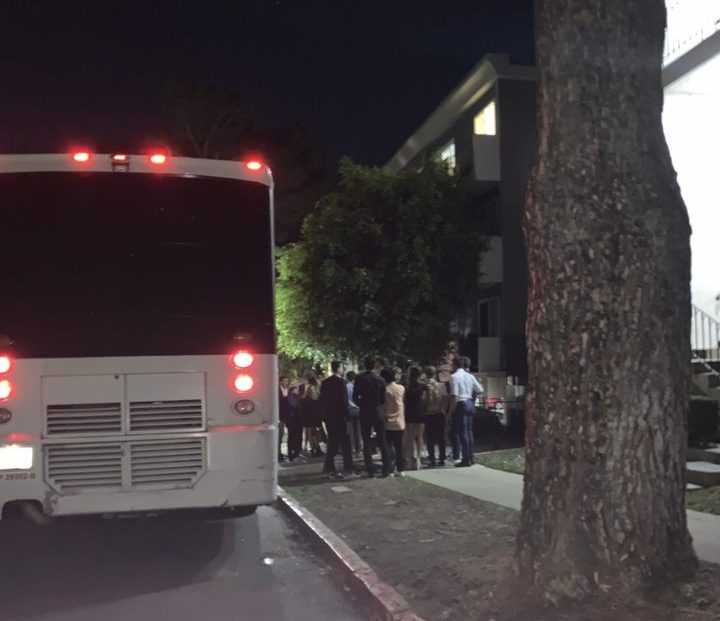
Herd impunity? UCLA students line up for party bus in February, 2021.
 However, UCLA’s own Fraternity Row has been partying since the summer, according to concerned students. Recent graduate Grayson Peters says the parties are an “open secret” at the university. When asked to grade UCLA on their regulation of superspreader parties, student government representative Sachi Cooper gives the university “a deep F.”
One sorority member told Capital & Main that so many fraternity brothers got COVID-19 this year, they now party under the guise of herd immunity. The source requested anonymity for fear of retribution from her sorority and from the Panhellenic Association, of which she is a member.
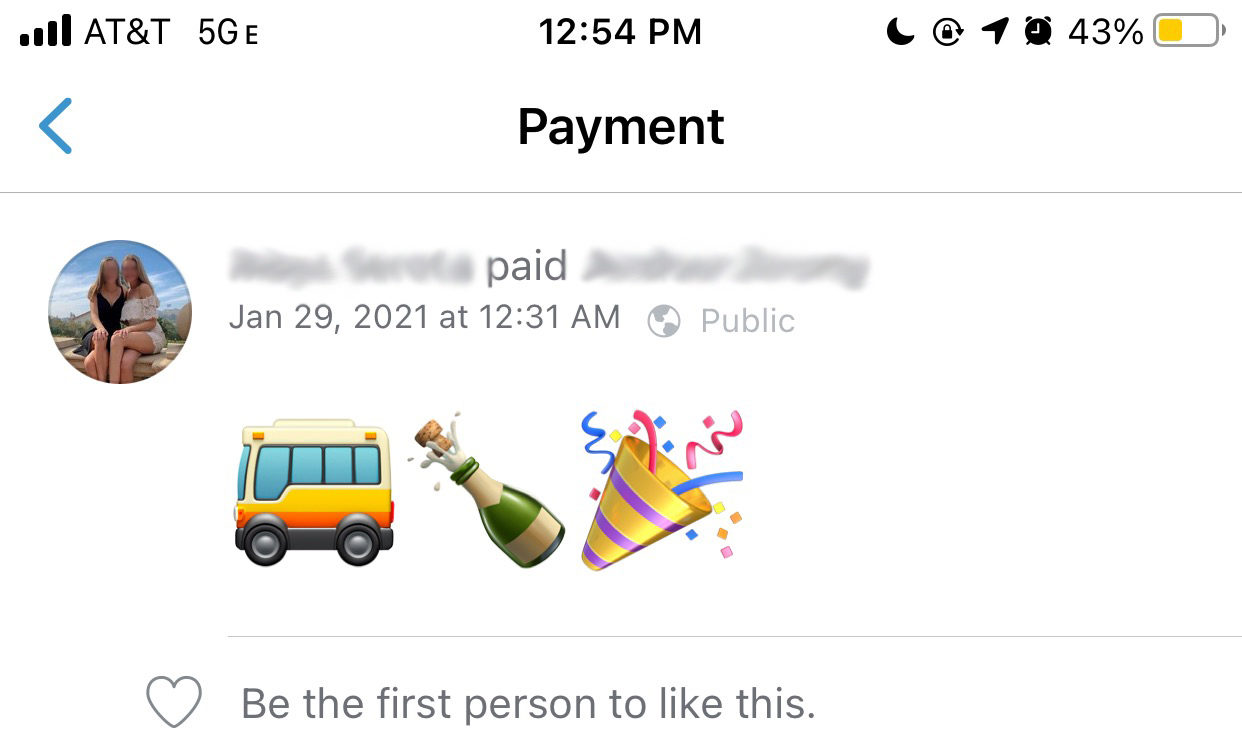
She also provided Capital & Main screenshots of social media posts, Groupme messages and a litany of Venmo payments from Greek life members after a controversial incident in early February, when sorority sisters hired a party bus for a friend’s (unmasked) 21st birthday. “At least 50” attended, she says. The payments openly referenced the bus; one combined a bus emoji with streamers and popping champagne.
Students were first photographed boarding the bus and then photographed again at the party. All images and text messages shared to Capital & Main were also shared with UCLA’s Office of Fraternity and Sorority Life and an additional complaint was made to the dean of students, but to little effect, the source says. Complaints to the Panhellenic Association get referred back to the sororities themselves, which didn’t punish their members in this case, and only a few fraternities were fined after a wave of parties in the fall.
“You just tell the university and you never hear back,” she says.
The dean of students never responded to Capital & Main’s request for comment. A spokesperson for UCLA says students found in violation of the university’s COVID-19 policies may be excluded from student housing or “referred to the formal disciplinary process for potential sanctions.”
Private Medicine and Its Discontents: “We weren’t allowed to wear masks”
USC: D-
UCLA: C
UCLA and USC are home to two of Los Angeles County’s largest hospitals. As of 2018, USC’s 401-bed Keck Hospital near Los Angeles’ Lincoln Heights neighborhood employed more than 1,200 nurses and more than 4,000 total staff. UCLA’s 10-story Ronald Reagan Medical Center occupies four acres and includes a neuropsychiatric hospital and a children’s hospital. It offers 427 inpatient beds and 158 ICU beds. Since March 2020, both universities have provided critical care to residents of Los Angeles County as COVID-19 swept Southern California.

USC’s Tommy Trojan (Photo: Bestweekevr)
But nurses at both medical complexes say they had to fight for the necessary personal protective equipment (PPE) when the virus arrived in the United States. Before COVID, nurses could be disciplined for wearing masks when not treating patients—a policy that continued into the early days of COVID, even though hospital administrators had time to learn about the virus as it spread in China and Italy.
Kerri Dodgens, a Keck Hospital ICU nurse, says she was asked to take off her mask at the nurses’ station before the crisis fully established itself in the United States. The administrator told Dodgens she was setting a bad example and that the administrator was comfortable not wearing a mask. “I said, ‘I’m happy you’re comfortable, but I have a four-month [old] baby at home,’” Dodgens recalls. Neither hospital dodged the national PPE shortage in the early days of quarantine, forcing nurses to recycle N95 masks.
“In a memo dated March 26, 2020, Keck Medicine alerted staff that all employees must wear a mask on-site when not possible to maintain six feet separation from others,” USC told Capital & Main, contending that it always provided ample PPE for health care workers and followed stricter guidelines than the county’s.
Insufficient testing and contact tracing, however, remained issues months after mask supplies improved. As late as December 2020, only USC nurses who were directly exposed to the virus at the university’s medical facilities could get tested. “If you’re working in the hospital you shouldn’t have to fight to get a COVID test,” says Dodgens. “Meanwhile, the hospital or the university had no problem testing all of their football team.” USC’s football team belongs to the NCAA’s Pac-12 division, which asks players to be tested at least weekly, if not daily.
Furthermore, USC reduced annual sick leave for nurses to 96 hours in February of 2020, as the virus ravaged China, timing that infuriated Dodgens and her colleagues, who felt the reduction of hours anticipated just how badly sick leave would be needed in the months ahead.
“The changes were not triggered by the development or discovery of the virus,” USC said, but were rather designed to “better manage unscheduled call-offs.”
On Feb. 11, Keck nurses picketed outside the hospital, then did so again in December. An arbitrator has since ruled Keck Hospital must scrap its new sick leave program and rehire anyone let go under the policy, according to Dodgens. But months after the ruling USC has still not yet reverted to its former policy, she says, while nurses were let go for exceeding their 96 hours.
At UCLA, nurses faced the same PPE, testing and contact tracing issues, with nurses also scolded for wearing masks outside of a patient’s room.
“We didn’t have access to [N95 masks] in the beginning,” says Marcia Santini, a nurse in the emergency department at Ronald Reagan UCLA Medical Center. “The whole hospital went through this phase where they were keeping them under lock and key.” After protests, UCLA asked nurses to recycle their N95s, which Santini says is not how they are intended to be used.
And testing has been so inadequate, according to Santini, that nurses were even denied testing after being exposed to the virus. Resident doctor Mark Kelly says getting tested was so difficult, he got tested through Los Angeles County instead.
As at USC, news that the football team was regularly tested “set a bomb off,” says Santini. “We were infuriated. It was really a pinnacle point. It just goes to show where their priorities lay.”
“UCLA Health COVID-19 testing, contact tracing, quarantine, return-to-work and PPE protocols have been consistent with county, state and federal public health guidelines as they evolved throughout the pandemic,” UCLA Health wrote in a statement to Capital & Main.
Introduction to Labor Relations: Pregnant and Exposed to the Virus
USC: C
UCLA: C-
Frontline workers at USC and UCLA have been furloughed without pay. At USC, only a handful of longtime employees were spared months on unemployment rolls. The UC system has laid off workers, but a spokesperson for the American Federation of County, State and Municipal Employees (AFSCME), which represents custodians at UCLA, says the union successfully fought to keep the majority of its workers employed. (Disclosure: The union is a financial supporter of this website.)
“I don’t know what’s going to happen,” says one former USC dining hall employee, who requested anonymity while he seeks reemployment at the university. He claims that USC accepted federal payroll protection loans, although spokespeople for the university told Capital & Main that USC never accepted a PPP loan – a point they reiterated after publication of this story.
“Almost everybody I know from USC got laid off,” says another former employee. When the cafeterias closed, the employee transferred to custodial work and weathered an employee infection spike after staff gathered without masks in a break room. Then he was laid off.
UCLA did not report receiving PPP loans, though the Associated Students of the University of California, Los Angeles, which employs student and career workers across campus, retained 500 jobs with a $2 million-$5 million loan, according to public PPP records.
At UCLA, senior custodian Andrew Martinez says PPE is still distributed unevenly across departments a year after the first outbreaks—when staff felt mask shortages were understandable.
“Not all departments are providing masks at the beginning of the shift,” he says. “In dining, people walk in, they get a mask, and that’s on a daily basis. In my department we have to ask for our mask. In certain areas people have asked for a mask and had to wait three to five days to get a mask.”
Furthermore, employees have been asked to sanitize, without the protection of N95s, dormitories where students contracted COVID-19. One employee, seven months pregnant, was transferred away from overly physical work but was made to sanitize exposed rooms – without an N95.
“Why is it okay to put a pregnant woman cleaning a COVID-exposed room with the bare minimum of PPE?” asks Martinez.
When asked about the incident, UCLA said it cannot comment on individual cases because of employees’ privacy rights, but added that workers are not asked to sanitize any rooms until 48 hours after COVID exposure. “UCLA has adequate supplies of masks, and they are readily available to employees,” a spokesperson wrote.
Intermediate Workplace Psychology: Untenured and Uncovered
USC: B-
UCLA: B-
From the start, faculty at both schools felt unprepared to work from home. At USC, faculty members like history and film professor Laura Serna hustled to set up online-learning instruction after the UCs and California State Universities had which switched to remote instruction early and stuck with it. “[The California State Universities] made a really hard, firm decision early on,” says Serna. “‘This is what’s going to happen, we’re going virtual.’ USC did not do that. They had hoped the situation would somehow become better.”
At USC, professors prepared in-person curricula again as the university teased a fall reopening, then scrapped them when the plan was abandoned.
Meanwhile, UCLA extended its faculty family leave program only to tenured professors, according to writing lecturer Mia McIver. Paid administrative leave was offered to all faculty but only during their teaching times, making it “functionally unavailable” to untenured lecturers, says McIver, who teaches one to two more courses per quarter than do tenured professors. When reached for comment, UCLA said its leave programs were the result of bargaining agreements with faculty unions.
USC: D- Lacked adequate preparation. UCLA: D Did not work well with others – especially when the others lacked tenure. When assessed for their response to the COVID-19 crisis, Los Angeles’ most prominent universities are close to flunking. USC and UCLA repeatedly punished and otherwise declined to protect their most vulnerable: campus workers, nurses and doctors, faculty, staff and their debt-saddled students who so desperately needed those in power to do something right. The administrative elite may have genuinely tasted crisis in 2020, but for so many in their charge, COVID-19 was an introduction to disaster.Midterm Summary
Copyright 2021 Capital & Main


-

 Latest NewsMay 22, 2026
Where California’s Gubernatorial Candidates Stand on Climate and Taking Big Oil Money
-

 The SlickMay 29, 2026
Feds to Open Tens of Thousands of Acres of Colorado Wilderness to Oil Drilling
-
 Deadly Dust: The Silicosis EpidemicMay 27, 2026
California Moves to Ban Quartz Countertop Fabrication to Combat Silicosis Epidemic
-
 Latest NewsMay 26, 2026
Conditions at California ICE Detention Centers Are Getting Worse, Inspections Find
-
 Imperial DivideJune 3, 2026
California’s Lithium Valley Dreams Meet Reality at the Only Restaurant in Town
-

 Column - State of InequalityMay 28, 2026
Top Democratic Candidates Agree on Housing Urgency, Not the Fix
-
 Latest NewsJune 1, 2026
Deep Cuts to Civilian Support Staff for Families of Deployed Marines Raise Concerns
-

 Column - State of InequalityJune 4, 2026
California’s Economy Runs on Labor Trump Wants to Deport