
Culture & Media
‘Ameryka’ a Biting Commentary on Our National Psyche
A new staging of Nancy Keystone’s award-winning political play comes to the Kirk Douglas Theatre in Culver City.

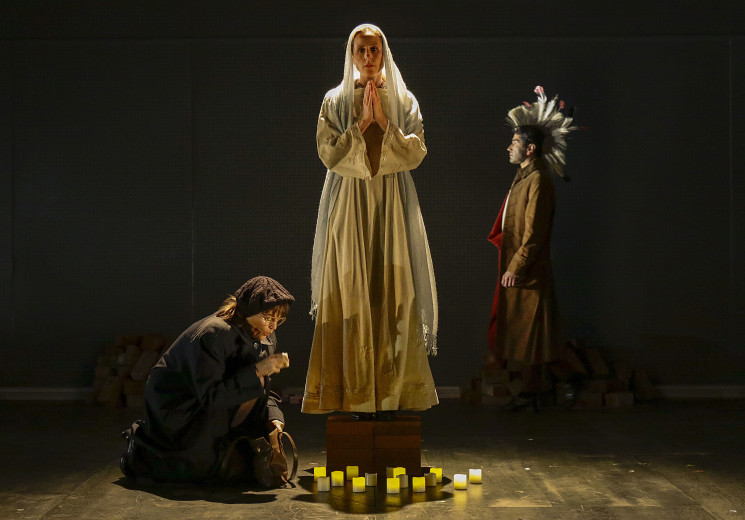
In 2009, Ameryka’s writer/director Nancy Keystone was perusing a catalogue, Western Amerykański: Polish Poster Art and the Western, when she spotted a 1989 poster that celebrated the first democratic elections in Poland since World War II. The central image was a black-and-white-photo of Gary Cooper in the 1952 film High Noon. Keystone’s curiosity was piqued over the odd connection between Polish elections and classic American cinema, and her subsequent research helped spark this sprawling political piece that spans two countries — the U.S. and Poland —and several historical time periods.
A collaborative effort of Keystone’s Critical Mass Performance Group, the play speaks to the struggle of ordinary citizens for a voice in their destiny and the tactics and hypocrisy of the powerful forces that would silence them. Originally staged in 2016 at the Shakespeare Center Los Angeles, here it’s played out on a large spare proscenium (set by Keystone) at the Kirk Douglas Theatre as part of Center Theatre Group’s “Block Party” project, which supports smaller LA. Companies. The patchwork narrative shifts back and forth among the American Revolutionary War period, the 1950s under McCarthyism, the 1980s, when a two-faced Reagan administration fired striking air traffic controllers while supporting the striking Polish Solidarity movement abroad, and the early years of this century when the CIA, obsessed with the war on terror, established a base in Poland, sweetening its presence with American dollars.
These scenarios are peopled with both fictional and historical personages, including Tadeusz Kosciuszko (Jeff Lorch), a Polish military officer and passionate democrat who fought with the colonists against the British, his friend Thomas Jefferson (Curt Bonnem), who spoke against slavery but kept his slaves, and Kosciuszko’s military aide during the Revolutionary War, Agrippa Hull (Lorne Green), a free black man and soldier whose accomplishments inspired Kosciuszko to champion abolitionism, in contrast to Jefferson (who was charged by Kosciuszko to use his estate after he died to help free slaves, and promised to do so but never did). A scene where Kosciuszko and Jefferson dine at Monticello and discuss the evils of slavery, while being catered to by Jefferson’s slave (Ray Ford), is only one of the pungently ironical moments the play serves up.
Twentieth century personages include a pious William Casey (Russell Edge), who leads a prayer vigil with his underlings before plotting to implement a national directive challenging the Soviets through Poland (“Fuck Yalta”), Anna Walentynowicz (Valerie Spencer), a colleague of Lech Walesa, and Father Jerzy Popieluszko (Lorch), the pro-Solidarity priest assassinated in 1984.
After opening with the rough-handed arrest of Walentynowicz by Polish security agents, the play harks back to 1959. (Fictional) jazz musician Gene Jefferson (Ford) visits Poland, where he discovers that Poles love jazz and other things American, including Westerns and Gary Cooper. An African-American who steels himself daily against condescending racism (illustrated by his prior interview with a State Department official) he’s taken aback at their rah-rah America enthusiasm. That same cultural disconnect manifests in a scene from the ’80s; a gay American man named Ray (Ford) recounts meeting this terrific Polish guy in a bar, only to be put off when the Pole sings Reagan’s praises for supporting Solidarity. To Ray, Reagan’s legacy are the thousands of AIDS victims.
A complex entangled piece, Ameryka packed a punch when it was staged at the Shakespeare Center nearly 18 months ago (winning the Stage Raw award for Production of the Year) but loses some of its edge in the larger space at the Kirk Douglas. Less than optimal acoustics seem to be part of the problem. Many of the original ensemble members are reprising their roles; one exception is Lorch, recently brought in to replace the original actor. His work is fine, as is everyone’s, but I did wish for more distinctive and distinguished ardor from this character in particular.
Still, Ameryka remains a substantive, historically informative work, a biting commentary on the contradictions and illusions that bedevil not only our own national psyche but others. It’s the sort of drama we need more of.
Critical Mass Performance Group, Kirk Douglas Theatre, 9820 Washington Blvd., Culver City; (213) 628-2772, online at www.CenterTheatreGroup.org; Wed.-Sat., 8 p.m.; Sat., 2 p.m;, Sun., 1p.m.; through April 29.
Copyright Capital & Main



-
 Imperial DivideJune 3, 2026
California’s Lithium Valley Dreams Meet Reality at the Only Restaurant in Town
-

 Column - State of InequalityJune 4, 2026
California’s Economy Runs on Labor Trump Wants to Deport
-

 Featured VideoJune 5, 2026
At This New Mexico Park, Mountain Bikers Pedal Amid Hundreds of Oil Wells
-
 Latest NewsJune 9, 2026
Ousted by the Trump Administration, U.S. Immigrants Remain Locked up in African Kingdom
-
 The SlickJune 10, 2026
Data Centers Are on the Ballot — This Pennsylvania Candidate Won Her Primary Keeping Them Top of Mind
-

 Latest NewsJune 8, 2026
The Glacier May Be Gone, but the Love Isn’t
-
 Latest NewsJune 12, 2026
California Town Lets Private ICE Detention Centers Police Themselves
-
 Column - State of InequalityJune 11, 2026
County Tax Measures Show Limits of Local Responses to Medicaid Cuts