
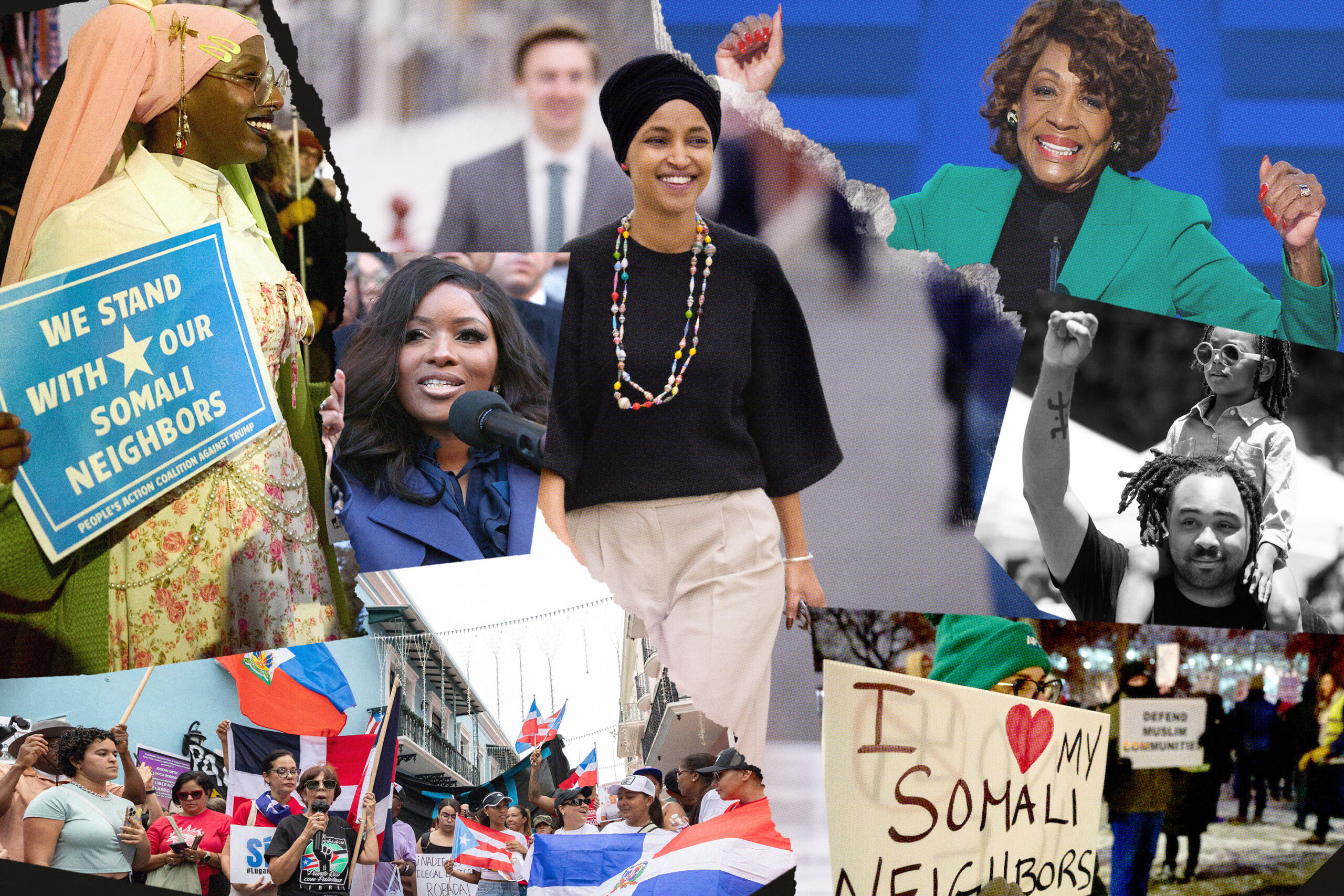
We have to call out the increasingly blatant bigotry of the right — like President Trump’s
calling Somali Americans “garbage” — or risk accepting it as the new normal.
By Erin Aubry Kaplan
I confess, every December I look forward to drowning out the bad news of the moment with holiday cheer, the more mindless the better. All the exchanges of “Merry Christmas” help to build a soundproof wall of good feeling that puts the burning world at a distance, at least temporarily.
Not this year. The sentiment that will forever define December 2025 for me is the antithesis of any greeting, or cheer: Somalis are garbage.
That’s what Donald Trump said during a Dec. 2 cabinet meeting. It was the culmination of a rant against Somali immigrants in which he said, “They contribute nothing,” “I don’t want them in our country,” and “Their country stinks… [U.S. Rep.] Ilhan Omar is garbage, her friends are garbage.”
More rank and reprehensible racism from the president of the United States. Worse than the real garbage that came out of his mouth is the fact that it surprised no one; it follows years of racial insults, many made repeatedly, that include calling accomplished Black women “low IQ” and disparaging Haiti, Somalia and other majority-Black nations as “hellholes” and “shithole countries.” For Trump, this behavior is entirely normal. Nearly a year into his second term, we are all clear on that. It’s official.
Join our email list to get the stories that mainstream news is overlooking.
Sign up for Capital & Main’s newsletter.
Many Americans have fallen into their own norm at moments like this, a ritual where Trump says something vile, his MAGA supporters minimize or condone it, and liberals and people of conscience condemn it. After a few beats, everybody stows it away on a high shelf and moves on with the expectation that another eruption will happen any day. And so it goes.
It’s easy to lose sight of the fact that Trump’s promotion of white supremacy is normal only in the sense that it happens with regularity. Here are just a few examples: attacking the Smithsonian Institution for focusing too much on “how bad slavery was,” promoting the false claim that white South Africans are victims of “white genocide” and attempting to publicly humiliate that country’s Black president in the Oval Office.
But normal does not mean OK. It does not mean acceptable, sane, moral or inconsequential. Which is why we should all recognize and articulate that truth in real time, as loudly as possible and as often as necessary.
I know that’s hard to do when antiblackness is swiftly morphing before our eyes from a Trump quirk into something very close to government policy. Just days after his gutter-level remarks about Somalis, the National Park Service announced it would cut Martin Luther King Jr. Day and Juneteenth — the two most significant holidays commemorating Black history — from the list of free entrance days and replace them with Trump’s birthday, June 14. How much clearer can the determination to normalize racist authoritarianism get?
NAACP President and CEO Derrick Johnson condemned that decision as “an attack on the truth of this nation’s history. It’s an attempt to erase the legacy of Dr. King, minimize the story of emancipation, and sideline the communities that have fought for generations to make America live up to its promise.”
Well said, though woefully understated, almost clinical. It’s sprinkling droplets of water on a raging fire that began as live sparks during Trump’s first term and now burns out of control.
Too many of us are ill equipped to contain the fire. Many white Americans, even the most Trump-averse, hold back when it comes to calling out and condemning white supremacy. Many of us lean on individualism, chalking up the latest round of appalling remarks as Trump being Trump — atrocious, yes, but ultimately just one rogue guy that we have to endure, for now.
But the consistent failure to recognize that the crisis extends far beyond Trump himself is another dangerous kind of normal, because it deliberately obscures a wider acceptance by MAGA and others of an anti-Black racism that’s always been at the root of the problem.
That acceptance was on full display last week, in the rows of Republicans sitting impassively at the table with Trump, sanctioning his bigotry with their silence. But they were not entirely silent; after Trump wrapped up his tirade against Somalis, a group that includes Rep. Omar and some 80,000 people of Somali descent in her state of Minnesota, Vice President JD Vance banged on the table in assent, and the room broke out in applause. To see some of the most powerful leaders of a multicultural democracy (which we still are, technically) spontaneously and shamelessly denigrating an entire demographic of Black people — many of them citizens and permanent residents — was sickening.
The insults routinely lobbed by Trump and Vance are part of this administration’s pattern of perpetrating lies, especially outrageous lies about Black people for which they suffer virtually no consequences.
Look what happened when Vance spread false claims during the presidential campaign last year that Black Haitian immigrants in Ohio were eating people’s pets and Trump repeated it eagerly during a presidential debate. The smear genuinely put off many people; at the time I thought it might even give MAGA voters pause. It didn’t. Worse, once Trump retook office, his enablers worked to make being held accountable for such lies, insults and racism a thing of the past, and beside the point.
It isn’t. To the contrary, consternation about the unrelenting Republican attacks on the nation’s people of color is the point. It’s therefore up to us to resolve that when the next vile Trump comment goes viral, we widen the lens beyond the incorrigible president to see antiblackness for what it is: a social poison that too many of us ingest and don’t really know how to get rid of.
It’s an unsavory truth to consider, especially at this time of year. But what better time is there to call out the inhumanity of a declaration that Somali Americans are garbage than during the season when we’re all supposed to be bolstering peace, brotherhood and good will toward all?
Stopping to reflect on that and react appropriately will certainly make this Christmas feel less merry. But it’ll be a Christmas you’re not likely to forget. And not forgetting is truly the point.
Copyright 2025 Capital & Main
Erin Aubry Kaplan examines the persistent barriers to racial justice and opportunities for progress in an era of receding black presence in Los Angeles and California.