
Culture & Media
Scalia Gets Airbrushed Treatment in John Strand’s Play
Playwright John Strand’s presentation of Antonin Scalia as not the “monster” his critics make him out to be may hold some truth, but it’s surely an incomplete one.

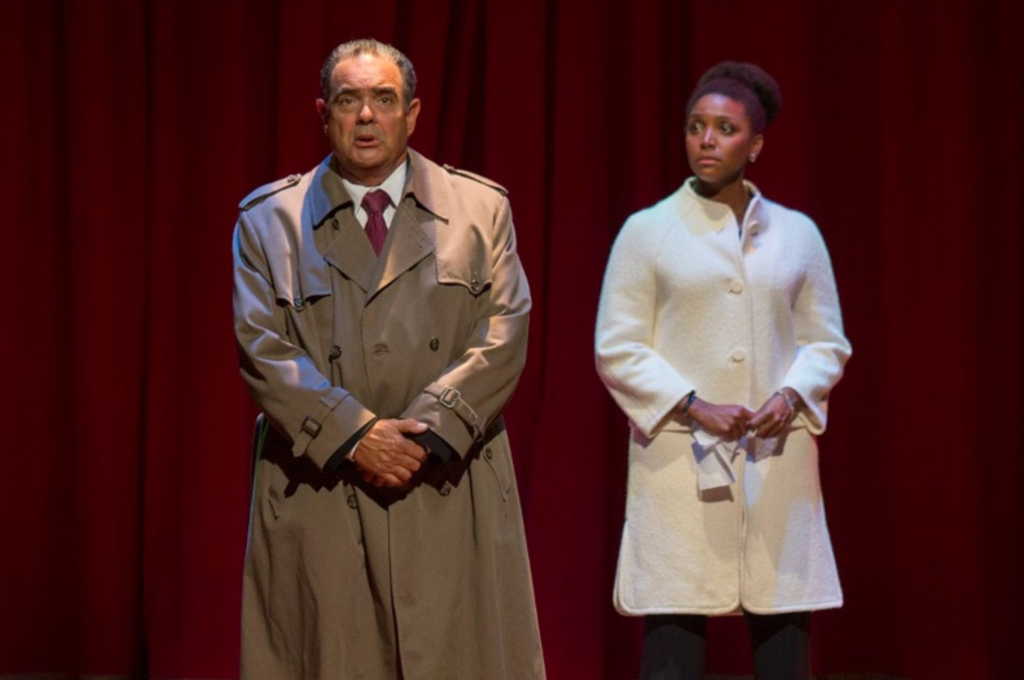
Edward Gero and Jade Wheeler (Photo by Jim Cox Photography)
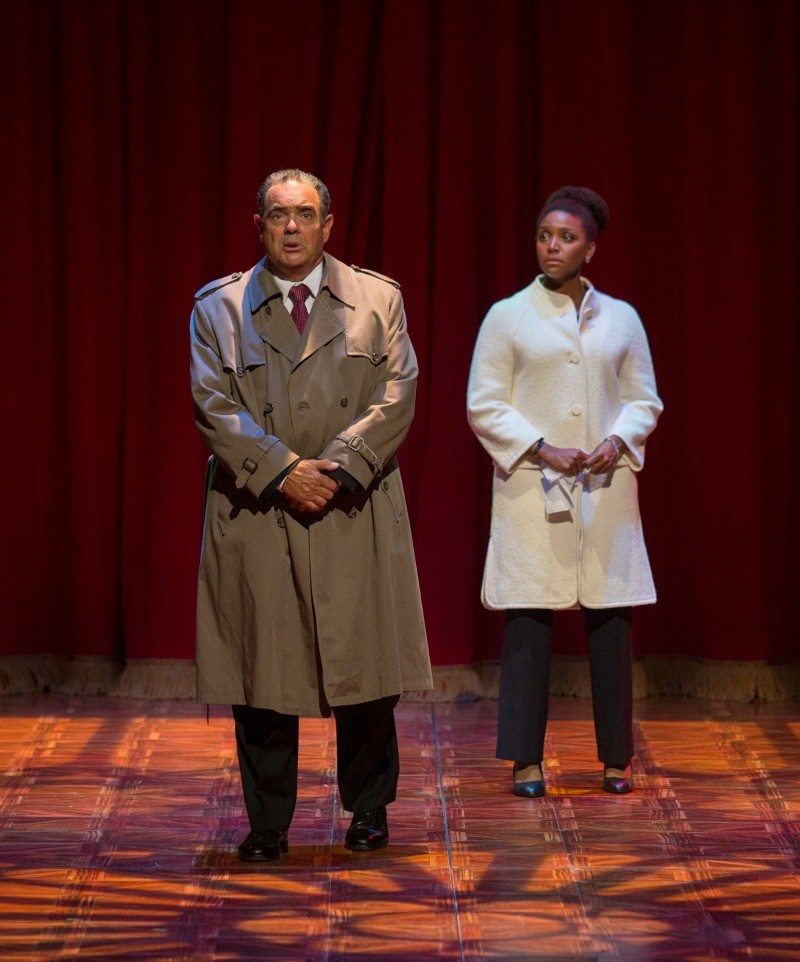
In John Strand’s play, The Originalist, the late Supreme Court Associate Justice Antonin Scalia (Edward Gero) is presented as a lovable curmudgeon — rather like the tough, gruff but charismatic professor you might have had back in your university days. To appreciate the character, and the play, you need to be willing to suspend your knowledge of the sum damage of Scalia’s opinions on civil rights and the democratic process, something this writer found difficult to do. Director Molly Smith has termed the evening “historical fiction,” but to my mind “fictional history” would be more accurate — unsettling because of its potential to distract people from historical fact.
The narrative is structured around a debate between Scalia and a young woman he hires to clerk for him – a character, Strand has said, he conceived after interviews with several of Scalia’s clerks, who spoke of his warmth and openness to other (well-argued!) points of view.
The time is 2012. Cat (Jade Wheeler), a Harvard law school graduate, is a gay woman of color, although her sexual orientation isn’t revealed right away. When asked about her political leanings, Cat tells Scalia she’s a “flaming” liberal — but instead of being put off, the justice seems impressed by her honesty and willingness to work for a hardcore “originalist” such as himself. (Scalia defined originalism as interpreting the Constitution “not [by] what current society, much less the court, thinks it ought to mean, but what it meant when it was adopted.”) As time goes on, they build a complex relationship, with Scalia lending her emotional support when her father falls ill. Cat’s major triumph is getting him to insert a tempering phrase into his outraged dissent when the high court strikes down a section of the anti-gay Defense of Marriage Act, which he passionately supports.
Strand’s theme, expressed in the dichotomy between these two characters, is the importance of listening to, and respecting, those with opposing political viewpoints. Scalia and Cat argue about many things besides DOMA: Roe v. Wade, gun control and the capital punishment of a minor (which Scalia defends), to mention a few. Most fundamentally they clash over the nature of the Constitution, which in the play Scalia pronounces as “dead, dead, dead,” while Cat argues that, as a living document, it must change with the times.
It’s hard to take issue with the play’s intent — to foster compromise in a world where acrimony holds sway — or to challenge Strand’s presentation of Scalia as not the “monster” his critics make him out to be. Still, while this airbrushed depiction of the man — funny and compassionate beneath a cantankerous exterior — may hold some truth, it’s surely an incomplete one. It’s one thing to cut slack for a retro grandad with a world view from another century. It’s another when you’re depicting someone with Scalia’s power and influence, whose rulings have negatively affected the lives of so many. (This is, after all, a jurist who opposed granting new trials to prisoners after fresh evidence pointed to their innocence, on the grounds that nothing in the Constitution warranted it.) To ignore this aspect of Scalia’s legacy, while touting this as a debate about American law and the foundation of our republic is, to me, disingenuous.
Gero, who originated the role in the Arena Stage production in Washington in 2015, is very good; he’s sharp, funny when he needs to be, and consistently watchable. Wheeler’s rather thankless task is to lob questions at him to elicit information about both Scalia’s personal life and his legal opinions. Unfortunately, this performer hasn’t developed much of a persona beyond that, and to that extent the play’s didactic elements are underscored.
Pasadena Playhouse, 39 S. El Molino Avenue, Pasadena; Tues.- Fri., 8 p.m.; Sat., 4 & 8 p.m.; Sun., 2 p.m. (no performances April 18 & 25; one Sunday evening performance at 7 p.m., April 30); PasadenaPlayhouse.org or (626) 356-7529. Through May 7.



-

 Column - State of InequalityMay 21, 2026
In California Governor’s Race, Xavier Becerra Walks Away From Single-Payer
-

 Latest NewsMay 22, 2026
Where California’s Gubernatorial Candidates Stand on Climate and Taking Big Oil Money
-

 The SlickMay 20, 2026
70-Foot Wastewater Geyser Reflects New Mexico’s Latest Oilfield Challenge
-

 The SlickMay 29, 2026
Feds to Open Tens of Thousands of Acres of Colorado Wilderness to Oil Drilling
-
 Deadly Dust: The Silicosis EpidemicMay 27, 2026
California Moves to Ban Quartz Countertop Fabrication to Combat Silicosis Epidemic
-
 Latest NewsMay 26, 2026
Conditions at California ICE Detention Centers Are Getting Worse, Inspections Find
-
 Imperial DivideJune 3, 2026
California’s Lithium Valley Dreams Meet Reality at the Only Restaurant in Town
-
 Column - State of InequalityMay 28, 2026
Top Democratic Candidates Agree on Housing Urgency, Not the Fix