
Learning Curves
Los Angeles and Oakland Teachers Rally Amid Deadlocked Contract Talks
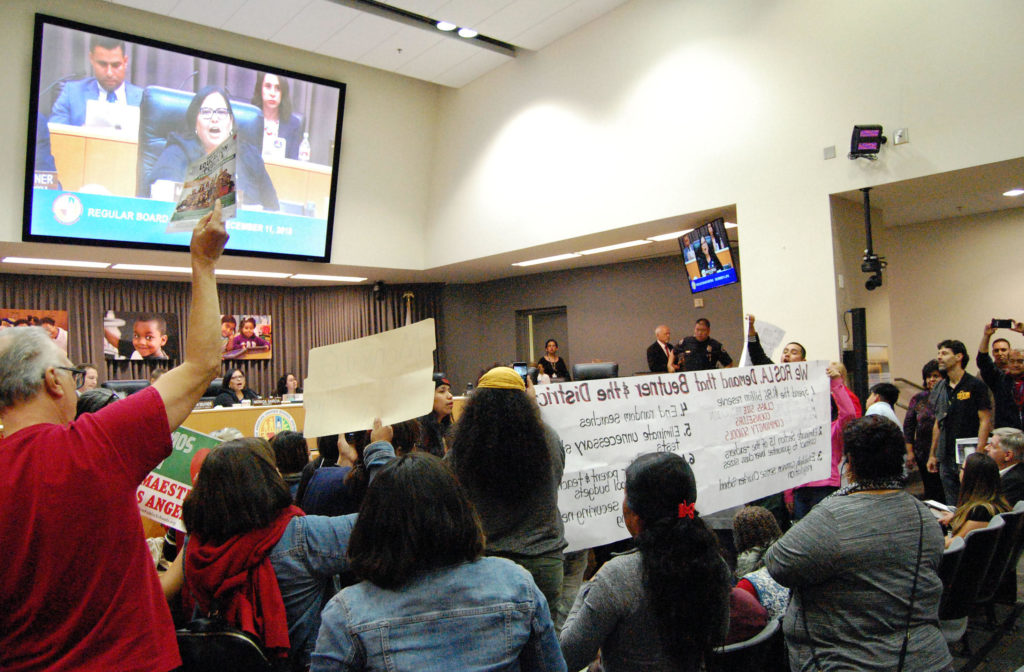
A Los Angeles school board meeting turned raucous days ahead of two solidarity rallies to be held Saturday in L.A. and Oakland.

“Learning Curves” is a weekly roundup of news items, profiles and dish about the intersection of education and inequality. Send tips, feedback and announcements of upcoming events to braden@capitalandmain.com, @BillRaden.
Two California teachers unions, which are currently deadlocked in separate contract talks with their respective school districts, are on the verge of launching the West Coast’s biggest teacher walkout since 1989. What happens next will decide far more than fair wages for career educators. At stake are broader principles of equity, expressed as contract demands for smaller class sizes and less testing, the addition of sufficient health and social services staff, and an investment in community schooling and fair funding — aimed at restoring public education as a public good for all Californians, rather than as a private interest granted to the lucky few.
While they await the results of a state-mediated fact-finding process, United Teachers of Los Angeles (UTLA) and the Oakland Education Association (OEA) have declared Saturday, December 15, a day of solidarity, and have invited all to join teachers in a rally to defend public education. The Oakland action kicks off at Omni Commons at 11 a.m., while L.A.’s march and rally begins at Grand Park at 10 a.m.
Chanting @UTLAnow teachers and Los Angeles Unified families drive L.A. supe @AustinLASchools Buetner from the December 11 school board meeting, protesting his portfolio privatization plan. pic.twitter.com/lbshCPUdaZ
— Bill Raden (@BillRaden) December 12, 2018
Meanwhile, an estimated 90 Oakland Unified teachers skipped classes December 10 in a one-day wildcat sickout to protest some of the state’s lowest teacher pay — against a backdrop of California’s fast-rising living costs. But a more fundamental grievance is with the $60 million that Oakland Unified must cut over the next two years. It has led superintendent Kyla Johnson-Trammell to adopt a draconian district downsizing plan that could close up to 24 mostly low-income neighborhood public schools and coordinate the remainder of the 87-campus district with the city’s 45 charters on things like enrollment and transportation. The strategy has been likened to a “portfolio model,” the controversial template for privatized district governance that favors charter expansion at the expense of traditional public schools.
It also bears an uncanny resemblance to “Re-Imagine LAUSD,” the prematurely leaked but still mostly secret pet portfolio plan of L.A. Unified supe Austin Beutner — just one of the issues behind the takeover by 50 placard-carrying protesters at the L.A. school board meeting last Tuesday. Students, parents and teachers seized the floor and unfurled a banner of union-aligned demands: an end to random student searches; reductions in class sizes and testing; and the hiring of more health workers, community schools and per-pupil funding. For good measure, they also chanted down attempts by board president Mónica Garcia to restore order, a caterwaul that eventually drove Beutner and his board allies from the room.
Interrupted was a budget hearing marked by a kind of testy déjà vu: CFO Scott Price again played down the significance of a nearly $2 billion cash surplus; and board members George McKenna and Scott Schmerelson again wearily pushed back against Board District 4’s Nick Melvoin’s insistence that the district’s so-called structural budget deficit was a recipe for mass layoffs and state receivership (in spite of how, in 10 years, none of the district’s projections of red ink has ever been manifested).
“It’s called spin,” shrugged UTLA Central Area board member Tomás Flores at a post-occupy sidewalk rally. “What they have been spinning is that the district is at the edge of bankruptcy. … I believe that the fact-finding did not need to continue any longer than the three days. There wasn’t anything else to be said. The district hasn’t been honest.” (Beutner declined to comment for this story.)
If November’s blue wave means the tide has indeed turned against California’s market-driven ed reformers, grassroots activists aren’t resting on any laurels. That’s why they are circulating a petition launched by the Oakland Public Education Network (OPEN), asking Governor-elect Gavin Newsom to abide by four seemingly common sense hiring principles:
- No conflicts of business interests
- Education-related appointments must strictly mirror California’s 90/10 proportion of public-to-charter-school enrollments
- No more Betsy DeVoses guarding the regulatory henhouse (i.e., appoint only seasoned, public school-committed educators to the Advisory Commission on Charter Schools)
- Genuinely partner with the public schools community to uproot what OPEN considers the predatory incentives and equity barriers that it says are the legacy of California’s 25-year-long ed reform wrong turn.
One reason Newsom might want to expedite the restoration of California’s ed code to a less laissez faire era of grace is the deregulated marketplace’s tendency to incentivize a school’s drift into inequality. That’s the conclusion of “Are California’s Charter Schools the New Separate-But-Equal “Schools of Excellence,” or Are They Worse Than Plessy?”
The February study, by University of Connecticut law professor Preston Green and Montclair State University professor of counseling and educational leadership Joseph Oluwole, looks at California’s low-income public schools landscape, including the history of racially segregated, pre-civil rights “separate-but-equal” schools, to investigate claims that it can be advantageous to concentrate low-income black and Latino kids.
Their conclusion? Bad idea. Despite some worthy, individual examples, when taken out of the community or scaled up and put under an Education Management Organization (EMO), corporate priorities and financial gain invariably drain off resources. Green and Oluwole recommend that states ban EMO franchises altogether and allow authorizing districts to consider economic impact.
Copyright Capital & Main


-
 Column - State of InequalityMay 21, 2026
In California Governor’s Race, Xavier Becerra Walks Away From Single-Payer
-

 Latest NewsMay 22, 2026
Where California’s Gubernatorial Candidates Stand on Climate and Taking Big Oil Money
-

 The SlickMay 20, 2026
70-Foot Wastewater Geyser Reflects New Mexico’s Latest Oilfield Challenge
-

 The SlickMay 29, 2026
Feds to Open Tens of Thousands of Acres of Colorado Wilderness to Oil Drilling
-

 Latest NewsMay 18, 2026
Budget Cuts Threaten Program That Doubles Food Dollars for Californians in Need
-
 Deadly Dust: The Silicosis EpidemicMay 27, 2026
California Moves to Ban Quartz Countertop Fabrication to Combat Silicosis Epidemic
-
 Latest NewsMay 26, 2026
Conditions at California ICE Detention Centers Are Getting Worse, Inspections Find
-

 Imperial DivideJune 3, 2026
California’s Lithium Valley Dreams Meet Reality at the Only Restaurant in Town