
Labor & Economy
Achieving Obama’s Economic Goals: Five Steps to Take


President Obama’s inspiring inaugural address thrust a challenge upon every American: We must work to build a nation which “thrives when every person can find independence and pride in their work;” an America where “the wages of honest labor liberate families from the brink of hardship.”
Confronted by a Republican House and cautious centrist Democrats, the President can only seek progressive economic reform if the 99 Percent organize to demand it.
Fortunately, there’s no shortage of ideas around which we can organize. Here are five practical proposals for redirecting the U.S. economy toward justice, crafted by some of our wisest economic experts.
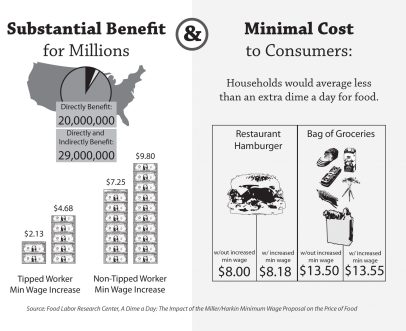
1) Increase the federal minimum wage to $9.80 per hour, as proposed by Senator Tom Harkin and Rep. George Miller. This one simple step will improve the lives of 29 million workers. Contrary to claims by the fast food chains and other low wage employers, raising the minimum has little effect on consumer prices and no negative effect on job creation.
 2) Restore full employment with a massive public investment program, even if it temporarily increases the deficit. Deterioration of our nation’s infrastructure poses one of the greatest threats to our nation’s future prosperity. With interest rates low and unemployment high, now is the best time in decades to rebuild the roads, water systems and clean energy infrastructure economic growth requires, argues Andrew Fieldhouse of the Economic Policy Institute. A trillion dollar investment (that’s $1,000,000,000,000!) in public works over the next five to seven years would speed the return to full employment. By making our economy more productive, borrowing to fund this pro-worker and pro-business program would also do far more than public service reductions to cut the U.S. deficit in the medium to long term.
3) Reduce the non-war military budget to the Bush-era level. Believe it or not, routine defense spending (the amount the U.S. military spends on everything but our foreign wars) has actually crept upward in the past six years. Cutting back to the 2007 level would save $500 billion over the next decade. All government spending creates jobs, but spending on human needs creates more jobs than spending on war. Transferring the savings to domestic programs could create up to 800,000 jobs without weakening national defense, says Lawrence J. Korb, who was an Assistant Secretary of Defense under President Reagan. Click here for Korb’s detailed list of the most wasteful parts of military budget.
4) Invest in high-quality, universal early childhood education. This investment — which would preserve and greatly expand on the proven success of Headstart and other existing education programs — will more than pay for itself, writes University of Massachusetts Economics Arthur MacEwan. “Economic gains are reflected in the higher salaries that the children earn later in life, the greater economic contribution to society that these salaries tend to reflect, and the higher resulting tax payments. There are also impacts that yield fiscal savings for the government: lower incidences of grade retention and special education; elevated high school graduation rates and college-attendance rates; reduced reliance on social support programs; and less engagement with the criminal justice system.”
5) Adopt the common sense tax proposals in Vermont Senator Bernie Sanders’ deficit reduction plan including:
Ending all tax breaks for oil, gas and coal companies.
- Imposing an emergency surtax on millionaires.
- Making Wall Street pay an extra tax on the swaps, derivatives and other speculative investments that crashed our economy.
- Canceling tax breaks for companies that move jobs overseas.
- Eliminating abusive off-shore tax shelters.
- Assessing investors at the same tax rates as wage earners.
(Steve Askin is Research Director for Good Jobs LA, where his post first appeared. The opinions expressed above are his own. Republished with permission.)



-

 Imperial DivideJune 3, 2026
California’s Lithium Valley Dreams Meet Reality at the Only Restaurant in Town
-

 Column - State of InequalityJune 4, 2026
California’s Economy Runs on Labor Trump Wants to Deport
-

 Featured VideoJune 5, 2026
At This New Mexico Park, Mountain Bikers Pedal Amid Hundreds of Oil Wells
-

 Latest NewsJune 9, 2026
Ousted by the Trump Administration, U.S. Immigrants Remain Locked up in African Kingdom
-

 The SlickJune 10, 2026
Data Centers Are on the Ballot — This Pennsylvania Candidate Won Her Primary Keeping Them Top of Mind
-

 Latest NewsJune 8, 2026
The Glacier May Be Gone, but the Love Isn’t
-

 Latest NewsJune 12, 2026
California Town Lets Private ICE Detention Centers Police Themselves
-

 Column - State of InequalityJune 11, 2026
County Tax Measures Show Limits of Local Responses to Medicaid Cuts