The sportswear company is one of the few that hasn’t caved to Trump
on diversity, equity and inclusion. Now it’s under investigation.
By Erin Aubry Kaplan
Will Nike save civil rights?
Such a question in normal times would be purely rhetorical, maybe the provocative title of a panel discussion about the interplay of capitalism and democracy. But as the Trump administration continues to scrub efforts at racial equity from every corner of American life, the question is becoming literal.
After stripping the federal government of its diversity, equity and inclusion commitments in its first year, the administration is now going after the private sector with the same goal. In February, the Equal Employment Opportunity Commission revealed via press release that since last year it’s been investigating Nike over its diversity, equity and inclusion policies. The sportswear giant, whose domestic workforce was 9% Black in 2024, beefed up its diverse hiring and promotion policies in 2021 after the murder of George Floyd. While the EEOC is investigating other companies for their diversity practices, including Napa Auto Parts and Dollar General, Nike has the highest profile and greatest cultural resonance.
Join our email list to get the stories that mainstream news is overlooking.
Sign up for Capital & Main’s newsletter.
It’s head-spinning that the investigation is being conducted by an agency created through the Civil Rights Act of 1964 to combat racial and other kinds of discrimination in the workplace. In yet another historical and moral inversion of the Trump era, the EEOC is now largely focused on going after discrimination against white people — in Nike’s case, “a pattern or practice of disparate treatment against white employees,” according to the recent EEOC court filing. The EEOC didn’t answer written questions from Capital & Main about the investigation, but chair Andrea Lucas has repeatedly suggested DEI itself is a form of discrimination that potentially violates civil rights laws.
A bad development for sure, though some might say not so bad in the scheme of things. Unlike universities, law firms and nonprofits targeted by President Donald Trump for their progressive agendas or pursuit of social justice, corporations are not in the business of civil rights or civic engagement. The investigations, however unwelcome, do not seek to dismantle corporations’ core mission of profitmaking (Nike reported $51.4 billion in revenue in 2024).
That doesn’t mean the EEOC is cutting companies a break. In February, the agency filed a federal court motion to compel Nike to hand over all the information it had requested in a subpoena — extensive records on hiring, mentorship programs, career development opportunities and other personnel information that date back to 2018. Nike, which didn’t respond to a Capital & Main call and email requesting comment, said in a statement in February that it’s been cooperating with the agency and that the court motion “feels like a surprising and unusual escalation.” In a response filed along with the EEOC court motion, it criticized the subpoena as “broad, ambiguous and unduly burdensome.”
While Nike has not entirely capitulated to federal demands, its public statements are not exactly the language of resistance. Steven Pitts, who focused on Black employment issues for 19 years before retiring as associate chair at the UC Berkeley Labor Center in 2020, isn’t optimistic that Nike will hold its ground.
“I can’t imagine them fighting this, because it’s not important to their bottom line,” he said bluntly. The fact that the country has lost the “scaffolding” around societal norms, and that Nike has been in a sales slump in recent years, makes such a surrender more likely.
And yet this moment is reminding us that corporations are employers who are very much a part of the mission of equality and always have been. Inclusive hiring creates equal opportunity, an essential component of democracy. Not that we should be looking to corporations to uphold principles of inclusion and democracy. That’s largely happened in the other direction: with the government pushing businesses to do the right thing starting in earnest in the 1960s.
Since then, progress towards representational hiring has been slow, and has come mostly in the public sector. Business is often the last place we’ve looked to for social change. And with good reason — because as quickly as companies step up, as many did with a surge of commitments to racial diversity post-George Floyd, they can step back when the political winds shift. The exploitative nature of big business can also offset or contradict any actual good deeds.
To wit: Nike may be a corporate leader in diversity hiring, but it’s also been accused over the years of relying on sweatshops in foreign countries to make its goods. An investigation by ProPublica and The Oregonian last year found that workers in Cambodia suffered from extreme heat in factories, despite Nike’s pledges to permanently reform its practices.
Yet in this Orwellian moment, big business has become a real line of defense in the war on multiethnic America. Some, like Costco, Apple and Coca-Cola, have held the line by keeping DEI policies in place — for now. But that feels like more the exception than the rule. Target, a retailer favored by Black consumers that also increased commitments to DEI five years ago, unceremoniously cancelled those commitments not long after Trump retook office last year. Dozens of other companies, from Meta to McDonald’s, did the same.
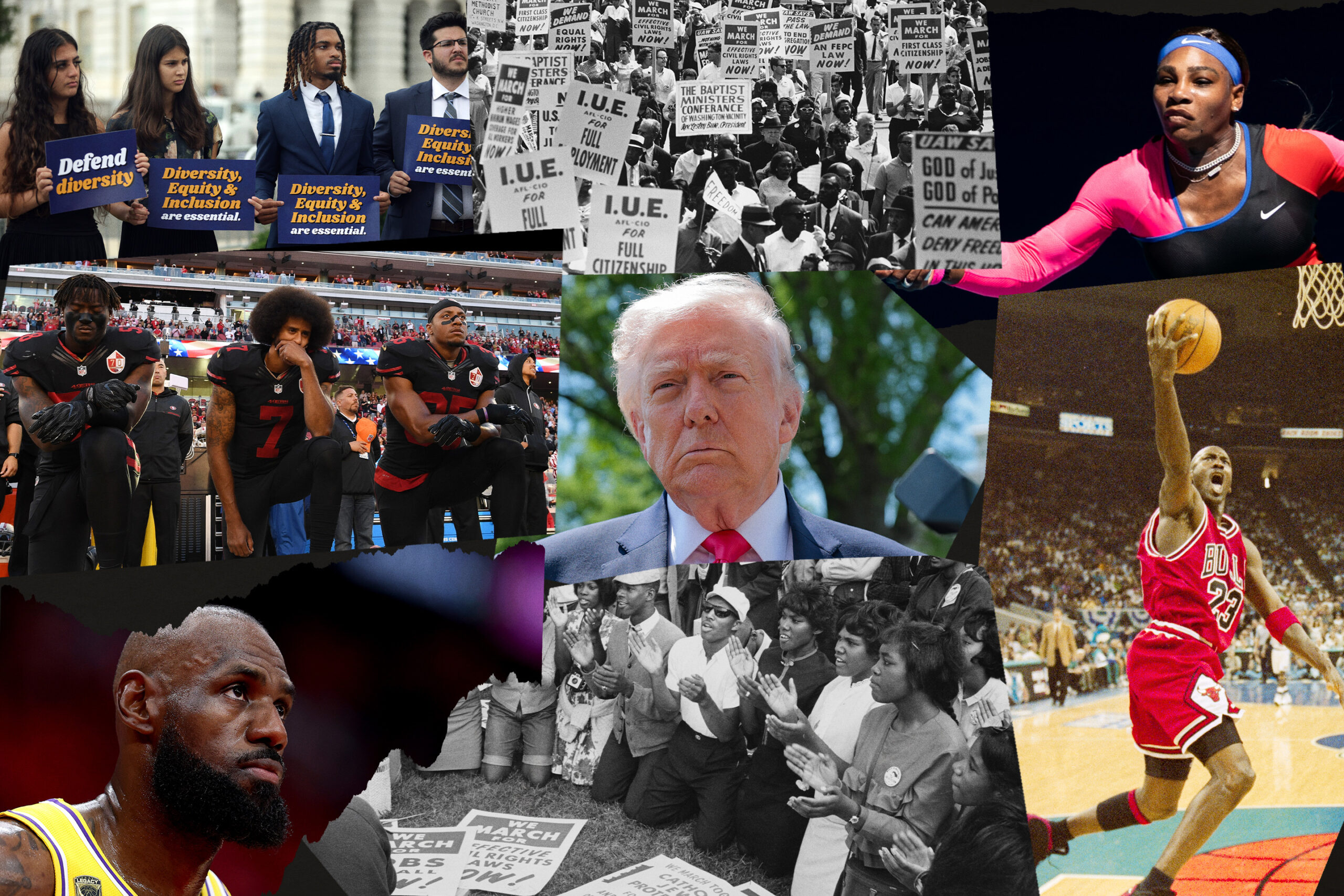
But Nike is a different category. In addition to being the biggest athletic shoe and sportswear retailer in the world, Nike owes a debt to Black people that goes deeper than consumerism. A small company started in 1964 by a track coach and a track athlete in Eugene, Oregon, Nike eventually grew into a retail and lifestyle behemoth that built its brand on the careers of Black athletes, starting with basketball icon Michael Jordan and continuing into the 21st century with luminaries like Tiger Woods, Serena Williams and LeBron James. The sneaker craze launched by Air Jordans in 1985 has become a fashion and cultural fixture.
Nor has Nike shied away from racial controversies. In 2016, Colin Kaepernick, the Black San Francisco 49ers quarterback, ignited a big one when he protested rampant police brutality by kneeling during the national anthem before games. Conservatives and Republicans — from Tucker Carlson to Donald Trump — were infuriated by what they called unpatriotic behavior that had no place in sports. Kaepernick was released by the 49ers in 2017 and never played in the NFL again. In 2018, Nike launched an advertising campaign, called Dream Crazy, featuring a somber but determined-looking Kaepernick and the phrase, “Believe in something. Even if it means sacrificing everything.”
Though it came after the fact, it was a bold corporate move and effective marketing — tacit acknowledgement of the history of Black freedom fighters whose heroic, often lonely struggles against injustice in the face of overwhelming odds have always been the perfect metaphor for a sports ethos of pushing yourself to the limit and beyond. It’s history embedded in “Just Do It,” the Nike slogan that’s become synonymous with American initiative and grit.
But 2016 was a different moment. Trump had just been elected president as a wild-card outsider and faced more pushback, even from within his own party and cabinet. Now, 10 years later and in his second term, he has the full support of the GOP, and all three branches of government — enough mainstream political firepower to retire racially progressive ideals for good.
If Nike does surrender its own commitment to those ideals, it will be surrendering much more than company policy. At a time when symbolism counts for more and more, one company that simply stays the course it’s chosen for itself can counter a hundred others that don’t.
Pitts said that despite the high profile — and high stakes — of Nike’s fight with Trump, what the company chooses to do about its diversity practices happens at a level that simply doesn’t affect the average Black worker — say, someone coming out of prison who needs a job.
“The bigger question is, how do you grow an economy that works for most folks? How do you get better institutions going?” Pitts said.
“We’re in a fundamental crisis of capitalism,” he added. “The real question is how do we respond?”
How inspiring it would be if Nike responded by following its own longstanding advice — Just Do It — took the noise and obstacles in stride and continued pursuing a goal it clearly embraced and had no plans to abandon. Interestingly, Nike’s famous slogan was updated last year from an imperative to a question, “Why Do It?” When it comes to diversity, at Nike or anywhere else, that’s a question that should already be settled.
Copyright 2026 Capital & Main
Erin Aubry Kaplan examines the persistent barriers to racial justice and opportunities for progress in an era of receding Black presence in Los Angeles and California.