
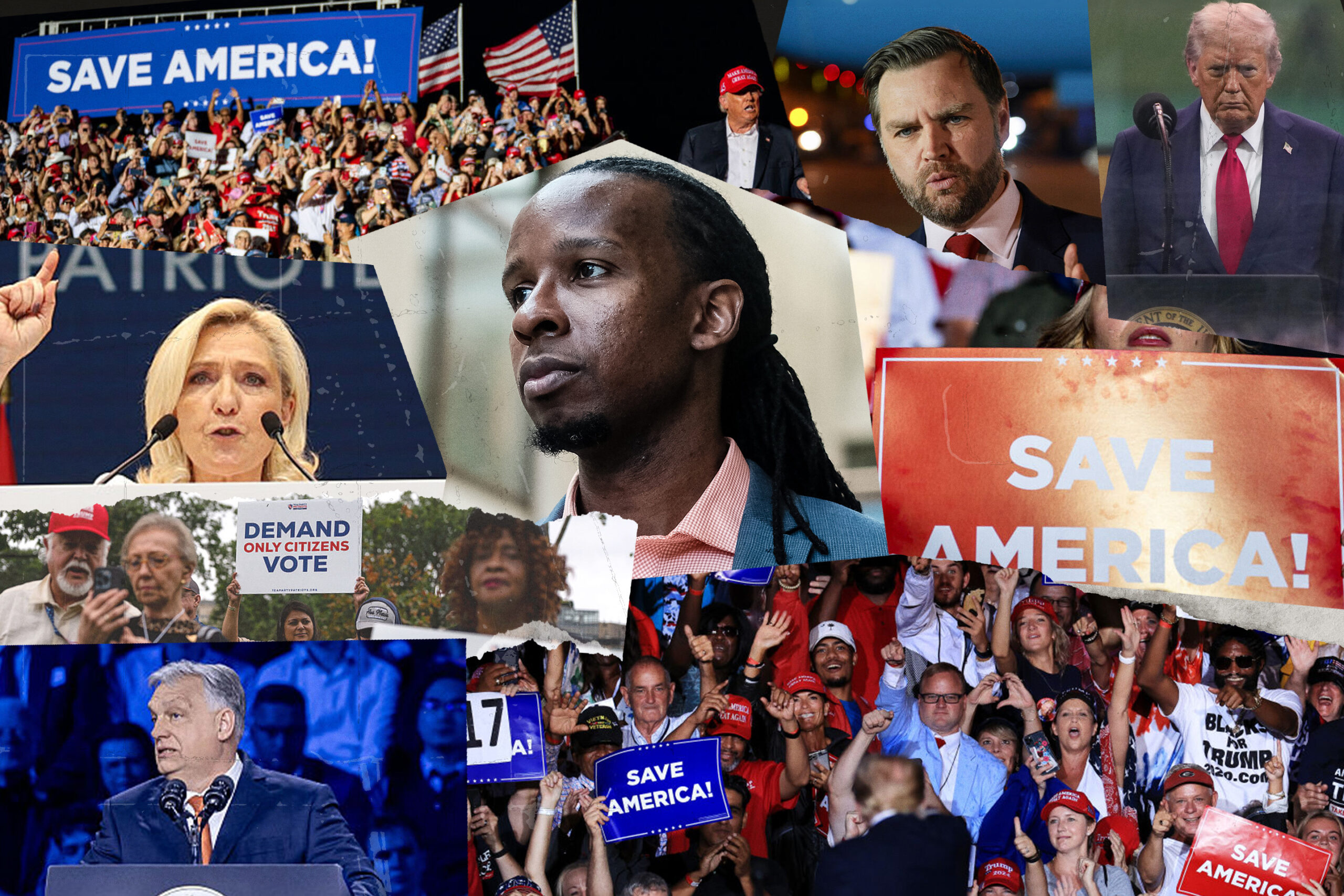
Author Ibram X. Kendi on the Great Replacement Theory’s threat to generations
of racial progress, and how he stays hopeful in perilous times.
By Erin Aubry Kaplan
On a Wednesday night in the heart of downtown Inglewood, people file into the Miracle Theater, a 1930s moviehouse remade into a space for live theater that also hosts community and cultural events. The Miracle is part of what locals hope will be this historically Black Southern California city’s revival, its name reflecting both great optimism and frank acknowledgement of the steep odds of the success of economic justice that’s decades overdue.
It’s a fitting venue for tonight’s discussion with Ibram X. Kendi, the scholar, historian and author of multiple books, including the bestselling How to Be an Antiracist. He is here to speak to how Black success everywhere is being steadily imperiled by the embrace of a white nationalist conspiracy theory that threatens to quash social and racial progress in America and across the globe.
Join our email list to get the stories that mainstream news is overlooking.
Sign up for Capital & Main’s newsletter.
On stage, Kendi discusses his new book, Chain of Ideas: The Origins of Our Authoritarian Age. In a dense but surprisingly brisk 510 pages it lays out the meteoric but little-noted rise of a conspiracy theory called the Great Replacement and its significance at a time of rising fascism and authoritarianism. Kendi defines the Great Replacement Theory as the belief that global elites are enabling people of color to displace the lives, livelihoods and electoral power of white people.
Kendi has long been accused by rightwing figures such as Christopher Rufo and John McWhorter of being opportunistic, but in person he is forceful, thoughtful and measured. He speaks evenly and gives each question posed by the moderators and audience members equal consideration. In the rare moments that he raises his voice, such as when he talks about America’s failure to truly acknowledge the racist foundations of Trumpism, he speaks with a kind of focused indignation that reflects his upbringing by parents who were both Methodist ministers.
“What if the media called what is happening ‘neo-Nazi’ instead of ‘conservative’?” he says to the audience. “Because that’s what Trump is.”
* * *
Of the many Black figures targeted by the MAGA right, few have attracted its fury like Kendi. The professor, MacArthur “genius” grant recipient and longtime scholar of antiracism zoomed to national prominence in 2020 during the nationwide racial reckoning following the murder of George Floyd. Kendi had already won a National Book Award for his first work, Stamped From the Beginning: The Definitive History of Racist Ideas in America. But it was his next book, How to Be an Antiracist, that became an instant cultural touchstone and something of a handbook for many Americans suddenly confronted with the depth and persistence of the nation’s history of antiblackness.
At the same time Kendi was being embraced, however, he was also being vilified by figures on the right that under President Donald Trump were becoming more stridently racist as they embraced the notion of America for white people first and foremost. While the George Floyd reckoning petered out, on went the vilification of Kendi and other Black leaders and intellectuals, including Nikole Hannah-Jones, creator of The 1619 Project, and Kendi’s fellow National Award Book winner Ta-Nehisi Coates. The attacks on Barack Obama, launched by Trump himself when he peddled the racist lie that the nation’s first Black president was not really born in the U.S., never abated.
The hate was so unrelenting that Kendi finally decided to respond — as a scholar and researcher. What, he wondered, was really at the core of all the vitriol that was so personal, but also seemed much bigger than that?
In Chain of Ideas, Kendi posits that white people in countries all over the world are converging in a simultaneous embrace of the Great Replacement Theory, or GRT. Though it’s been around a long time in various forms, the phrase was coined by French novelist Renaud Camus in 2010, when he became convinced that Muslim immigrants from former colonies were overtaking the white population of France and its traditions. GRT warns that Muslims and people of color, whether immigrants or citizens, are literally replacing white Christians and traditional European culture, and must be stopped.
In 2026, GRT adherents — politicians, business titans and ordinary people — are rejecting all social justice movements, including antiracism, as not just excesses of “wokeness,” but as acts of so-called white genocide. In this zero-sum view of the world, democracy and multiculturalism have become existential threats to whiteness, and cannot be tolerated.
This worldview should sound absurd. But Kendi’s urgent, meticulously researched book shows that the conspiracy theory is very alive, still evolving and has gained a foothold at the highest levels of power, from Elon Musk in the U.S. to Viktor Orban in Hungary (who voters recently ousted after 16 years) and far-right parties consolidating in France and beyond. Americans need only look at the actions of the second Trump administration, including its obsessive focus on racial discrimination only in terms of anti-whiteness, its antipathy toward immigrants and its insistence on pitting a supposedly “great” American past against a chaotic, out-of-control present.
* * *
When I interviewed Kendi by phone a few hours before the Inglewood event, he explained some of the more pernicious aspects of the Great Replacement Theory.
“What has been pivotal in GRT construct is a past ‘good’ immigrant versus a ‘bad’ new immigrant,” Kendi said in our call. “In the past, immigrants who came legally assimilated and improved the country. But now they’re coming ‘illegally’ and they’re creating these separate societies and they’re destroying the nation.”
The construct of bad immigrants also includes Black Americans who have been citizens for generations, longer in a lot of cases than many white people, but who have consistently been treated, legally and otherwise, as less than American and unfit for a white, civilized nation. As Kendi said in the interview, it’s an idea that dates all the way back to our Founding Fathers.
“Thomas Jefferson argued that gradually African Americans should become free,” he said. “But when that happens he said they’re not going to be able to live next to us in peace and prosperity. They will be perpetually at war.”
What Jefferson proposed was the mass deportation of all emancipated African Americans back to Africa, a concept known as colonization.
“In the 19th century it was the most powerful racial reform movement in the country, and it was perceived by both centrists and white enslavers as the solution to the Negro problem,” said Kendi.
It’s abundantly clear to me that while the movement faded, the notion that people of color aren’t really Americans and need to live apart, or to just leave, has not. Suffice it to say that we still have a Negro problem.
* * *
Kendi told me that writing Chain of Ideas helped him understand that the fierce backlash against racial justice that gained traction in 2021 had in fact been ascendant for at least a decade.
“Renaud Camus wrote in 2011 that the major antagonist to GRT was antiracism,” he said. “In his book You Will Not Replace Us! in 2018, he said they needed to go to war against antiracism in order to stop this imaginary great replacement. So it was building around the world.”
It makes sense, then, that when George Floyd was murdered and Americans started to gravitate en masse toward antiracism, GRT mobilized to shut it down, like a hazmat team responding to a known pathogen.
What makes GRT so dangerous, Kendi argues, is that its zero-sum thinking infects more than white populations.
“It has mutated from Black and brown replacing white to ideas like Black being replaced by Latino immigrants or Black Christians being replaced by Muslims,” he said. “So it’s allowed even people being presented as replacers to believe they’re being replaced, too.”
To complicate things even more, Kendi added that privilege, while often synonymous with white, is ultimately not racial but relational.
“Black people aren’t privileged in relation to whites, but a Black American is privileged in relation to a Black immigrant who has to constantly live in the shadows to not get kidnapped by ICE,” he explained.
* * *
Despite the very real threats posed by GRT, it remains hard to imagine that America could really lose — or throw away — the fruits of its 250-year struggle for freedom. To many it’s the long-running battle against racism, authoritarianism and tyranny of all kinds that makes America what it is, and what it should be. Kendi is unsentimental.
“It is entirely possible, because this administration is using the playbook of authoritarians around the world in places where people didn’t think it was possible,” Kendi said. “That’s what makes this age so insidious, and also what makes Great Replacement Theory so insidious. It causes people to consent to dictatorial states.”
For some, that means choosing the protection of so-called privilege over the power of democracy. The stakes of that choice make this an especially fraught moment for Black people, who have fought for hundreds of years for that democracy.
“Black people in particular need to understand the stakes of this moment, and the way we do that is understand GRT theory,” Kendi said, adding that it isn’t enough to say Black people have been here before (they haven’t) and that all they have to do is stick to things like voting (even though that is important).
The unprecedented scope of the crisis is perhaps best reflected in how willing Trump has been to demolish institutions that benefit all Americans as a way of “tearing down democratic infrastructure and building an authoritarian state,” Kendi said.
“Great Replacement Theory is giving politicians justification for destroying infrastructure in the name of protecting the citizenry.”
It doesn’t get more alarming than that.
* * *
There is nonetheless a hopeful cast to Kendi’s latest work, centered on his belief that “human groups are natural allies against inequities,” and that coming together is more instinctual than sowing division.
“Frankly, that’s the hope, and that’s one of the reasons I wrote the book,” he said. “So that we can be moved in that direction, recognize the conspiracy theories that are driving us apart and envision a new way of seeing different groups, and see the ways in which we’re linked as part of a chain of humanity. And that we can have solidarity and power we need to overcome what’s happening.”
Later that evening at the end of the event at the Miracle Theater, an audience member asks Kendi how, in the face of so much turmoil, he personally maintains that hope. He didn’t hesitate, or raise his voice.
“My ancestors who were enslaved never gave up hope,” he said. “Hope is what caused them to flee plantations. I never give up, no matter what is happening.”
Copyright 2026 Capital & Main
Erin Aubry Kaplan examines the persistent barriers to racial justice and opportunities for progress in an era of receding Black presence in Los Angeles and California.