
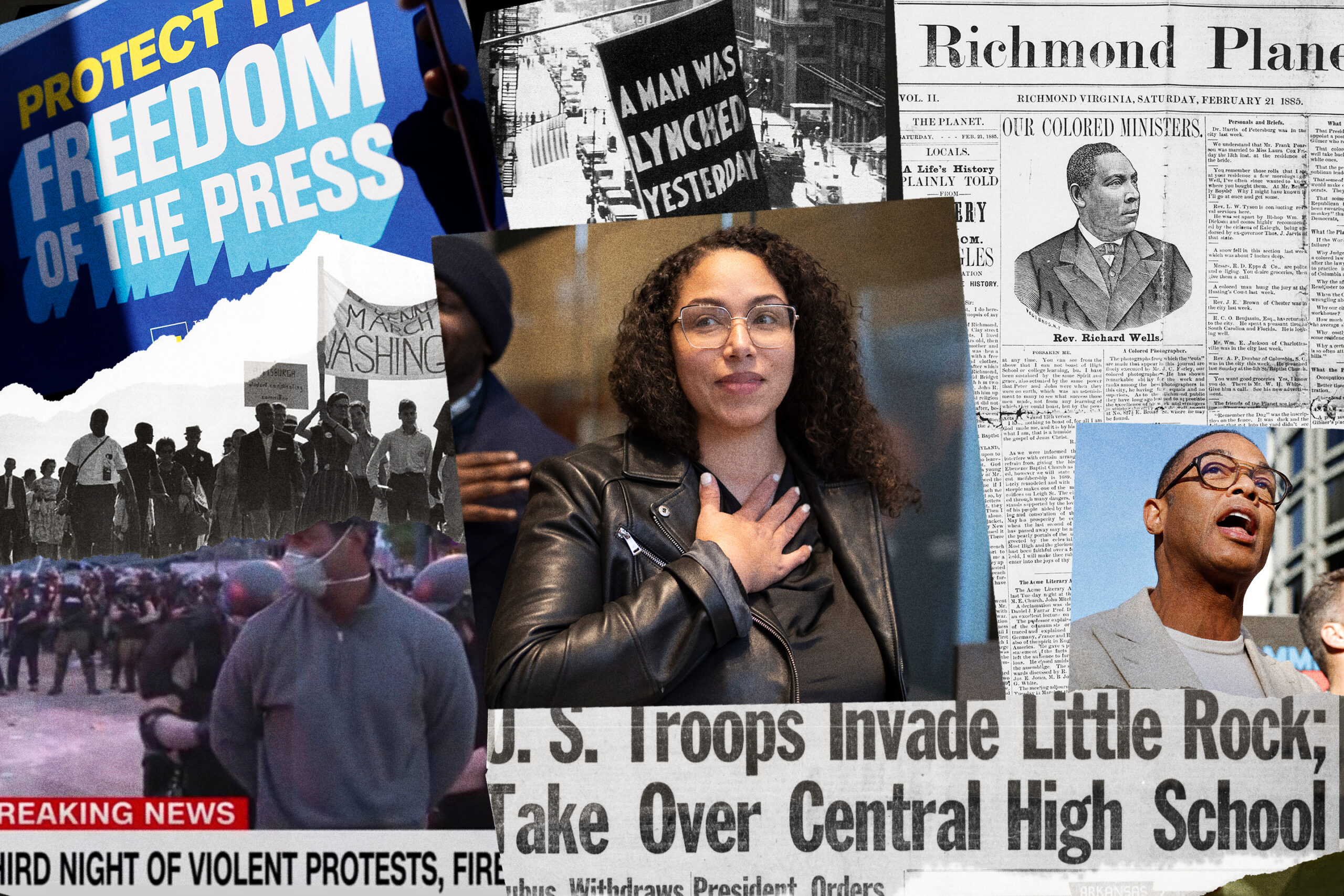
A Minnesota journalist, arrested for covering a protest, reflects on standing up
to power and how the Black press keeps the U.S. honest about its history.
By Erin Aubry Kaplan
Last month, on her 38th birthday, Georgia Fort told me that she finally feels like an adult. Not because her three kids are getting older or because she’s reached a landmark level of achievement in her 16-year career as an independent journalist in her home state of Minnesota. Her new sense of maturity is not about accolades, but adversity.
Earlier this year she and fellow independent journalist Don Lemon were arrested by federal officials after covering a protest, and overnight, became national symbols of the fight to preserve free speech and a free press in the increasingly repressive age of Trump.
“Federal charges will certainly do that, grow you up,” Fort said.
Join our email list to get the stories that mainstream news is overlooking.
Sign up for Capital & Main’s newsletter.
While the experience has thrust her into a limelight she never expected, she’s embracing the opportunity to be a symbol of resistance — to the attempts to curb press freedom, and to bigger forces of oppression and regression that for her have become impossible to ignore. Fort believes journalists have a particular duty to confront it all. For her, that determination is also informed by her Christian faith.
“Now, spiritually, I feel like I need to stand,” she said. “There’s no more room for uncertainty. You have to hold your head up.”
President Donald Trump’s long-running attack on the press took an ominous turn on Jan. 30, when Fort and Lemon were arrested — she in Minnesota, he in Los Angeles. Both Black journalists had covered a protest against Immigration Customs Enforcement at a Minnesota church pastored by an ICE official. Along with seven activists, Fort and Lemon were charged with conspiracy and interfering with people’s right of worship. Both are awaiting trial.
The arrests seemed like a convergence of Trump’s attacks on the press and on Black people — journalists and others — who routinely speak out against injustice. They also felt like the culmination of the brutal ICE raids in Minnesota that began in January and resulted in the fatal shootings of two American citizens, Renee Good and Alex Pretti, by Department of Homeland Security agents. That so much came to a head during February, Black History Month, made Fort more resolved to step up.
“As we celebrated the centennial of Black History Month, we celebrated so many of my ancestors and who they stood up for,” she said.
The attacks got personal for Fort last June. She was already covering the brutal tactics of ICE, coverage that included the story of Isabel Lopez, a 27-year-old poet and activist who had been roughed up by agents during a protest June 3. Fort posted a video of the incident on social media. A week later, Lopez came to Fort’s office for an interview. Minutes after she left, as Fort watched, ICE agents swarmed Lopez, arrested her and charged her with assault. The veteran journalist was rattled.
“It didn’t feel like a coincidence,” she said. “I felt harassed, like they were sending me a message.”
The feeling intensified from there, though Fort continued following protests and press conferences, sometimes for 12 to 16 hours at a stretch. After Good was killed, she held a private session for media to show camera footage of that incident.
Work has become more complicated since her arrest. Fort had frequently worked alone, livestreaming events, but now feels like a target. Security feels essential.
“I received threats, even before the arrest,” she said. “There is a cost to telling the truth.”
* * *
Fort and Lemon are not the first Black journalists in Minnesota arrested for doing their jobs. Back in 2020, during the protests in Minneapolis over the murder of George Floyd, CNN anchor Omar Jimenez, who was on the scene with a crew covering the protests, got handcuffed and arrested on live television.
“When I saw that I knew that if they didn’t respect his press credentials they wouldn’t respect mine,” Fort recalled. “I started to be aware of how I showed up in spaces.”
She also began to understand the precariousness of journalism globally, especially for journalists of color, including in far more dangerous places like Gaza, where more than 240 journalists were killed in the last two years, according to the United Nations.
“Omar was arrested, and there was no consequences for it,” Fort said. “Or in Gaza.”
Fort has worked in media since college, starting out as a radio host focused on music and hip-hop before eventually transitioning into news. When she was 19, her 4-month-old daughter — her firstborn child — died of suffocation in the care of a babysitter, a tragedy that informed her later coverage of deaths of young people, some of them the result of police shootings.
“As a mom who lost a child, I was frequently interviewing moms on the day their child had been killed,” she said. “It allowed me to find purpose in my own pain, gave me a much deeper reason to wake up and want to get up and go to work.”
Fort landed her first contract in 2015 as a news reporter at a local television station in Columbus, Georgia, eventually making her way back to Minnesota. Years of doing a mix of breaking news, court reporting and what she called “feel good stories” set the stage for covering the 2021 trial of Derek Chauvin, the Minneapolis police officer who was convicted of murder for the killing of George Floyd.
The experiences with traditional media and street-level coverage honed her approach to independent journalism. Understanding the role of Black reporters in the history of journalism itself was also key.
Black media’s mission not to ignore or sanitize painful truths is one of the reasons, Fort believes, that it remains one of the most vital institutions in America, despite being chronically underinvested in and undervalued. She secured a contract from Target in 2023 that enabled her to launch a broadcast news show, “Here’s The Truth,” which covered a wide range of topics, was immaculately produced by a well-paid staff, and went on to win three Upper Midwest Emmy awards. In 2023 she also co-established the Center for Broadcast Journalism to mentor young journalists and diversify the media industry in Minnesota. After Trump returned to office last year and began attacking diversity, equity and inclusion via executive orders and federal workforce purges, the Target contract, along with so many others, was eliminated.
Fort said shifts of mind and heart have to happen in the country before things change, or change back. Meanwhile, Black voices in media remain powerful, and impactful. New York Times opinion columnist Jamelle Bouie asserted last month that Trump’s assault on democracy has always been racially motivated, but too little acknowledged, writing, “The question is why so many others have refused to see what he has never bothered to hide.” David Jackson’s photo of Emmett Till in an open casket in 1955 was a graphic image that was seen around the world, exposing the hypocrisy of American democracy. The 14-year-old was lynched and horribly brutalized by a white mob in Money, Mississippi.
“That photo changed American culture,” she said. “It made America look in the mirror and acknowledge how the racial terror and brutality was wrong. Mamie Till [Emmett’s mother] took a stand, and the Black press showed up.”
Fort said there are signs that America is looking in that mirror again. Six prosecutors in Minnesota quit rather than follow the Justice Department’s orders to investigate the widow of Renee Good, and after Alex Pretti was killed, a Republican candidate for governor dropped out of the race. Still, Fort has no illusions.
“I know what it looks like now, but when you look at what our ancestors had to overcome, that should give us hope,” she said. “People need to pay attention to what’s happening and ask themselves, what are you willing to do about it? My answer is to keep documenting, telling stories because it’ll inspire others to hew to truth.”
“It may not be much but it matters,” she added. “I might be under attack, defunded, even afraid. But I will continue to do it.”
Correction: An earlier version of this column incorrectly stated that Fort recorded an incident involving Isabel Lopez and posted it on social media. Fort posted the video but did not record it. The column also incorrectly stated that Fort’s coverage of the trial of Derek Chauvin earned her a Midwest Emmy nomination. Fort was nominated for Upper Midwest Emmy awards for other work, but not for coverage of the Chauvin trial.
Copyright 2026 Capital & Main.
Erin Aubry Kaplan examines the persistent barriers to racial justice and opportunities for progress in an era of receding black presence in Los Angeles and California.