
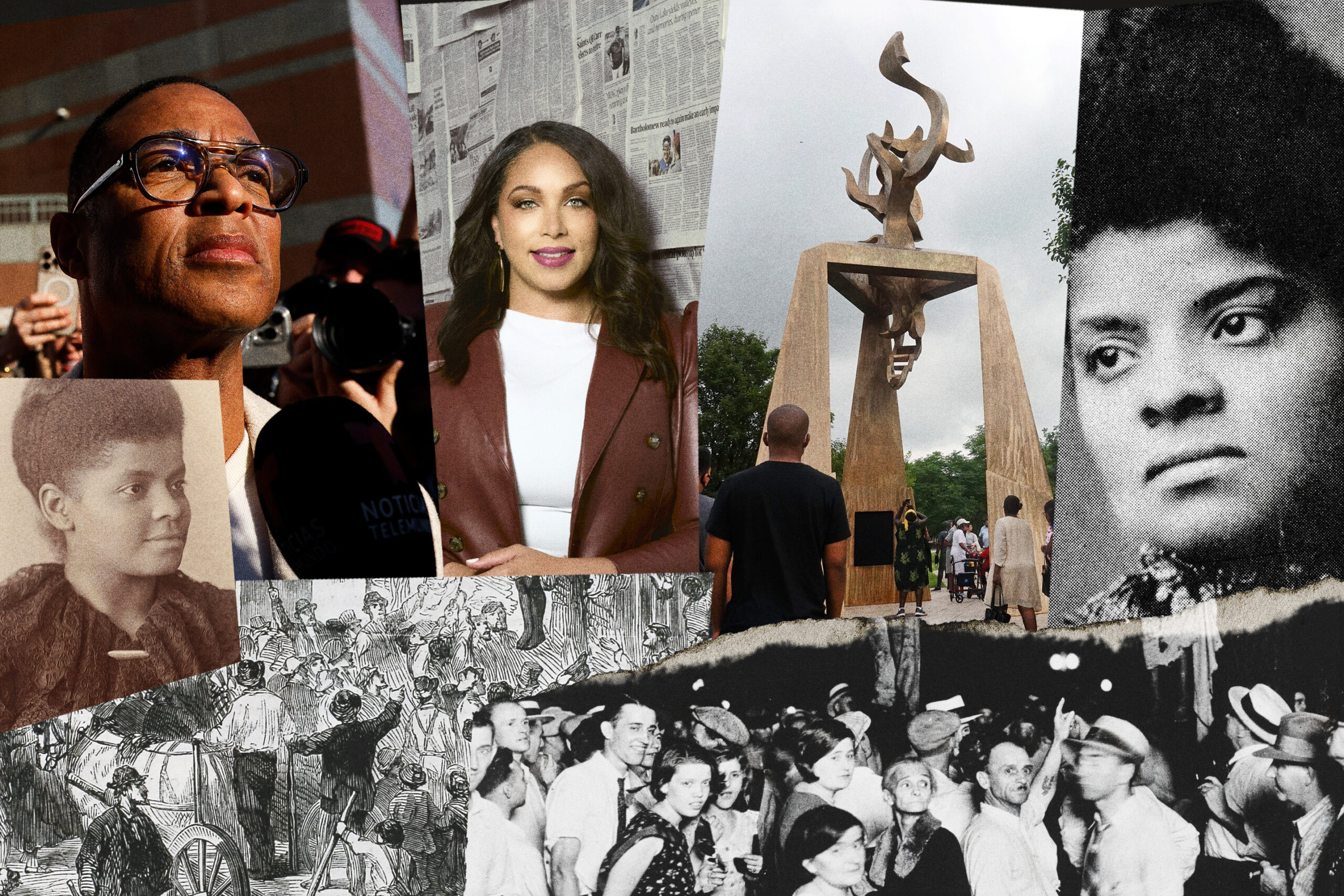
The arrests of two Black journalists for doing their jobs mark a new chapter of an age-old struggle for
democracy, inclusion and unflinching truth that traces back to the pioneering journalism of Ida B. Wells.
By Erin Aubry Kaplan
Not to be immodest, but I’ve always felt a certain connection with the trailblazing journalist Ida B. Wells. We were born 100 years apart — 1862 and 1962, at the dawn of the two most intense periods of the Black freedom struggle in American history. Wells grew up in the years following the end of slavery, as activists sought to establish a framework for Black equality; I grew up during the Civil Rights Movement, which sought to banish the vestiges of slavery that were still in effect a century later.
As a journalist, Wells’ great achievement was bearing witness. In routinely exposing the racial and humanitarian horrors of lynching — the great evil of her time — Wells was holding up a mirror to white America that it was loath to look in. Sometimes, white America erupted in vengeance. When Wells editorialized in her newspaper, the Memphis Free Speech and Headlight, that lynching was a reaction to consensual sexual relationships between black men and white women, a white mob burned down her office and warned her never to return. She didn’t, eventually relocating to Chicago. But she never stopped her work.
Join our email list to get the stories that mainstream news is overlooking.
Sign up for Capital & Main’s newsletter.
The arrests on Jan. 30 of journalists Don Lemon and Georgia Fort by federal officials had me thinking of Wells, the crucial role of Black journalists as witnesses to injustice and how doing that can stoke white wrath.
Lemon and Fort were indicted by a Minnesota grand jury and charged with conspiracy and interfering with peoples’ right to worship in the course of covering a protest that unfolded at a St. Paul church where a U.S. Immigration and Customs Enforcement official is a pastor. They were there as witnesses, as all journalists would be. But as Black journalists their bearing witness has specific, added significance, especially at a time when ICE agents carrying out President Donald Trump’s agenda are using the kind of brutal tactics against people of color that recall sheriffs in the 1960s South. The ICE raids are what the church protest, which Lemon and Fort covered, was about.
Arresting two Black journalists is not just an affront to American democracy and its system of checks and balances — a free press is, after all, the only profession named and protected in the Constitution. But it’s clear that these actions are about more than just attacking the press, they’re also part of Trump’s long-running antagonism towards Black people and their implicit (and of course, explicit) critiques of his racism. Trump launched his political career by spreading the racist lie that the nation’s first Black president was not really born in the United States (on Friday he posted, then deleted, a racist video clip depicting Barack and Michelle Obama as apes); as president he has waged war on Black history and on the very idea of Black people as legitimately American. He has also continuously attacked the media and denigrated journalists at CNN and countless other outlets as “the enemy of the people.”
Small wonder that his administration, whose powers are increasingly being weaponized to carry out Trump’s personal vendettas, now targets Lemon, a former CNN anchor who has become a prominent Trump critic. Fort seems to have drawn the administration’s ire for being a journalist and a Black woman. The latter is a group Trump has gone out of his way to trash, belittle and threaten, from U.S. Rep. Ilhan Omar of Minnesota to Federal Reserve Gov. Lisa Cook to the thousands of Black women whose careers were disproportionately destroyed by the DOGE-led purge of federal workers last year.
Black journalists nettle Trump because, as in Wells’ time, they call for accountability even when they’re simply covering facts. Wells wrote about lynchings in grisly detail to make sure people were forced to see extrajudicial murders that they preferred to ignore. Breaking through to mainstream consciousness was a tough job.The Black press was a product of segregation like so much else; however diligent their reporting, Black people had their narratives, whites had theirs. That segregation started to break down with the onset of the Civil Rights Movement, when mainstream press started covering race in earnest.
That didn’t mean Black journalists automatically got respect. One of the more startling moments captured by a TV camera during the Little Rock, Arkansas, school desegregation effort in 1957 was of a white mob viciously kicking and assaulting veteran Black journalist L. Alex Wilson. That footage made the racial violence that always threatened clearly visible. TV became the mirror that America was forced to look into, and allowed the racial terror long documented by the Black press to be beamed around the world.
As Black journalists who’ve worked in mainstream media, Lemon and Fort are the legacy of that (limited) progress. But history has a way of looping back on itself, or even standing still. Both are now independent journalists focused on exposing racial injustice and white supremacy, which Wells did her whole life. The injustice that used to be the bane of Black folk is now being visited on everyone else — a consciousness breakthrough Wells would have welcomed. Both journalists have pledged to continue their work in the face of threats and oppression, as Wells did also. “I have spent my entire career covering the news. I will not stop now,” Lemon told CNN. In an interview with Anderson Cooper after her arrest and release, Fort vowed to “continue telling the stories of my community.”
As much as these arrests are an unprecedented and dangerous step toward institutionalizing autocracy, they can also be seen as a sign of Trump’s weakness, and an indication that his casting Black people as criminals might not work this time. I have to say that it’s encouraging, and even fitting, that Black journalists whose moral credibility has been historically marginalized have become the face of the latest fight to protect the First amendment rights of all Americans. Late night talk show host Jimmy Kimmel, who had his own experience with being silenced by Trump’s media allies, introduced Lemon as a guest by saying he “was arrested for committing journalism.”
Some seventy years after the launch of the last sustained movement for Black freedom and civil rights, we could be at the start of another. Wherever we are on the historical timeline, it isn’t a stretch to say that at this moment we — not just journalists but protesters, concerned citizens and everyone bearing witness to and raising their voices about the transgressions of the Trump regime — are all Don Lemon and Georgia Fort. Not to mention Ida B. Wells.
Copyright 2026 Capital & Main
Erin Aubry Kaplan examines the persistent barriers to racial justice and opportunities for progress in an era of receding Black presence in Los Angeles and California.