
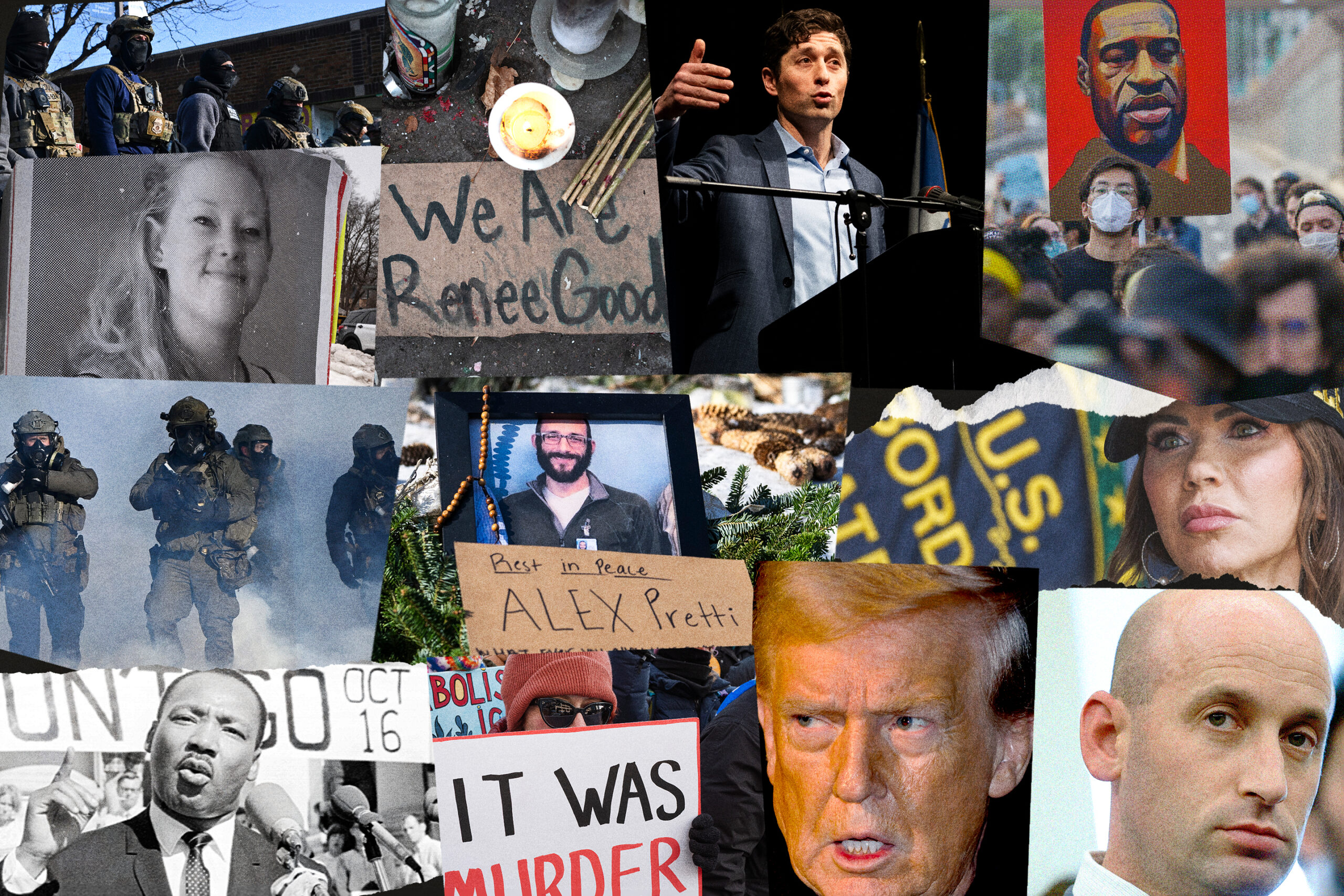
Despite Trump’s best efforts to wipe out the legacy of George Floyd, history reasserts itself.
By Erin Aubry Kaplan
Summer 2020 was a watershed moment in the nation’s long, incomplete history of racial justice, one both tortured and hopeful. And it started in Minneapolis, with the murder of George Floyd, a Black man, by Derek Chauvin, a white cop, that was captured on video for all the world to see. The nation exploded in protest across color lines as institutions from schools to the arts to businesses pondered the historic role of police in racial injustice and sought ways to effect more meaningful change.
2020 was also a watershed moment for President Donald Trump and the MAGA right. The street demonstrations, especially in big cities, turbocharged their campaign to paint protesters demanding racial justice as criminal, lawless and unpatriotic. As the nation soul-searched, Trump called for the ramping up of law enforcement and the military to suppress what he repeatedly called the “radical left” and the “enemy within.” At one point after Floyd’s murder, Trump asked top military officials if they could shoot protesters, former Defense Secretary Mark Esper later revealed.
Join our email list to get the stories that mainstream news is overlooking.
Sign up for Capital & Main’s newsletter.
Though the spirit of racial reform persisted, it eventually got stymied by a furious backlash of law-and-order rhetoric emanating from some of the nation’s top power figures, starting with the president himself.
That long backlash appears to be at an inflection point. The killings of Renee Good and Alex Pretti by federal agents in Minneapolis this month, also caught on video seen around the world, have prompted intense public outrage that is in some ways similar to the outrage over George Floyd.
These slayings, and the shameful way the administration has defended them and reflexively smeared the victims, starkly reveal what our federal government under Trump has become: a consciously antidemocratic operation that will spare no dissenters regardless of their citizenship status or racial background.
Unlike Floyd, Good and Pretti were white. Still, they were victims of law enforcement charged with protecting the public flagrantly violating that duty, in full view. Politicians (chiefly Democrats), ordinary people and even police officials are calling for accountability. There are sustained, widespread protests. But the equation has changed: In 2026, the conversation around who is the culprit is not focused on a rogue cop like Derek Chauvin, U.S. Immigration and Customs Enforcement officer Jonathan Ross or the still unidentified federal agents who killed Pretti. It’s the federal government itself.
Since retaking office last year, Trump immediately set about doing two things: destroying the moral impetus behind diversity, equity and inclusion — a legacy of 2020 — and beefing up ICE to carry out a promise to deport as many immigrants as possible as quickly as possible. The two are related, with the first priority paving the way for the second. As the deportation operations got underway it became clear that the immigrants really being targeted were those from Latin America, the Caribbean and Africa — people of color. To Trump, his deputy chief of staff Stephen Miller and others in his administration, these immigrants were simply part of the long-criminalized population of color who are also American citizens, people like George Floyd.
With Trump and his supporters pushing a narrative of “criminals” of color permanently here and flowing in from abroad, it was predictable that ICE would become far more than immigration enforcement, but a national enforcer of white supremacy. Doing so requires dispensing with democratic norms, like due process and rule of law. And that’s something our nation has had plenty of experience with through years of Jim Crow and racial terror.
But Jim Crow, and slavery before it, was a lawlessness that lived separately, only for Black people; white people glimpsed it here and there but mostly enjoyed the full benefits of Americanness, including the rule of law. But now, even that hard-line racial divide that has long been the foundation — in some ways, the stability — of our society is vanishing.
The fact that Good and Pretti were white, and U.S. citizens, has engendered outrage, but not disproportionately more than the outrage occasioned by the murder of a Black man in 2020. Because the second Trump administration has shown its intention of dehumanizing not just people of color, but all racial justice allies no matter their background.
Like Floyd, Good and Pretti were immediately smeared after they were killed by government officials. Homeland Security Secretary Kristi Noem and Stephen Miller rushed to call each of the victims a “domestic terrorist,” and they and other Trump officials have unhesitatingly lied about their killings despite plenty of video evidence that contradicts the administration’s accounts.
Under Trump 2.0, the list of Americans considered expendable is growing before our eyes. The betrayal by the federal government of its own people, something experienced by some for so long, is nearly complete. Ironically, the fact that racial distinctions are coming apart is actually a good thing, though none of us should have to experience it this way.
When Martin Luther King talked about Americans being bound up “in a single garment of destiny,” he was articulating the hope that people would affirmatively come together to create the kind of democracy America claimed it was. He could hardly have imagined the perverse inverse we are seeing today as Black Americans, immigrants and protesters — the kind that made the Civil Rights Movement possible — are tarred reflexively with the same brush and made into enemies of the state by Trump and his unrestrained, immoral weaponization of federal power.
Imperfect as it was, the federal government had a conscience in King’s time; at the moment, it seems to have none. That conscience now belongs almost wholly to the people, something that King, for all his appeals to government, understood. Our survival depends on understanding that now.
Copyright 2026 Capital & Main
Erin Aubry Kaplan examines the persistent barriers to racial justice and opportunities for progress in an era of receding Black presence in Los Angeles and California.